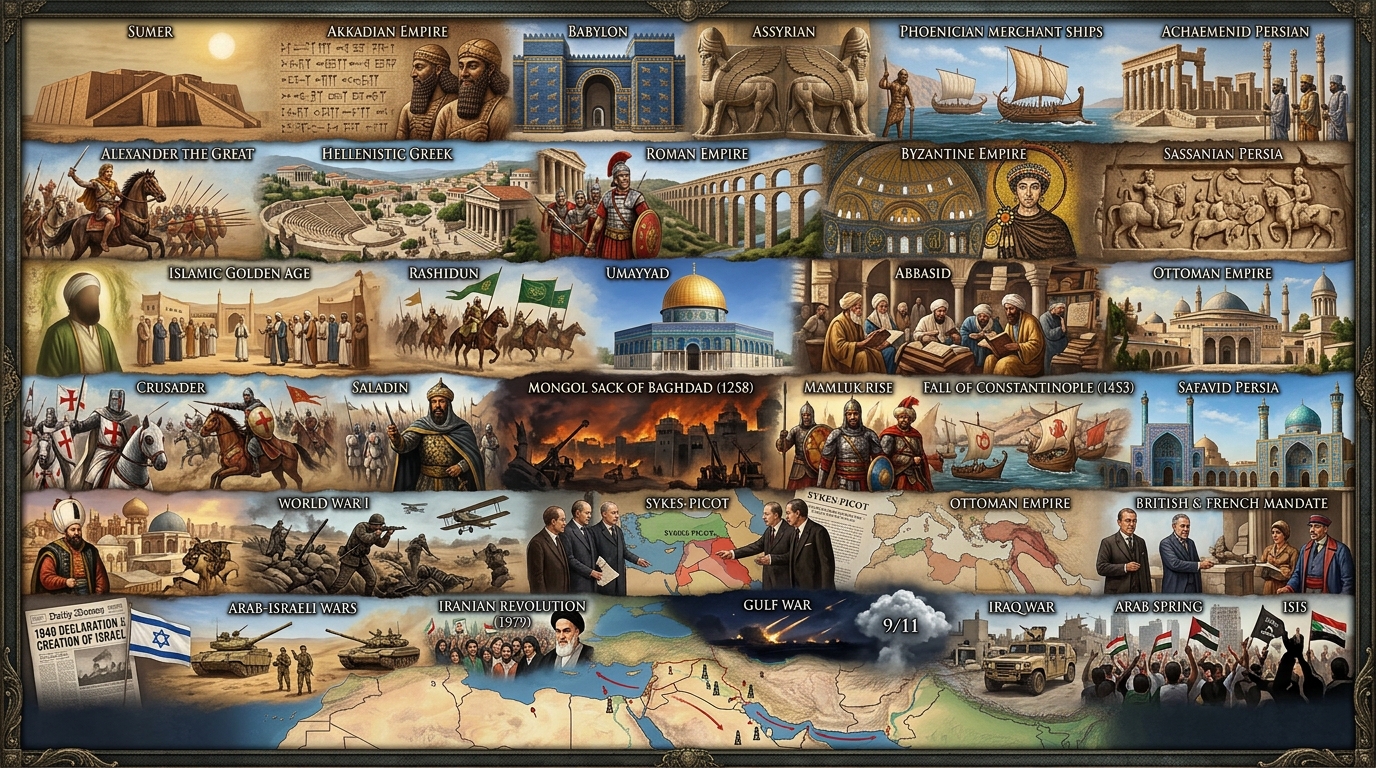
Every empire in history has tried to rule the Middle East. Sumerians, Persians, Greeks, Romans, Arabs, Turks, and Europeans all conquered it, and every one of them was changed by it. The Sumerians gave it cities. The Persians gave it the empire. The Greeks gave it Hellenism. The Romans gave it law, and then became Byzantines. The Arabs gave it a language and a faith that never left. The Turks gave it the longest lasting synthesis. The Europeans drew its borders, and then oil reversed the flow of power. This is not a list of conquerors. It is the story of a crossroads that absorbed them all, from ancient Mesopotamia to the modern era.
The inventions that never left
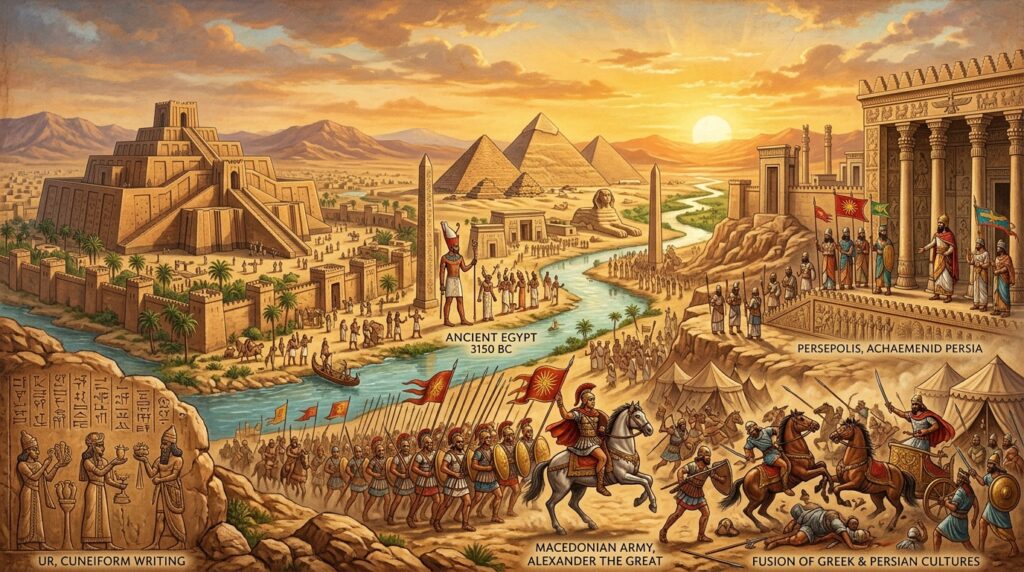
The recorded history of the Middle East begins in ancient Mesopotamia, where human societies first shifted from a nomadic lifestyle to permanent settlements based on agriculture. By the end of the fourth millennium BC, the Sumerians in southern Mesopotamia had developed the world’s oldest known urban and literate civilization. This early society pioneered many basic technologies and institutions. They built the first cities, invented uniform writing, and established complex bureaucracies as well as legal codes.
Nearby, ancient Egypt also emerged as a unified civilization around 3,150 BC. These two societies together marked the Fertile Crescent, stretching from Mesopotamia through the Levant to the Nile River, as the home of many advanced cultures and what would later be called the cradle of civilization.
In the coming centuries, many empires came and went in the ancient Middle East. The Sumerian city states were followed around 2,400 BC by the Akkadian Empire, which in turn gave way to later Mesopotamian powers such as Babylon and Assyria. These empires lasted more than 1,500 years and dominated the region through military power, administrative innovation, and cultural sophistication.
Meanwhile, in the Levantine corridor, the Phoenicians established several maritime city states that traded widely across the Mediterranean and developed an early alphabet, which would become the basis of the Greek and Latin scripts and eventually the modern alphabets used in most of the world today.
To the east, during the sixth century BC, the Achaemenid Empire founded by Cyrus the Great conquered Mesopotamia, Egypt, and most of Western Asia. This was a crucial moment. For the first time, the different regions of the Middle East were united under a single imperial system, which laid the foundation for a lasting imperial tradition in the region. Cyrus ruled by tolerance and good government, honoring local customs and religions instead of destroying them, and that model of empire would be copied by every successor.
The conquerors who became locals
It was during the classical ancient period that the Middle East saw a new set of cultural and political influences from the West. In 334 BC, Alexander the Great of Macedon invaded and eventually overthrew the vast Persian Achaemenid Empire, which stretched from today’s Turkey to Afghanistan. Although Alexander died in 323 BC and his empire quickly fragmented, his conquests introduced Hellenistic culture to the Middle East. Successor states such as the Seleucid Empire in Syria and Mesopotamia and the Ptolemaic dynasty in Egypt preserved and adopted Greek culture, language, and governance. Major urban centers such as Alexandria and Antioch became hubs of Greek learning and multicultural exchange. This blend of Greek and local tradition helped create a cosmopolitan environment that mixed East and West, facilitating the transmission of ideas, arts, and science that would echo for centuries.
As the Hellenistic kingdoms weakened, the Middle East rapidly came under the influence of another growing power: Rome. By the first century BC, the Roman Republic, soon to become the Roman Empire, had extended its reach to the eastern Mediterranean. Roman forces gradually annexed most of the region, including Asia Minor, the Levant, and Egypt, turning them into prosperous provinces of a vast imperial system. The Pax Romana, a period of relative peace and stability that lasted almost two centuries, brought economic integration, infrastructure development, and administrative harmony.
It was during the Roman period that one of the most important religious developments in world history occurred: the emergence of Christianity, which began in the first century AD in Roman Judea as a reform movement within Judaism. Despite early persecution, Christianity spread rapidly through the empire. By the early fourth century, Emperor Constantine adopted the faith and issued the Edict of Milan in 313 AD, granting religious tolerance throughout the empire. In 330 AD, he established Constantinople as a new imperial capital. And by the end of the century, Christianity had become the official religion of the Roman Empire, replacing classical paganism and deeply reshaping the cultural and spiritual landscape of the Middle East.
Yet the Roman grip on the region was never absolute. From the third to the seventh century AD, the empire’s eastern provinces, now administered from Constantinople and known as the Byzantine Empire, were locked in almost continuous conflict with a revived Persian state, the Sassanian Empire. These two superpowers divided the Middle East between them, the Byzantines holding Anatolia, the Levant, and Egypt, and the Sassanians ruling Iran, Mesopotamia, and parts of the Arabian frontier.
The conquest that changed the language
Their long standing rivalry culminated in a series of devastating wars, ending with the Byzantine-Sassanian War of 602 to 628 AD, which left both empires militarily exhausted and politically unstable. This mutual weakness created a historically important opportunity for a new force that would deeply reshape the region.
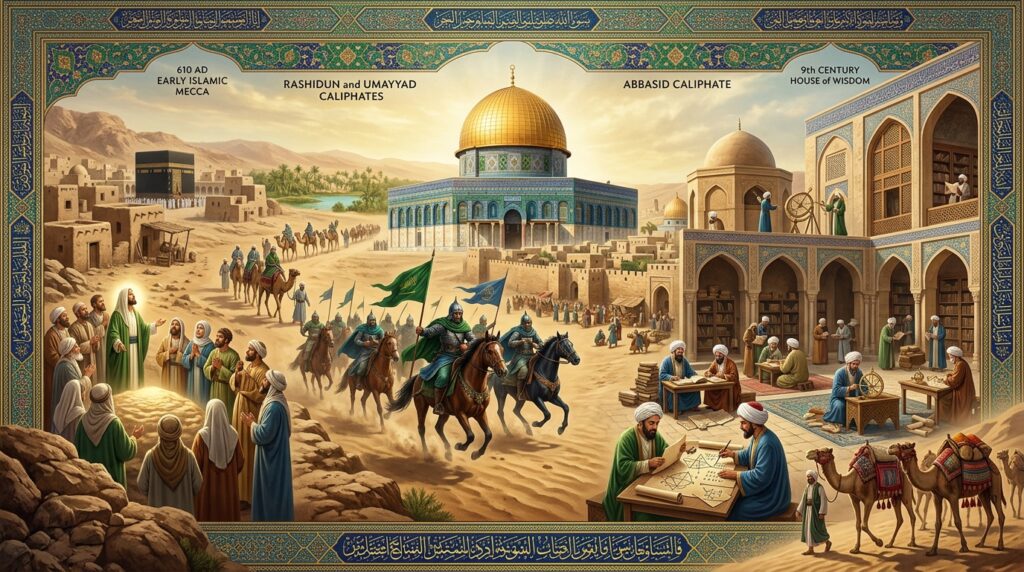
In the early seventh century, a revolutionary religious and political movement emerged in the Arabian Peninsula: Islam. The Prophet Muhammad, born in Mecca around 570 AD, began preaching in 610 AD, carrying a message of strict monotheism and social justice that drew on and reinterpreted earlier Jewish and Christian traditions.
Muhammad’s success in uniting Arab tribes under the banner of Islam was unprecedented. After his death in 632 AD, his successors, the caliphs, launched a series of astonishingly swift and successful conquests, filling the power vacuum left by the weakening Byzantine and Sassanian empires. Within just two decades, Muslim forces took Syria and Palestine from Byzantine control, Egypt by 642, and completely ended the Sassanian state by 651. Thus the Rashidun Caliphate emerged as a dominant imperial power controlling Mesopotamia, Persia, the Levant, Egypt, and stretching from North Africa to the borders of India.
These conquests were not only military successes but also a civilizational turning point. Islam became both the basis of a unified religious identity and a new imperial system. Arabic was adopted as the administrative language, gradually replacing the Greek, Aramaic, and Persian previously used. Over time, most people of the region came to speak Arabic and follow Islam, although Christians, Jews, and other religious minorities continued to live under Islamic rule, often protected, but subject to legal and financial distinction under dhimmi status.
After the rapid conquests, the Islamic world entered a period of political stability and cultural rise. The Umayyad Caliphate, established in 661 with its capital in Damascus, presided over a vast empire stretching from Spain to the Indus River. The Umayyads built lasting monuments such as the Dome of the Rock in Jerusalem, completed in 692, and expanded infrastructure and administration to maintain control over their diverse subjects.
But their rule was marked by tensions, especially with non Arab converts and supporters of Shia Islam, which culminated in the Abbasid Revolution. In 750, the Abbasids overthrew the Umayyads and established a new dynasty with its capital in Baghdad.
Under Abbasid rule, the Islamic world entered the period often called its golden age. Baghdad became a global center of learning, trade, and culture. The House of Wisdom, established in the early ninth century, became a center for scholars who translated Greek philosophical and scientific texts into Arabic, preserving classical knowledge and greatly expanding it. Advances were made in mathematics, algebra, algorithms, medicine, astronomy, philosophy, and literature. Economically, the Abbasid Empire benefited from its control of the Silk Road, which facilitated links between East and West. Culturally, its rule was a blend of Arab, Persian, Hellenistic, and Indian influences, fostering innovations from the development of Arabic numerals to literary masterpieces such as One Thousand and One Nights.
By the tenth century, however, the unity of the Abbasid Caliphate began to fragment. The empire’s immense scale made it increasingly difficult to govern effectively, and regional dynasties began to declare autonomy, while at least nominally recognizing the spiritual authority of the Abbasid caliph in Baghdad. In Iran and Iraq, Persian style governments such as the Buyids gained dominance from the mid tenth century, while Turkic leaders such as the Seljuks came to power in the eleventh century, claiming to protect the Abbasid caliphs as military patrons. Meanwhile, rival caliphates emerged, notably the Fatimids of Egypt, who established a Shia government in the early tenth century, directly challenging Abbasid supremacy and revealing the growing sectarian division within Islam.
This period of political division also exposed the Islamic world to new external pressures. In the late eleventh century, lords and knights from Western Europe launched a series of religiously motivated attacks known as the Crusades. These campaigns, which lasted until the end of the thirteenth century, led to the establishment of several short lived Crusader states in the Levant, especially in Syria and Palestine. Despite early Crusader successes, Muslim resistance gradually intensified. The Ayyubid dynasty under Saladin retook Jerusalem in 1187, and eventually Egypt’s Mamluks emerged as the dominant protectors of the Islamic world, defeating the last Crusader strongholds by 1291.
At the same time, a far more devastating threat emerged from the east: the Mongols. In 1258, Mongol armies led by Hulagu Khan sacked Baghdad, destroying the city and catastrophically ending the Abbasid Caliphate. The destruction of Baghdad, the intellectual and cultural heart of the Islamic world, marked a crucial turning point. The Mongols devastated much of Persia and Mesopotamia, but their advance into the Levant was stopped in 1260 at the Battle of Ain Jalut by the Mamluks, who once again proved themselves the region’s key protectors.
After the Mongol devastation, the Middle East remained politically fragmented. The Mamluk Sultanate ruled Egypt and Syria, while in Persia, the Mongols established the Ilkhanate, one of the successor states of the Mongol Empire. In Anatolia, the once powerful Seljuk Sultanate had fallen, giving way to a cluster of small Turkish states called beyliks. Among them, one would eventually stand out and establish a new imperial system across the region.
The empire that held it longest
The Ottoman Empire, founded by the Turkic leader Osman around 1300, began as a modest frontier state, but expanded steadily in the 14th and 15th centuries. In 1453, under Sultan Mehmed II, the Ottomans captured Constantinople, the capital of the long declining Byzantine Empire, renaming it Istanbul. This conquest was not only the symbolic end of the Christian Roman Empire in the East, but also established the Ottomans as the foremost power in the Islamic world. In the following decades, they absorbed other Turkish and Islamic states. And in 1516 to 1517, Sultan Selim I defeated the Mamluks, bringing Egypt, Syria, and the holy cities of Mecca and Medina under Ottoman control.
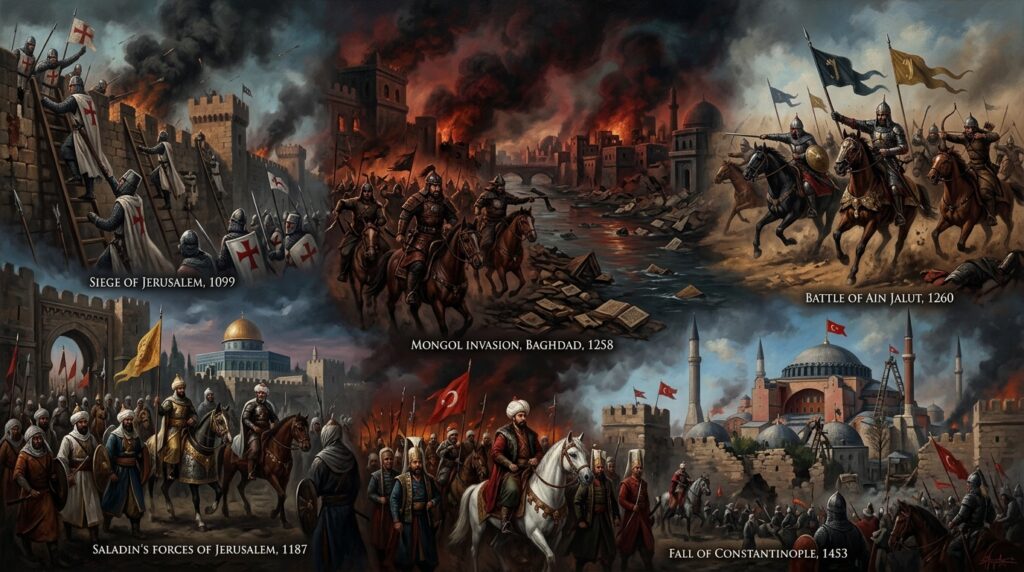
By the middle of the 16th century, under Suleiman the Magnificent, the Ottoman Empire reached its peak. It controlled all of Anatolia, most of the Arab world, including Iraq, the Levant, the Arabian Peninsula, and North Africa, as well as most of southeastern Europe. The Ottomans built a vast multi ethnic and multi religious empire that reintroduced a dimension of imperial unity to the Middle East not seen since the Abbasid era.
Importantly, this period also hardened new geopolitical and sectarian divisions. In the early 16th century, the Safavid dynasty emerged in Persia, establishing Shia Islam as the state religion and forming an ideologically opposed political system against the Sunni Ottoman Empire. This Ottoman-Safavid rivalry would shape regional politics and sectarian identities into the modern era, forming the roots of many lasting divisions between Sunni and Shia communities in the Middle East.
During the 16th and 17th centuries, the Ottoman Empire was among the most powerful states in the world. It controlled key trade routes between East and West, including the Silk Road and the Red Sea sea routes, and major cities such as Istanbul, Cairo, Damascus, and Baghdad flourished as centers of trade, learning, and culture. The Ottoman administration used the millet system, which allowed different communities, Muslims, Christians, Jews, and others, a degree of religious autonomy, while the sultan also held the title of caliph, claiming spiritual leadership of the Sunni Muslim world.
However, by the late 17th century and into the 18th, the empire began to experience relative decline. Internally, it faced corruption, economic stagnation, and bureaucratic inefficiencies. Externally, European powers, especially Austria, Russia, and later Britain and France, began to erode Ottoman territory and influence. The empire, appearing backward compared to rapidly modernizing European states, earned the name the sick man of Europe.
In response, a series of reform efforts known as the Tanzimat began in the 19th century. These reforms aimed to modernize the Ottoman army, civil administration, and society along European lines. While some successes were achieved, such as legal reforms and better infrastructure, the reforms were uneven and failed to reverse the empire’s strategic decline.
The borders drawn by others
Meanwhile, European imperial ambitions in the Middle East intensified. Britain established control in the Persian Gulf and gained significant influence in Egypt, especially after the construction of the Suez Canal in 1869, which made Egypt a crucial node in global trade. In the eastern Middle East, Persia, modern day Iran, remained formally independent, but came under growing pressure from both Russia and Britain. The discovery of oil in the country in 1908 marked a crucial turning point, ushering in the petroleum era and attracting further Western interest. By the early 20th century, the Arabian Peninsula had also become strategically important because of oil exploration, positioning the wider Middle East as a region of major economic and geopolitical importance.
The final collapse of the Ottoman Empire came with the First World War. In 1908, a reformist nationalist group known as the Young Turks seized power and brought the empire into alliance with Germany and Austria-Hungary. The war proved disastrous. The Ottomans fought on several fronts, against Russia and in Anatolia, and against British forces in Arabia, Mesopotamia, and Palestine, and suffered devastating defeats.
During the conflict, Arab leaders, especially Sharif Hussein ibn Ali of Mecca, entered negotiations with Britain and were promised support for an independent Arab empire after the war in exchange for launching a revolt against the Ottomans in 1916. However, these promises conflicted with other secret agreements. In the 1917 Balfour Declaration, Britain expressed support for the establishment of a national home for Jews in Palestine. Meanwhile, the 1916 Sykes-Picot Agreement, secretly negotiated between Britain and France, outlined plans to divide the Ottoman Arab provinces into zones of influence.
By the end of the war, the Ottomans were defeated and the empire ended. The Treaty of Sevres in 1920 formalized the partition of Ottoman territories. Although the Turkish War of Independence soon led to the establishment of the Republic of Turkey in 1923 under Mustafa Kemal Ataturk.
After the First World War, the modern Middle East was shaped by European colonial powers. The League of Nations gave mandates that legitimized British and French control under the pretext that they were preparing the territories for independence. Britain gained mandates over Iraq, Transjordan, and Palestine, while France took Syria and Lebanon, borders that largely followed the Sykes-Picot Agreement. These artificial borders were drawn with very little regard for the region’s complex ethnic, tribal, and sectarian realities, sowing the seeds of many conflicts that would erupt later in the 20th century.
The Arabian Peninsula followed a different pace. Britain had already recognized the rule of the Al Saud family over central Arabia. After the conquest of rival territories, the Kingdom of Saudi Arabia was established in 1932. Meanwhile, southern Yemen remained a British colony centered on the port of Aden.
In Palestine, the conflicting promises made to Jews and Arabs led to growing tension. Increased Jewish immigration following the Balfour Declaration sparked growing conflict between Jewish and Arab communities, foreshadowing a final and ongoing crisis over the future of Palestine.
During the 1920s and 1930s, European powers maintained their dominance in the Middle East, but anti colonial sentiments and nationalism steadily grew among local populations. Iraq experienced revolts against British control and was granted nominal independence in 1932, although Britain retained military bases and significant influence. Similarly, Egypt, although technically independent since 1922, remained under British de facto control until after the Second World War. In Iran, which was never formally colonized, British and Russian intervention remained extensive because of its vast oil reserves and strategic location.
In this interwar period, new ideological movements also emerged, especially Arab nationalism, pan Arabism, which advocated the political unity of Arab peoples, and the rise of nationalist parties seeking self determination and an end to foreign domination.
The power that came back
With the start of the Second World War in 1939, the Middle East again became a strategically important battlefield. The region saw intense fighting between Allied and Axis forces, especially in North Africa and the Levant. The war further strained European imperial capacity and raised nationalist expectations, as colonial rulers relied on local cooperation and promised post war reforms.
By the end of the conflict, European colonialism was collapsing and the momentum of independence was unstoppable. The first wave of decolonization between 1945 and 1950 saw Britain and France withdraw from Syria, Lebanon, Transjordan, and Iraq. In 1948, Britain completed its withdrawal from Palestine. But this departure accelerated one of the most enduring and destabilizing conflicts in modern Middle Eastern history.
The previous year, the United Nations had voted to partition Palestine into separate Jewish and Arab states. While this plan was accepted by Jewish leadership, Arab leaders rejected it, seeing it as a violation of Arab self determination. When Israel declared independence in May 1948, neighboring Arab states, Egypt, Transjordan, Syria, and Iraq, attacked, starting the 1948 Arab-Israeli War. Israel not only repelled the attack, but also expanded its territory beyond the proposed UN boundaries. As a result, hundreds of thousands of Palestinian Arabs were displaced, becoming refugees in neighboring Arab states. This deepened Arab resentment and entrenched the conflict that would repeat itself in the coming decades.
In the post war years, the Middle East underwent deep political transformation as colonial powers retreated and new nation states emerged under the influence of post colonial ideologies, especially pan Arabism. The most prominent supporter of this movement was Gamal Abdel Nasser, who came to power in Egypt after the 1952 military coup and became president in 1954. Nasser’s vision of Arab unity, socialism, and anti imperialism resonated widely, culminating in the short lived United Arab Republic, the union of Egypt and Syria from 1958 to 1961.
In 1956, his nationalization of the Suez Canal and the subsequent Suez Crisis, when Britain, France, and Israel attacked Egypt, elevated Nasser to a regional hero. Although Egypt’s military performance was mixed, international pressure, especially from the United States and the Soviet Union, forced the invaders to retreat, signaling the effective end of traditional European imperialism in the region.
Yet despite its appeal, pan Arabism ultimately failed. Ideological disunity, regional rivalries, poor economic results, and crucially the failure to resolve the Palestinian issue led to widespread disappointment. This sense of failure deepened further after the Six-Day War of 1967, in which Israel decisively defeated Egypt, Syria, and Jordan, and captured the Gaza Strip, the West Bank, the Golan Heights, and the Sinai Peninsula.
The scale and speed of the defeat discredited Arab nationalist governments and fueled the rise of Palestinian nationalism, increasingly led by Yasser Arafat and the Palestine Liberation Organization. In 1973, Egypt and Syria launched the Yom Kippur War, an attempt to regain lost territories. Despite initial advances, the war ended in stalemate. However, its most important result was a global oil crisis, triggered by the Arab oil embargo on the United States and other countries supporting Israel. This moment highlighted the Middle East’s growing economic and geopolitical importance, as oil became central to global power dynamics.
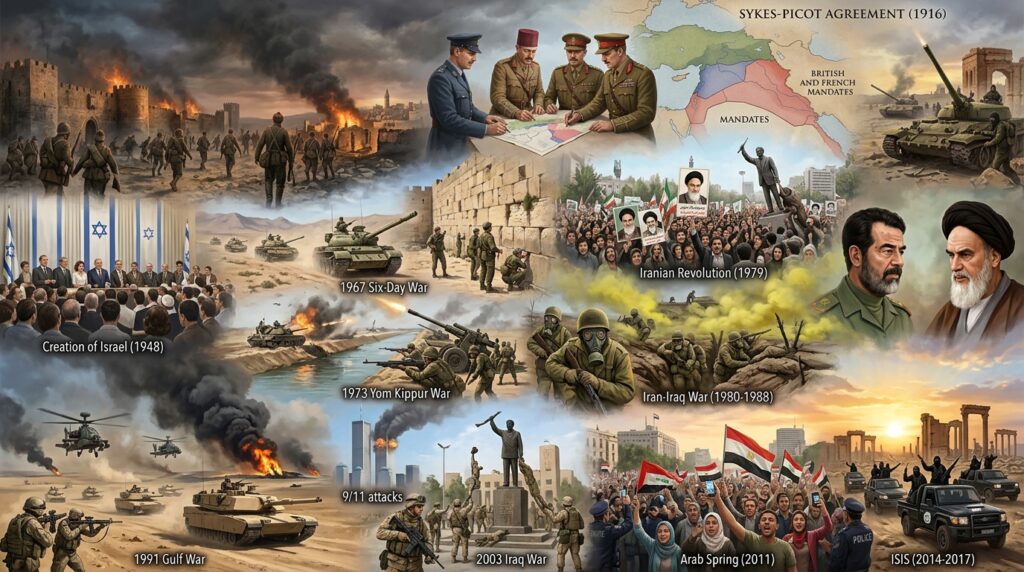
Then, in 1979, two seismic events permanently reshaped the region. First, Egypt under President Anwar Sadat became the first Arab country to make peace with Israel, signing the Camp David Accords and regaining the Sinai Peninsula in exchange for diplomatic recognition. Second, and more important in long term regional terms, was the Iranian Revolution. The overthrow of the Western backed Shah and the establishment of an Islamic Republic under Ayatollah Khomeini introduced a radical model of political Islam. The revolution not only broke relations with the United States, but also challenged secular Arab governments and Sunni monarchies, creating a new ideological rivalry across the region.
In response to the perceived threat, Iraq’s Saddam Hussein attacked Iran in 1980, starting the Iran-Iraq War. This conflict was ruthless and inconclusive, lasting 8 years and causing massive loss of life. Iraq emerged from the war economically crippled, and heavily indebted to the Gulf Arab states, especially Kuwait.
As a result, in 1990, in an attempt to erase its war debts and gain control over more oil reserves, Iraq invaded Kuwait. This aggression provoked the Gulf War, as a US led international coalition quickly intervened and expelled Iraqi forces in 1991. Although militarily successful, this war began a long period of US military presence in the region, with US bases and weapons partnerships spreading across the Gulf. This intervention also increased perceptions of Western imperial overreach, especially among Islamist groups.
By the end of the millennium, this growing US presence was increasingly resented in the region, seen as an insult to sovereignty and an enabler of authoritarian governments. This resentment fueled the ideology of radical Islamist groups, culminating in the 9/11 attacks carried out by Al Qaeda in 2001.
The attacks provoked the US led War on Terror, which made the Middle East its center. After the invasion of Afghanistan, the United States invaded Iraq in 2003, on the pretext of eliminating weapons of mass destruction and overthrowing Saddam Hussein. While his government fell quickly, Iraq sank into sectarian conflict, with violence between Sunni and Shia factions intensifying and creating fertile ground for extremist movements.
This regional instability set the stage for the Arab Spring in 2011, a wave of popular uprisings demanding democratic reforms and the end of authoritarian rule. These uprisings began in Tunisia and quickly spread to Egypt, Libya, Syria, and beyond. Although Tunisia transitioned toward democracy, most outcomes were dark. Egypt’s democratic experiment was short lived, ending in the 2013 military coup. Libya and Yemen sank into chaos, and in Syria, President Bashar al-Assad’s refusal to relinquish power led to a devastating civil war. This conflict displaced millions and became a proxy war involving Russia, Iran, Turkey, and Western powers, each supporting opposing sides.
Amid this chaos, a new jihadist force emerged, drawing strength from disaffected Sunni communities and the ruins of post occupation Iraq. ISIS, the Islamic State, declared a caliphate in 2014, capturing large areas in Iraq and Syria. The group committed widespread atrocities and used online propaganda to recruit followers around the world. By 2017, a combination of US led airstrikes, Iraqi and Kurdish forces, and Russian and Iranian backed Syrian forces succeeded in ending the group’s territorial control, although it continues to operate as a regional insurgency.
During the 21st century, the region has also seen major geopolitical shifts. Iran expanded its influence through militias and proxy groups in Iraq, Syria, Lebanon, and Yemen, creating a strategic corridor often called the Shia Crescent. This challenged the interests of Sunni powers, especially Saudi Arabia and its Gulf allies, who saw Iran’s growing regional reach as a direct threat to their security and ideological leadership.
Iran’s nuclear program, long a source of international dispute, added further tension. Although Iran insists the program is for peaceful purposes, many Western and regional powers fear it could lead to the development of nuclear weapons, potentially sparking a regional arms race.
Meanwhile, Turkey under Erdogan reasserted its regional ambitions, pursuing an independent foreign policy, deploying troops in Syria, Libya, and the Caucasus, and frequently clashing with Kurdish groups seeking autonomy in Iraq and Syria.
These competing currents of influence between Iran, Turkey, and the Gulf Arab states have formed a more multipolar Middle East in which shifting alliances and persistent rivalries form the basis of much of the region’s strategic landscape.
Amid these rivalries, however, some Arab states began to reassess their positions. In 2020, under US mediation, the Abraham Accords were signed, which saw the United Arab Emirates, Bahrain, Sudan, and Morocco normalize relations with Israel. Shared concerns about Iran, and frustration with the deadlock in the Israeli-Palestinian conflict, were also important drivers, marking a significant shift in regional diplomacy.
To this day, the Middle East remains a complex and contested geopolitical landscape. While some states, especially in the Gulf, have seen rapid modernization and economic growth through oil wealth, tourism, and investment, others suffer from authoritarianism, corruption, and conflict. Deep rooted sectarian, ethnic, and political rivalries persist, and the legacy of foreign intervention continues to shape public attitudes and regional alignments. The region stands at a crossroads, rich in potential, yet burdened by a history of division, intervention, and unfulfilled aspirations.
And that is the point. The crossroads does not belong to any one empire. It outlasts them. The Sumerians are gone, but their cities remain the model. The Persians are gone, but their empire remains the template. The Romans are gone, but their law remains. The caliphs are gone, but their language remains. The Ottomans are gone, but their borders still shape the map. The Europeans drew lines, and then the oil beneath those lines gave the region its power back. Every conqueror arrived believing the crossroads was theirs. Every one of them left something behind, and took something of the place with them. That is why the Middle East is not a prize to be won. It is a place that wins, slowly, by outlasting everyone who tries to own it.
2 thoughts on “The Complete History of the Middle East: From Ancient Mesopotamia to the Modern Era”