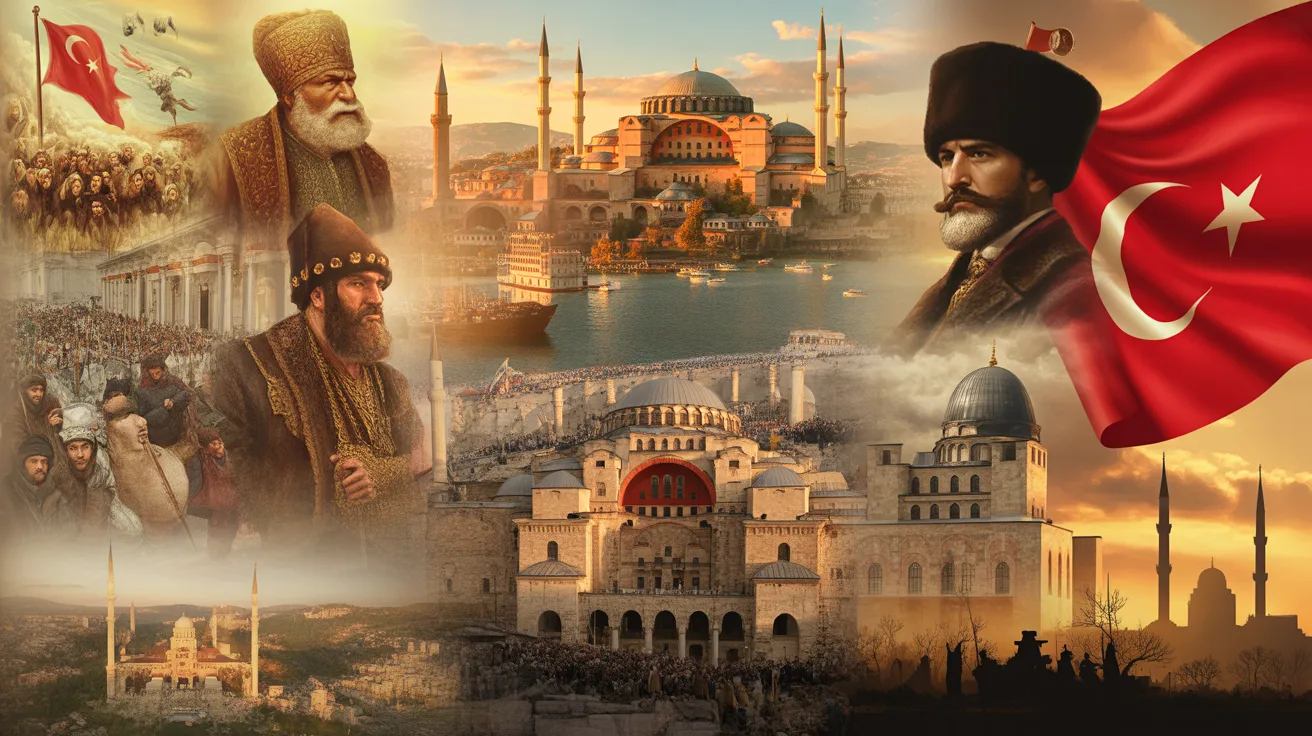
On 29 October 2023, the Republic of Turkey marked 100 years since its founding. That centenary also marked the end of something far older: in 1923, more than 600 years of Ottoman rule came to a close. At its peak in the mid-1500s, the Ottoman Empire ruled much of the Middle East, North Africa, and Eastern Europe. It began as an obscure regional power in northwestern Anatolia and grew, with startling speed, into one of the most diverse and wealthy empires the world had seen. Everyone knows this story as a rise and a fall. But the story itself has a problem, and it is the reason this article is written differently from the usual version. Historians now point out that the famous Ottoman decline supposedly lasted three hundred years. If an empire was declining all that time, why did it not fall? This article tells the full history, and at each turning point it shows where the simple rise and fall story breaks down.
From the steppe to Anatolia
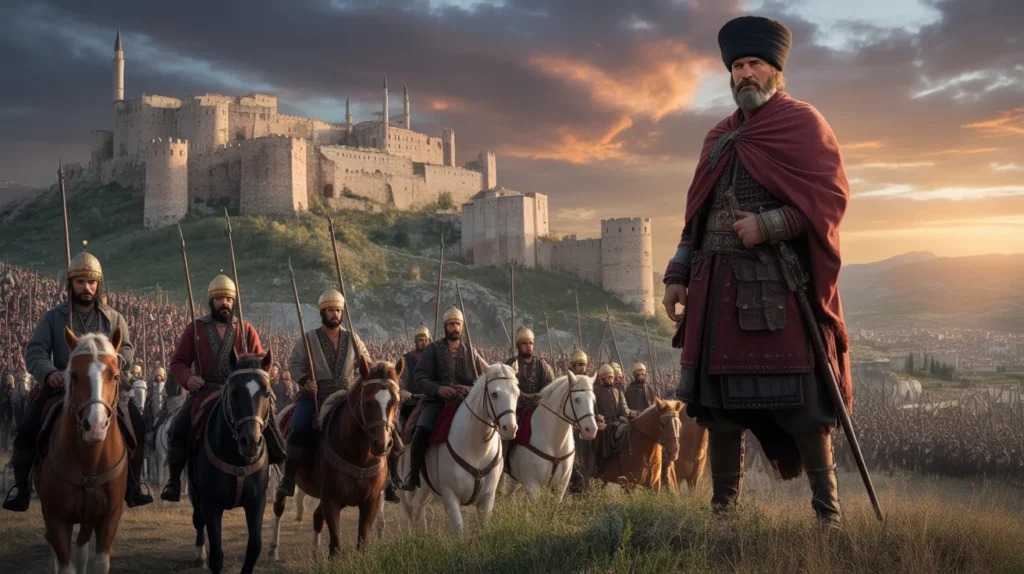
To understand how the Ottoman Empire began, you have to start further east, with the migration of the Turkic tribes. For centuries, Turkic peoples drifted westward from northeastern Asia across the vast Eurasian steppe. By the seventh century they were gathered around the Altai mountains, near the modern borders of Russia, Kazakhstan, and Mongolia, and over the following centuries they pushed further south and west. Some settled into a semi-nomadic life around the Caspian and Aral seas. Among the tribes there were the Oghuz. In the late tenth century, a leader named Seljuk broke away from the main tribal group and founded his own line. In the decades that followed, Seljuk and his descendants expanded into Persia and built the Seljuk Empire. They adopted Persian language and culture, and they embraced Islam. By the 1060s they had reached the borders of the Byzantine Empire in western Anatolia. Skirmishes between the two powers grew into open war, which ended at the Battle of Manzikert in 1071. The Seljuks crushed the Byzantine army, winning control of the Near East and the road into what is now Turkey. Over the next two centuries the Seljuk Empire slowly declined and split into a cluster of small Turkish states. The Turks, however, kept a large presence in Anatolia, above all in the Sultanate of Rum. That too faded by the early 1300s, breaking apart into small principalities called the Anatolian beyliks, scattered across the region.
Osman and the rise
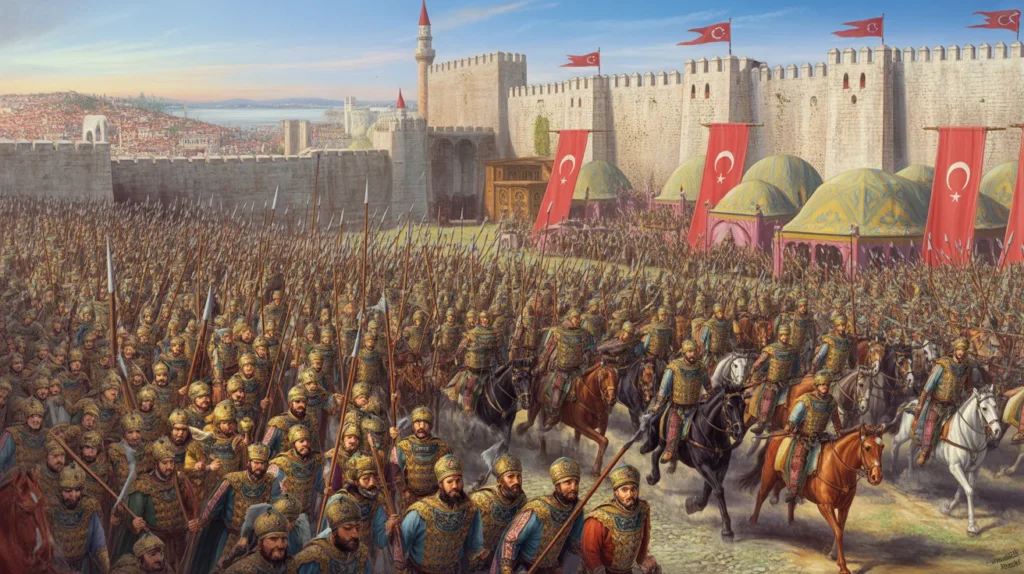
From one of those beyliks in northwestern Anatolia rose a warrior chief remembered as the founder of the Ottoman Empire. The sources for his life are unreliable and thin, but he is known as Osman, and the dynasty took his name. For nearly a century after Osman, the Ottomans pressed against the last remnants of the Byzantine Empire, which had once ruled most of the eastern Mediterranean but by the 1300s was reduced to the southern Balkans, mainland Greece, the Greek islands, and a scrap of land in Turkey. Its capital was Constantinople, the most heavily fortified city of the medieval world, which had survived many sieges over the centuries. If the Ottomans were to grow beyond northwestern Anatolia, they would have to do it at Byzantine expense, and take the capital itself.
A major step came in 1331, when the city of Nicaea fell to the Turks. A few years later, in 1369, Adrianople, only 200 kilometres from Constantinople near the modern borders of Greece, Bulgaria, and Turkey, also fell and briefly became the Ottoman capital, while further conquests followed in Serbia and Bulgaria. A short period of civil war shook the empire in the early 1400s, but in 1451 Mehmed II restored Ottoman power and set himself once more to the task of taking Constantinople for good. In early April 1453 he laid siege to the great city. The siege lasted seven weeks before the walls broke and the Ottoman army poured in.
The last Byzantine emperor was Constantine XI, who shared his name with Constantine I, the city’s founder more than a thousand years earlier and the man who gave it its name. Constantine XI died fighting on 29 May 1453, and later that same day the city itself fell to the Ottomans. Constantinople then became the capital of the rising Ottoman Empire. As a mark of the conquest, the cathedral of Hagia Sophia, built by the emperor Justinian more than 900 years earlier, was reconsecrated as a mosque, and four minarets were added to the complex.
The golden age
The fall of Constantinople was only the beginning of the Ottoman rise. In the century that followed, the Turks pushed on into the eastern Mediterranean, the Middle East, North Africa, the Balkans, and the Black Sea. In the early 1460s Mehmed II swiftly conquered the Morea in Greece, the Empire of Trebizond in northern Turkey, and then Bosnia in the Balkans. When he died in 1481 he had expanded into southern and eastern Turkey, conquered Albania, and sent an expedition to the Crimean peninsula that established an Ottoman presence on the northern shores of the Black Sea. His successor Bayezid II was just as formidable a warrior, and in his 30 year reign he added Syria and the Levant after defeating the Mamluks of Egypt in the struggle for the region. He also tightened Ottoman control of the Aegean after war with the Republic of Venice, which between 1499 and 1503 controlled many islands and passing trade routes. His successor Selim I is also notable: although he ruled only eight years, between 1512 and 1520, in 1517 he conquered almost all of North Africa. His armies defeated the Mamluks at the Battle of Ridaniya and brought Egypt and most of Libya under Ottoman control, while the ruler of much of Algeria and Tunisia, Hayreddin Barbarossa, agreed in 1519 to become an Ottoman vassal.
Perhaps the most famous Ottoman sultan, and the one who carried the empire’s expansion furthest to the peak of its power, was Suleiman the Magnificent. Ruling for nearly half a century, between 1520 and 1566, he saw the Ottomans emerge as a world power. He completed the conquest of most of the Balkans and led his armies to the gates of Vienna, which he unsuccessfully besieged in 1529. He also took the island of Rhodes from the Christian Knights of St John in 1522, seized Tripoli in North Africa in 1551, and expanded into the Arabian peninsula and Iraq. By the end of his reign, Ottoman rule stretched from Hungary and the northern shores of the Black Sea to Egypt and Oman in the south, and from Algeria in the west to the shores of the Caspian Sea in the east.
Much of the Ottomans’ success came from the skill of their army, which combined well trained infantry, cavalry, and artillery in a balance unmatched at its peak. Among the elite troops were soldiers known as the Janissaries. These were boys taken as children from Christian areas of southeastern Europe, enslaved and converted to Islam, then raised under strict discipline and professional training inside the Ottoman army, which made them a highly effective fighting force.
Here is the first crack in the simple story. Later historians treated Suleiman’s reign as the ideal golden age, and judged everything after it as decline. But that yardstick is part of the problem: a massive empire that lasted more than six centuries cannot be measured against one ideal moment.
The turn of the tide
From that position of strength in the early 1500s, the Ottomans spent the next two centuries fighting wars against Christendom in western and central Europe. Much of the early effort went into the struggle for the Mediterranean against Spain, the region’s dominant power. Spain controlled southern Italy and most of the Italian islands, and it led coalitions of Christian forces against the Muslim Ottomans to block their advance. For decades Turkish and Spanish fleets were sent against each other, ending in two great clashes in 1565 and 1571. The first was the Great Siege of Malta, in which the Ottomans tried to take the island from the Knights of St John, who had been given it by the Spanish crown decades earlier as compensation for the loss of Rhodes. The siege ended in failure for the Ottomans, and six years later their advance in the Mediterranean was checked again by a Spanish led Christian alliance, which sent a great fleet against them. The Battle of Lepanto, fought off the coast of northwestern Greece in 1571, involved more than 400 ships and 130,000 men and ended in another Ottoman defeat, though it proved to the Christian powers that the Turkish threat could at least be contained.
From the Ottoman point of view, the setback only turned their attention to other parts of Europe where they wanted to expand, especially since after their victory over the Hungarians at the Battle of Mohacs in 1526, full control of central Europe was within reach, if only the Austrian capital of Vienna did not block the way across the Danube. Although they had failed to take the city in 1529, a new siege was launched against Vienna in 1683 under the grand vizier Kara Mustafa Pasha. Despite an army of more than 150,000 men, the Ottomans failed to take the city, and when a Christian Holy League relief army under the Polish king John III Sobieski arrived on 12 September, they were defeated before the city walls in what became the largest cavalry charge in history, with 18,000 horsemen breaking over the Turks. The defeat at Vienna marked a turning point for Ottoman expansion in Europe, after which they would gain no more land on the continent.
But note what did not happen after Vienna: the empire did not collapse. It went on for another 240 years. A state that survives two and a half centuries after its supposed turning point is not simply falling. It is changing.
The long decline that was not a decline
As the late 1600s gave way to the early 1700s, the Ottoman Empire slowly settled into stagnation and entered a long period of relative decline. Much of the cause lay with the sultans of the period, who over time took a more and more retiring role in governing their empire. The government, headquartered at Topkapi Palace in Constantinople, had once seen active sultans take a direct role in the empire’s affairs, above all in the 1400s and early 1500s. But with each passing generation, day to day decisions were left more and more to the grand vizier, who acted as prime minister, and to a small army of officials and administrators, while the sultan spent most of his time in his harem and gardens.
The empire’s rule was also largely decentralized. Taxes were collected from the provinces to maintain a large army, but the regions themselves enjoyed a large degree of autonomy under local rulers and governors. It was also a tolerant empire: while converting to Islam was helpful for anyone who wanted to rise in society, it was by no means compulsory. Christians and other religious followers were accepted under Ottoman rule, and it became a major refuge for the Jews of Europe, who faced persecution and expulsion from countries such as Spain in this period. Cities such as Thessaloniki became centers of religious cosmopolitanism in the early modern period, with Jews making up 54 percent of its population as early as 1519.
The Ottoman Empire was also once very wealthy, with vast trading networks stretching from as far away as India and China along the Silk Road to Constantinople, Alexandria in Egypt, and Antioch and Damascus in the Levant. But over time, as the center of world economic activity shifted from the Mediterranean to the Atlantic, great ocean going ships carrying trade from the Americas and the Far East effectively bypassed the Ottomans and reduced Europe’s dependence on the overland trade routes that passed through their territory, leaving them effectively cut out. With this economic stagnation and the empire’s decline, the Ottomans began to fall behind their European rivals, who were themselves experiencing a scientific revolution that brought progress on all fronts through rapid advances in technology.
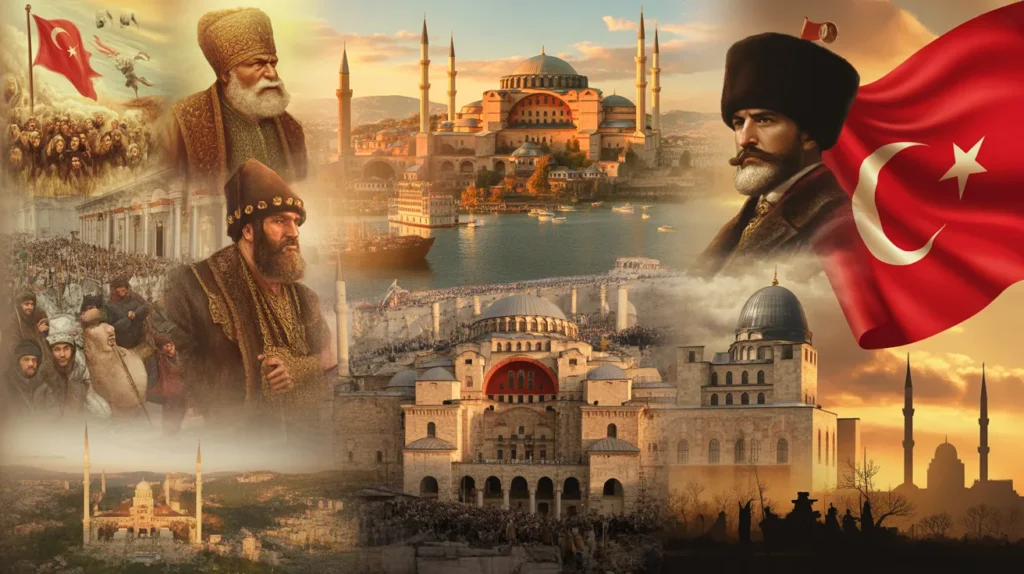
So the weaknesses were real: army recruitment problems, government corruption, civil unrest, and a world economy that moved away from Ottoman trade routes. What historians now dispute is not the troubles but the label. Calling three centuries of this a single decline hides what the empire actually did: it kept ruling three continents, it reformed itself in the Tanzimat era of the 1800s with new laws, schools, and administration, and it stayed a player in great power politics into the twentieth century. The famous sick man of Europe label was itself a political weapon, coined by the empire’s rivals to argue that its lands were ready to be divided. The losses of the 1800s, Serbia’s revolt in 1804, Greek independence by 1829, the loss of Algeria to France in 1830, and the Balkan nations breaking away in the 1860s to 1880s, were driven as much by rising nationalism and by Britain, France, Russia, and Austria-Hungary carving up the map as by Ottoman rot. Britain and France even fought the Crimean War in the 1850s to defend the Ottomans, because they wanted the balance of power in Europe preserved, not the empire destroyed. That is not the story of a corpse. It is the story of a state under pressure, adapting slowly, and losing ground to a new kind of politics it could not contain.
The Young Turks and the final war
This long period of pressure caused growing concern among the empire’s younger generations, many of whom identified as Turkish nationalists and demanded political reforms to slow the empire’s decline and hopefully revive its fortunes. At the forefront of this movement were the Young Turks, a group that wanted to replace the centuries old system of government by sultan and ministers with a modern constitutional monarchy, complete with a western style parliament and civil service. In 1908 they launched a revolution that successfully began an era of constitutional government. However, the Young Turks were a loose coalition of different political groups, including liberals, academics, and more conservative elements including the military. As a result they failed to govern by consensus or agreement. After the 1908 revolution and for several years into the 1910s, the internal politics of the Ottoman state remained turbulent, which further accelerated the empire’s end.
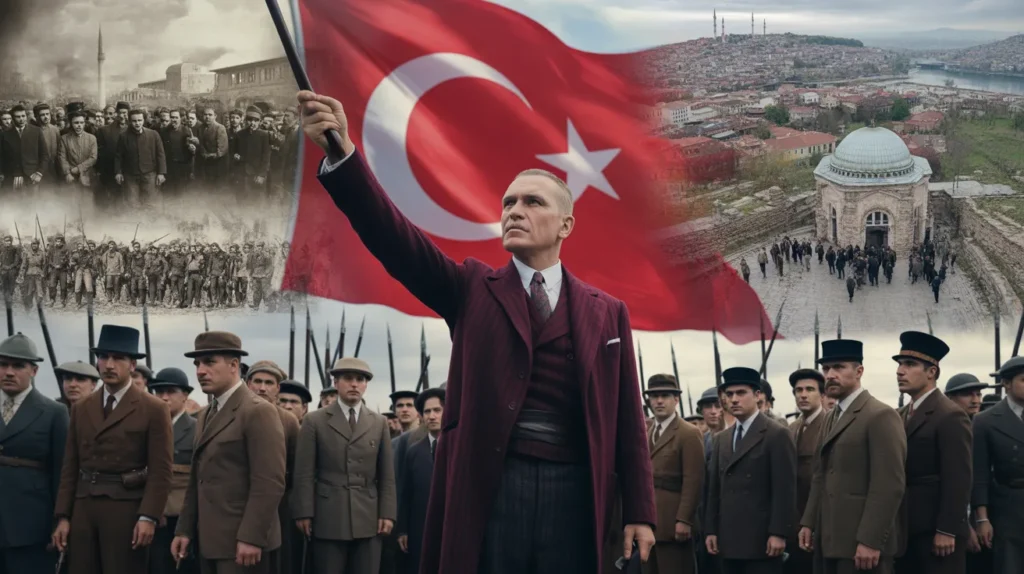
In the end, the fall of the Ottoman Empire came from both inside and outside, and it was bound up with the start of the First World War. Up to this point the Turks had avoided joining the two great military alliances that had developed between the European great powers in the late 1800s and early 1900s: the Triple Entente powers of France, Russia, and Britain, and the Triple Alliance powers of Germany, Austria-Hungary, and Italy. When war finally broke out in the summer of 1914, the Turks saw a chance for revenge against Russian advances over the previous century, and so decided to join Germany and Austria-Hungary as one of the Central Powers.
The Ottomans had mixed fortunes during the war. On one hand they won a major victory against British and ANZAC forces during the Gallipoli campaign, but in the Middle East and the Levant they lost most of their territory as a result of the Arab Revolt of 1916 to 1918, encouraged by the British adventurer T. E. Lawrence, known as Lawrence of Arabia. There was also a very dark and brutal side to Ottoman activity during the war, as from 1915 the government was involved in genocidal actions against its Armenian subjects, in which an estimated one and a half million people were killed.
Overall the war was a disaster for the Turks, as like Germany and Austria-Hungary they could not sustain the war effort, and by 1918 the Turkish army was collapsing on multiple fronts. With the end of the First World War in late 1918, the victorious Allies, Britain, France, Greece, and Italy, occupied most of Turkey and began to consider its postwar future. The last remaining Ottoman territorial assets in the Levant and the Middle East were divided between Britain and France, who took them as imperial mandates for their own empires. The Ottoman state was thus largely reduced to the area of modern day Turkey, but even its territorial integrity was soon threatened by the claims of Greece and Italy, the former wanting to annex areas where its people had once lived in Byzantine and ancient Greek times, while the latter wanted control of some islands such as Rhodes as compensation for its role in the war.
From empire to republic
What saved Turkey from partition was the war that followed the war. Under the leadership of Mustafa Kemal, later known as Ataturk, Turkish nationalist forces fought back the occupying armies in the Turkish War of Independence between 1919 and 1923. The Treaty of Lausanne, signed in July 1923, recognized the sovereignty of the new Turkish state within its modern borders and ended the capitulations and foreign zones that had carved up the empire. On 29 October 1923, the Republic of Turkey was proclaimed, with Ataturk as its first president. The sultanate was abolished, and six centuries of Ottoman rule were over. The empire that had begun with a small beylik in Anatolia had become modern Turkey.
So the entire history is not a simple rise and fall. It is a rise, a long transformation under pressure, and a sudden end in war and nationalism. That is why the empire’s legacy still shapes the Middle East, the Balkans, and modern Turkey today.
Read also: Mehmed II After 1453: The Conquests History Forgot
8 thoughts on ““The Entire History of the Ottoman Empire: Rise, Golden Age, Decline, World War I, Genocide, and the Birth of Modern Turkey””