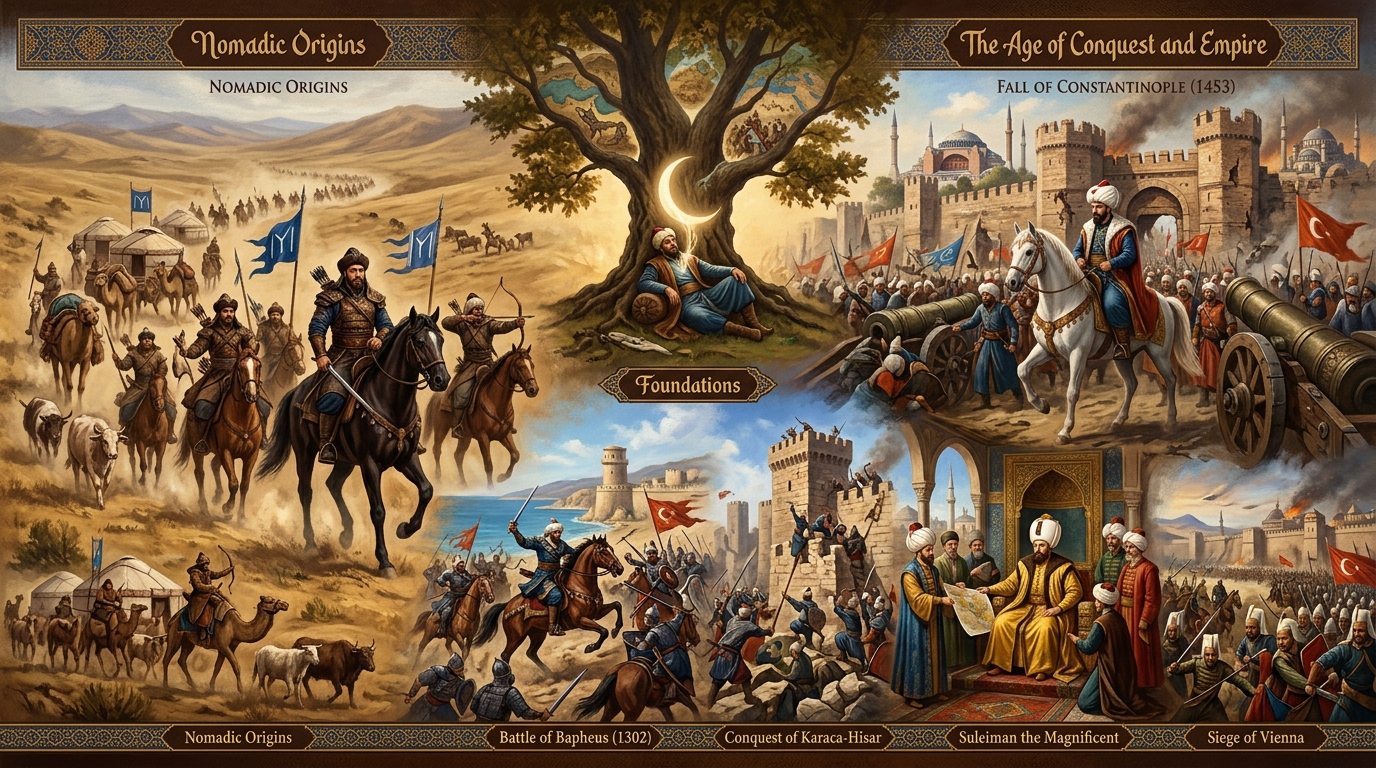
The Ottoman Empire did not begin with a great battle. It began with a prayer. In 1299, during Friday prayers, a small frontier chief named Osman Ghazi ordered that the sermon be read in his own name instead of the Seljuk sultan’s. That was a declaration of independence. Within four years, two small battles turned that declaration into a state. This is the story of those first victories: Bapheus in 1302 and Dimbos in 1303, and how a tribe of frontier raiders became the founders of an empire.
The vacuum
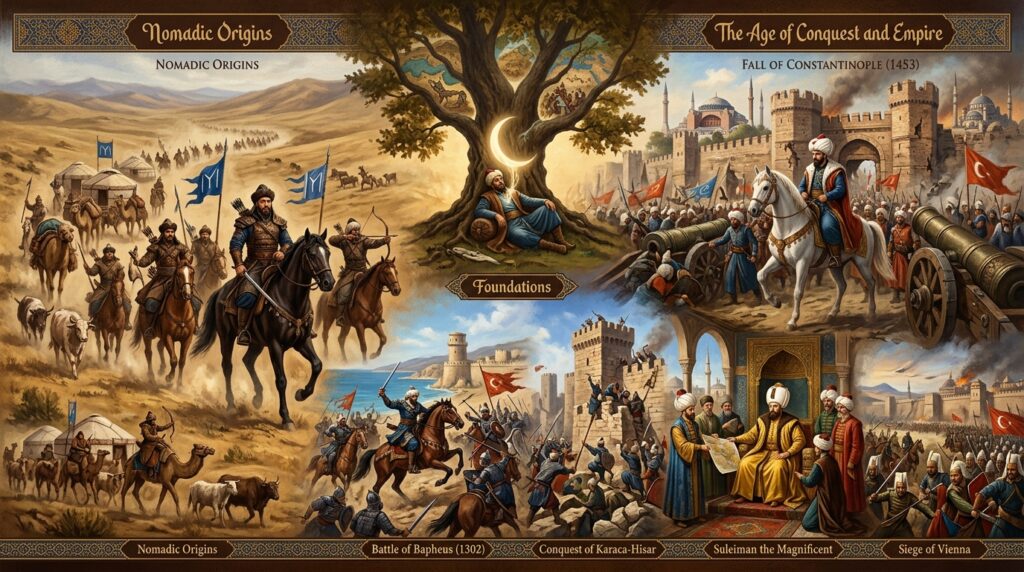
As tribal regions grew in size, the central authority of the Sultanate of Rum came to an end. By the late 1200s, Anatolian beyliks looked to the Seljuk sultan only as a formality, while the Anatolian nobility sought any chance to free themselves from Mongol overlordship. The chance came in 1296, when the Mongols imprisoned the Seljuk sultan for a failed bid to win independence for Rum. Taking advantage of the vacuum, many governors and beylik leaders across the peninsula declared their independence.
In 1299, during Friday prayers, Osman Ghazi did the same. He declared independence from Konya and ordered that prayers in his mosques be read in his own name instead of the Seljuk sultan’s. A newborn state had been born, and the newborn Ottoman nation was master of its own fate. For Osman, independence was the start of great ambitions.
From raiders to a capital
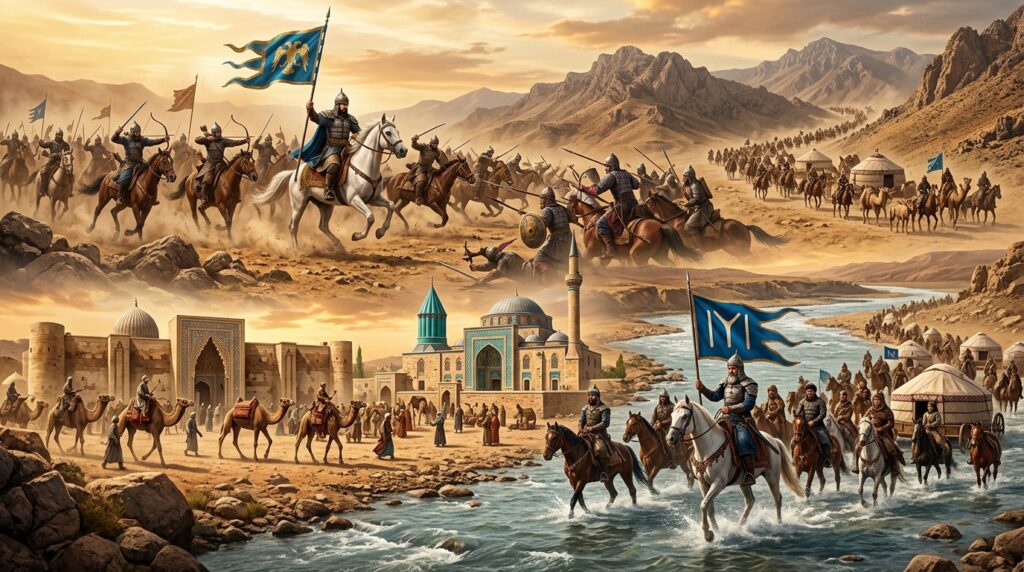
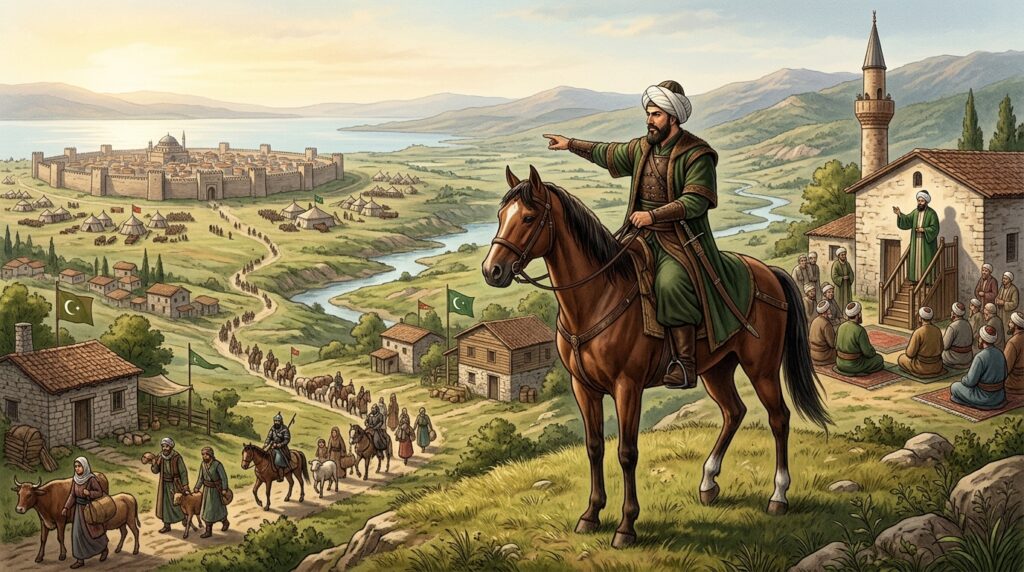
In 1301 Osman launched a campaign into Byzantine Bithynia, pushing as far as the coast. In a rapid campaign his forces captured the towns of Kopruhisar, Inegol, and Yenisehir. Yenisehir was turned into the capital, because Osman moved his administration and his household inside its walls. That move mattered more than the battles. In the same period, Muslim tribes and ghazi warriors began moving into the conquered Bithynian towns, leaving their nomadic life behind. A tribe that holds towns and runs a capital is no longer just raiding. It is governing.
Before the year ended, Ottoman forces began besieging Nicaea, a major Byzantine city. Nicaea was a prize: the Sultanate of Rum had lost it during the First Crusade in 1097, and it had since regained its position as a regional capital for Byzantine rule in Anatolia. But the siege was also bait. After failing to hold its Anatolian provinces and stop the spread of Turkish beyliks, the empire had to answer, and the siege of Nicaea forced the emperor Andronikos II to act.
Bapheus, 27 July 1302
In the summer of 1302, Andronikos II announced a campaign to retake the lost lands in Asia Minor. His son and co-ruler Michael IX had already tried early in the year, but his campaign failed, partly because his forces were weakened by mercenaries who had deserted after Osman’s campaigns the previous year. From Constantinople, a relief force of 2,000 men under George Mouzalon was sent to meet the local Byzantine commanders and end the siege of Nicaea. After landing at Yalova, the relief force advanced south toward Prusa, modern Bursa, where local Byzantine forces were gathering. But Osman, learning of the Christian force through spies, marched with 5,000 men and intercepted the relief force near the village of Koyunhisar.
On 27 July 1302, both armies prepared for battle on a flat field near the village. Mouzalon’s Byzantine force was made up entirely of infantry, including about 1,000 Alan cavalry recruited from the Balkans. Osman’s force, by contrast, numbered more than 2,000, mostly Turkish cavalry, many of them from allied beyliks in the surrounding regions.
The battle began when a general charge by the Muslim cavalry broke the Byzantine line. Almost immediately, the Byzantine infantry began to crumble, because Mouzalon’s Alan cavalry had already begun to desert the field, leaving the remaining Byzantine infantry at the mercy of the Turks. As a result of the cavalry charge, the Byzantine defensive lines decisively broke, and the remains of the relief force retreated north toward Nicomedia. The engagement, later famous as the Battle of Bapheus, was the first great victory in the history of the newborn Ottoman state.
Why did Byzantium lose? Not because Osman had the bigger army. He did not. Byzantium lost because its army was already broken before the battle: a failed campaign, deserting mercenaries, and local commanders who could not act together. Bapheus was the moment the empire’s weakness became visible to everyone in Bithynia.
Dimbos, 1303: the victory that hurt
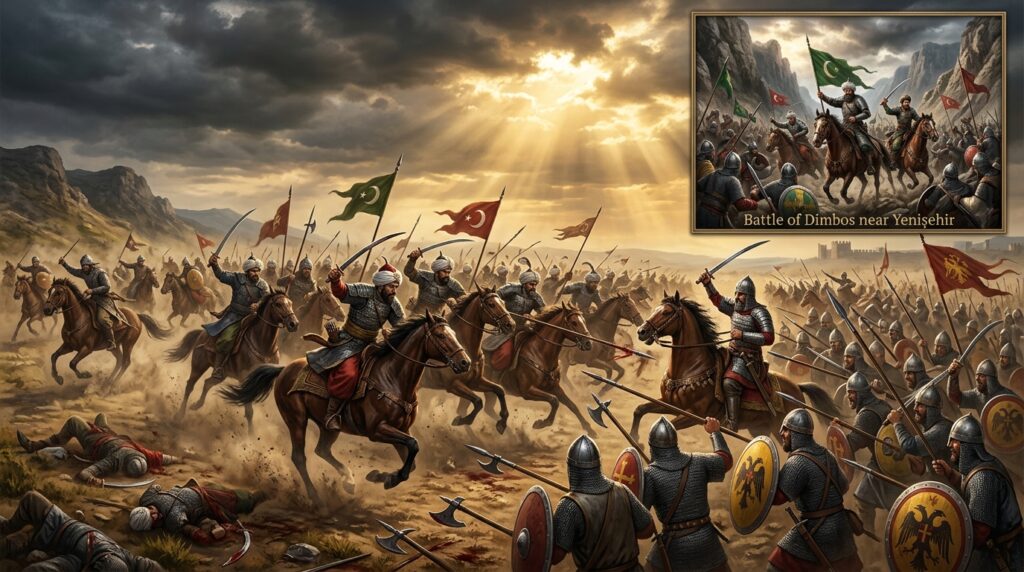
After the battle, Ottoman forces spread through the Bithynian countryside, looting villages and capturing settlements, including the coastal town of Gemlik. A year later, the Byzantine commanders of Prusa, Kite, Adranos, Kestel, and Ulubat made one final joint attempt to push back Osman’s forces and restore Byzantine authority in the region. They attacked the Ottoman capital Yenisehir and then planned to relieve Nicaea, which was still under Ottoman siege.
Hearing of the Byzantine counterattack on his newly won lands, Osman gathered 5,000 men and met the Byzantine force near Dimbos, at a narrow mountain pass. Sources say the Byzantine force was slightly larger, 5,000 to 6,000 men, but because both armies were forced to fight in a narrow pass, the Byzantines could not use their numbers to surround their enemy. The battle was bloody for both sides. The Byzantine commander of Kestel was killed, and so was Osman’s nephew Aydogdu. In the end, the intensity of the Ottoman forces under Osman and his son Orhan finally pushed the Byzantine army back. The Battle of Dimbos ended as a Pyrrhic Ottoman victory: a win that cost almost as much as a defeat.
And that is exactly why Dimbos matters. A tribe can win a battle like Bapheus by luck and enemy weakness. A state is proven when it absorbs a bloody, costly win and keeps its gains anyway. After Dimbos, no Byzantine force in Bithynia could seriously challenge Osman again.
What the first victories made
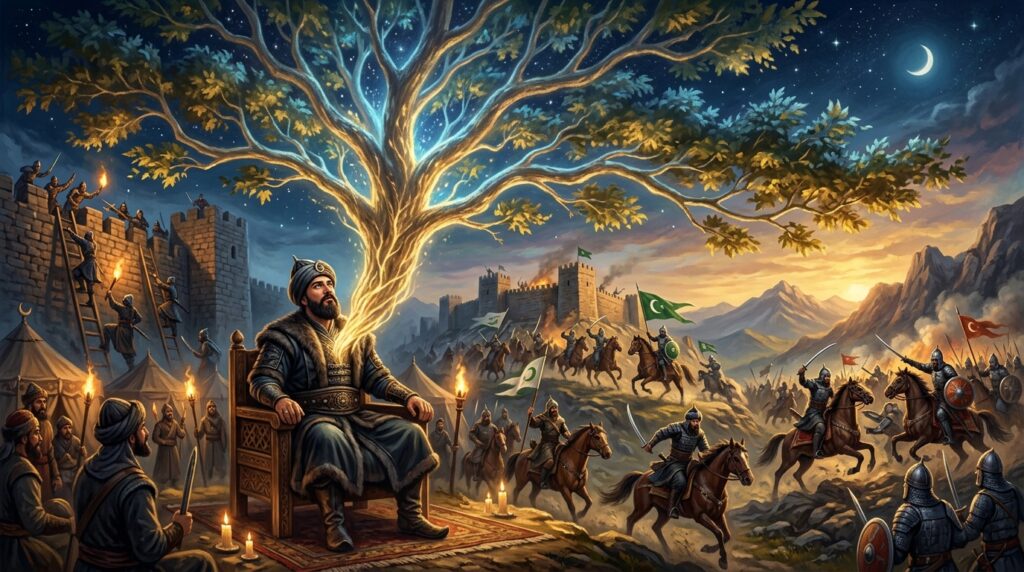
The road from here runs straight to Bursa. The great Byzantine cities that had held out against Osman, Bursa, Nicaea, and Nicomedia, were now isolated, and Bursa itself would fall to Osman’s son Orhan in 1326 and become the first true capital of the Ottomans. But the state had already been made in 1302 and 1303. Two small battles, a new capital at Yenisehir, and tribes settling into towns instead of tents: that was the moment a frontier chiefdom became an empire in waiting. The dream of a tree covering the world, told in our companion article, still lay in the future. The roots were planted here, in Bithynia, by victories so small that history books often skip them.
Read also: The Entire History of the Ottoman Empire: From Osman’s Dream and the Fall of Constantinople
2 thoughts on ““The Entire History of the Ottoman Empire: Origins, Osman Gazi, and the First Victories””