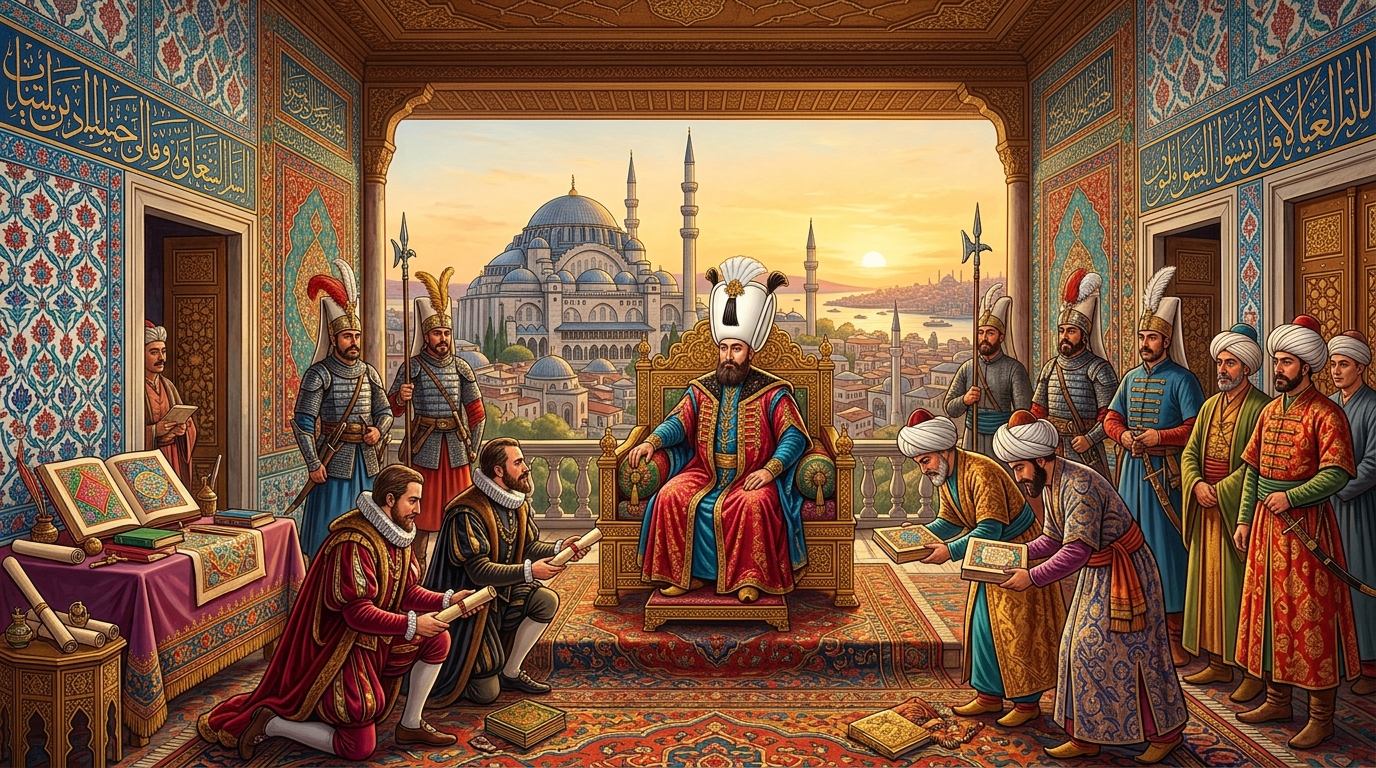
Every empire has a foundation myth. The Ottoman Empire has one of the strangest: a young tribal chief falls asleep in a holy man’s house and dreams that a tree grows out of his own body until its shade covers the whole world. That chief was Osman. That dream is why his people called themselves Ottomans. And the city where the dream came true was Constantinople. This is the story of the dream and the city, from a small Anatolian tribe to the conquest of 1453.
The dream
Osman was the leader of a small Anatolian tribe that had emerged from the chaos left by the Mongols. The early history of the Ottomans is notoriously murky, because they did not write much down until they had stopped moving their capital every thirty years and settled properly. But the story they told about themselves begins with a dream. Osman, the story goes, was staying at the house of Sheikh Edebali, a respected holy man whose daughter he loved. One night he dreamed that the moon rose from Edebali’s chest and sank into his own. Then a great tree sprang from his body. It grew in beauty and strength until its shade covered the earth. From its roots flowed four rivers: the Tigris, the Euphrates, the Nile, and the Danube. Its branches shaded four mountain ranges: the Caucasus, the Taurus, the Atlas, and the Balkans. Edebali interpreted the dream as a sign: Osman’s descendants would rule a great empire. Osman married Edebali’s daughter, and the dynasty began.
Was the dream real? No historian can say. It was written down long after Osman’s death, and it has all the marks of a foundation myth: a divine sign, a holy man’s blessing, a marriage that binds the chief to religious authority. Some modern historians go further and question the holy warrior image itself. They argue Osman was a pragmatic nomadic warlord who took advantage of Byzantine weakness, not simply a ghazi fighting for faith. The truth is probably a mix: faith gave his followers a cause, and opportunity gave them land. What matters is what the dream did. It gave a tiny tribe a story big enough to grow into.
The road to the city
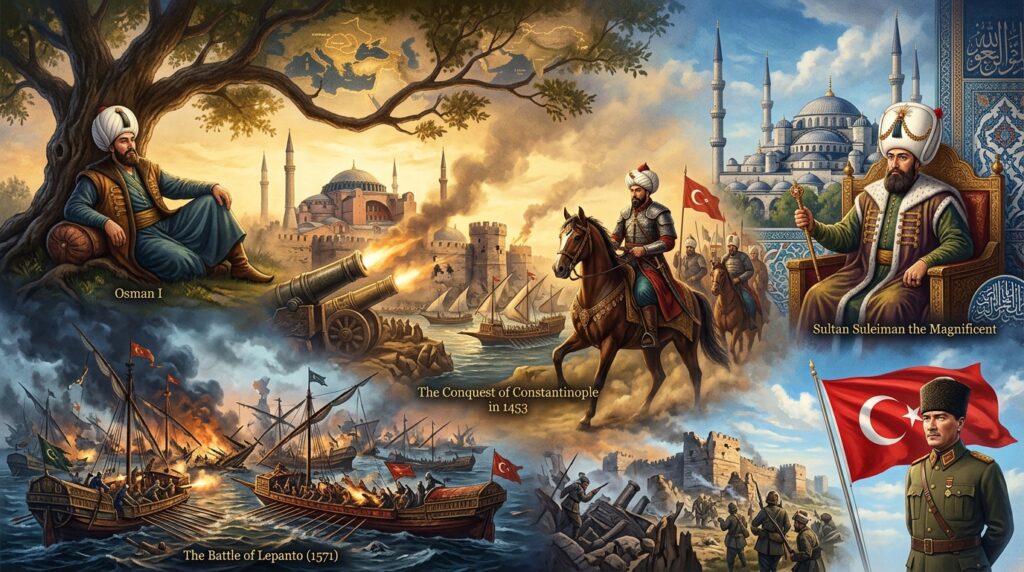
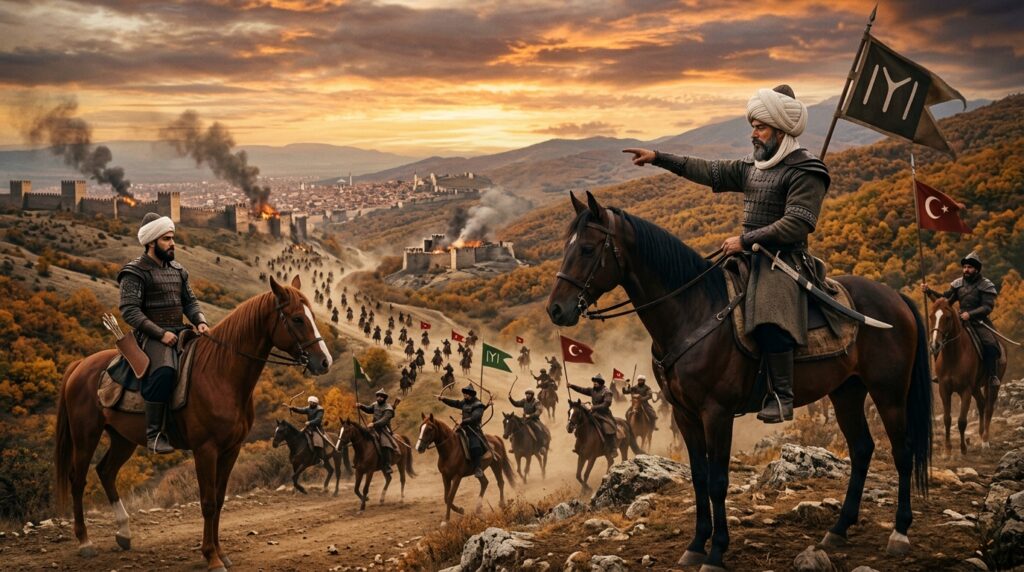
Osman and his son Orhan began the conquests and pushed northwest to Bursa, then crossed the strait the Greeks called the Hellespont to Adrianople, which remained the Ottoman capital for nearly a century. Holding their lands was a different problem. The aging Byzantine Empire still sat in the middle of them, a city with an empire attached, splitting Ottoman Anatolia from Ottoman Rumelia in Europe. The fourth sultan, Bayezid the Thunderbolt, earned his nickname by doubling the empire in a decade.
Then came the interruption that nearly ended everything. The Turco-Mongol conqueror Timur seized Anatolia and threw the Ottomans into a short civil war without a sultan, the only major civil war in their six hundred year history. It sounds absurd that there was only one, until you hear the official solution adopted afterward for succession crises: state level fratricide, the killing of brothers. It sounds foolish because it was, but it worked. After the crisis was settled and the empire restored, the Ottomans turned their attention back to Constantinople, the so called Red Apple of Christianity. Besides being the only strategic non-Ottoman spot on the map, taking the city carried enormous secular and religious prestige. It would also give them a strategic center between their divided holdings in Anatolia and Rumelia, and an internal source of revenue from Black Sea trade.
The siege
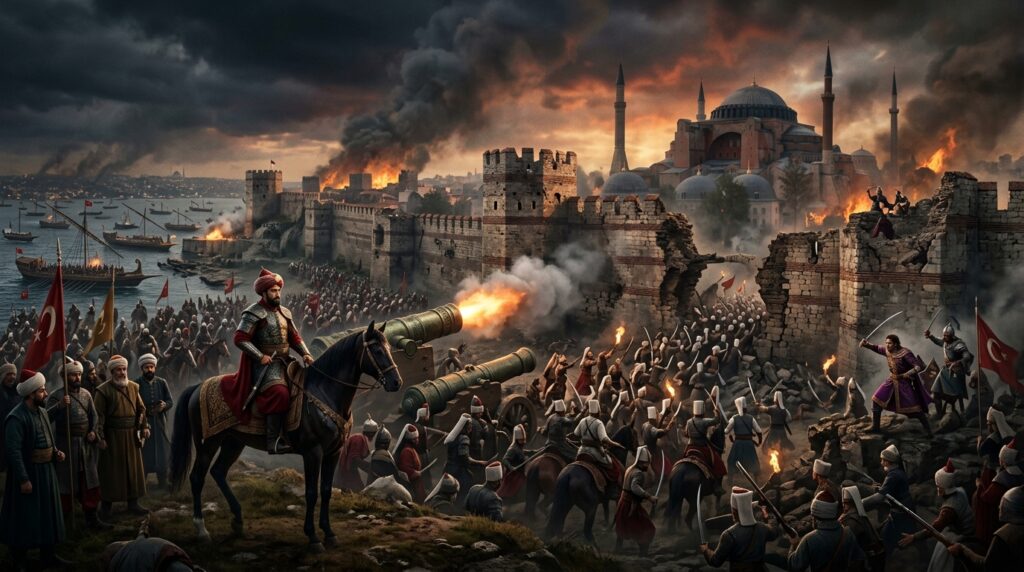
Sultan Mehmed II genuinely wanted Constantinople to surrender, but it did not, so he took it with mad siege weaponry and a huge army against a small garrison. He made taking Europe’s most historically unconquerable city look easy. The siege lasted seven weeks in the spring of 1453. Great bronze cannons, the largest the world had seen, hammered walls that had stood for a thousand years. On 29 May 1453 the walls broke, the Ottoman army poured in, and the last Byzantine emperor, Constantine XI, died fighting. Much of the city was destroyed, but the Byzantine church of Hagia Sophia survived, and the sultan was so impressed by it that he ordered it preserved by turning it into a mosque. As a result, Hagia Sophia, as it is known in Turkish, still stands today. The Ottomans were conquerors, but they were well aware of the historical inheritance they were taking on with the city of Constantinople.
What 1453 changed
Before and after the conquest, the city was known to the Ottomans as Konstantiniyye, which means the city of Constantine in Arabic, and it stayed that way for most of the empire. Unofficially people called it simply the City, and Greek phrases about being in the city or going to the city came out as eis tin polin, which is what we know today as Istanbul.
The conquest changed the world in three ways. First, it ended the Byzantine Empire, the surviving eastern half of Rome, after more than a thousand years. Second, it made the dream real: the tree’s shade now stretched across continents, and Constantinople as capital gave the Ottomans the base from which they would take the Balkans, the Middle East, and North Africa. Third, it fed the Renaissance. Greek scholars fleeing the fallen city carried classical Greek and Roman works west into Italy, works Muslim scholars had preserved, along with the trade wealth that funded new art. Mehmed himself loved the classical works and saw himself as a new Alexander. In historical importance, he was not that far off.
From here the story runs on: Mehmed expanded in every direction, even gaining a foothold in the Crimea besides the Aegean and Anatolian holdings, and the empire he built would last until 1923. That full story, and the question of whether the empire then declined for three hundred years or simply transformed, is told in our companion article.
Read also: Mehmed II After 1453: The Conquests History Forgot
2 thoughts on “The Entire History of the Ottoman Empire: From Osman’s Dream and the Fall of Constantinople”