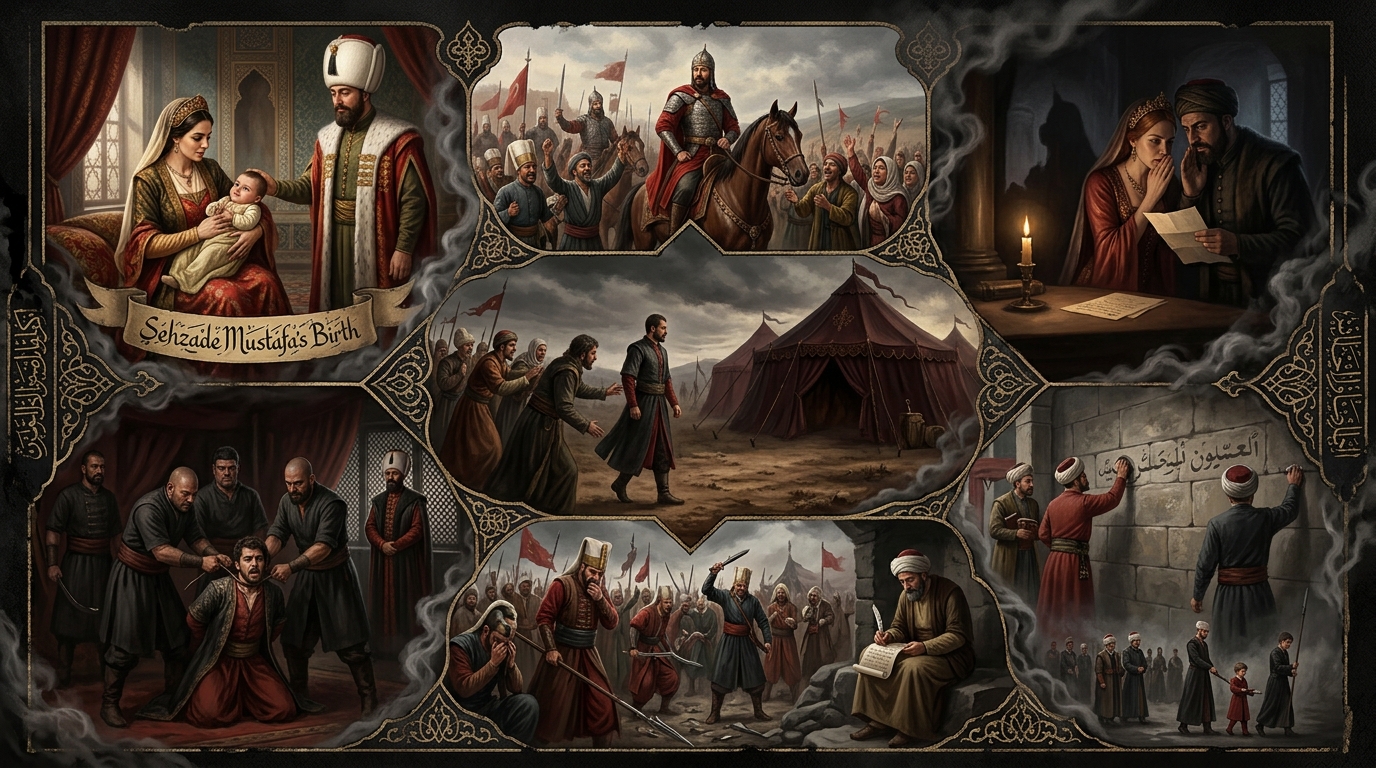
There is a moment in Ottoman history almost no one talks about, not because it is unimportant, but because someone had it buried.
Imagine you are the most beloved prince in the history of one of the world’s greatest empires. Imagine soldiers worship you, people in the streets chant your name. Imagine you were trained your whole life to sit on the throne your grandfather built with blood and intelligence. And then, imagine your own father calls you to his tent. You go because he is your father, because you trust him, because you did nothing wrong. And inside that tent, instead of conversation, men were waiting, silent men. And the last thing you feel is a bowstring around your neck.
This prince’s name was Sehzade Mustafa. And after his death, the most powerful empire on earth tried to show he never existed.
To understand what happened to Mustafa, you must understand what the Ottoman Empire looked like at its complete peak.
The most beloved prince
The year is the mid-16th century. Suleiman the Magnificent is on the throne, and this title is not flattery, it is reality. Under Suleiman, the Ottomans penetrated deep into Europe: they took Hungary, besieged Vienna, dominated the Mediterranean, and ruled an area from the doors of Persia to the coasts of Algeria. He was the most powerful political entity on earth at that time. And Suleiman himself was not only a conqueror: he was a lawgiver, a poet, a patron of architecture, a person in whose court scholars, artists, and diplomats came from every corner of the known world. By any objective measure, he was extraordinary.
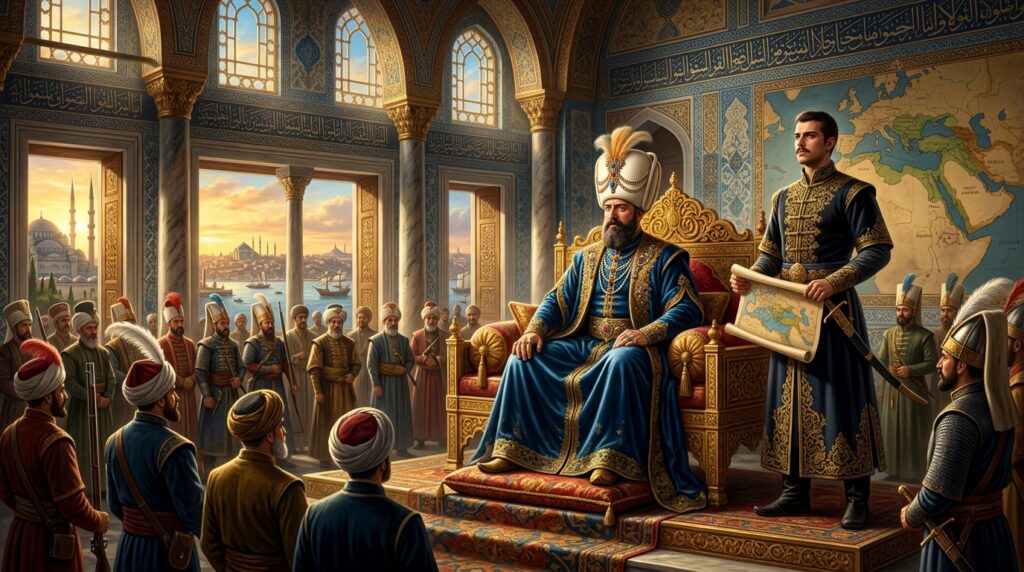
And his eldest son, Mustafa, was becoming exactly like that.
Born around 1515 to Suleiman’s first concubine Mahidevran Sultan, Mustafa was prepared for succession from childhood, with the seriousness the Ottomans brought to everything. He was taught theology, law, military strategy, and state affairs. He served as governor of Manisa, the traditional training ground for Ottoman princes, and then as governor of Amasya, an extremely important frontier province. He was capable, disciplined, and politically intelligent.
But above all this, he was beloved. The Janissaries, the elite military backbone of the Ottoman army, worshipped him. Common people saw in him everything a future sultan should be. There were soldiers who openly said they could not wait for Mustafa to sit on the throne. In the ruthless, distrustful environment of Ottoman court politics, this kind of popularity was not only an asset, it was a target.
The other side of the throne
The second part of this story, the part without which you cannot understand the rest, is Hurrem Sultan.
Hurrem was one of the most politically formidable women in Ottoman history. A Ruthenian concubine girl who rose to become Suleiman’s legal wife: for a concubine in the Ottoman system this was basically unprecedented. She gave him several sons: Selim, Bayezid, Mehmed, and Cihangir. Her sons were rivals to Mustafa for succession. And in the Ottoman world, rivalry for the throne was not an abstract political competition: for the losers it was a death sentence. The system basically guaranteed that whichever son became sultan would have the others killed.
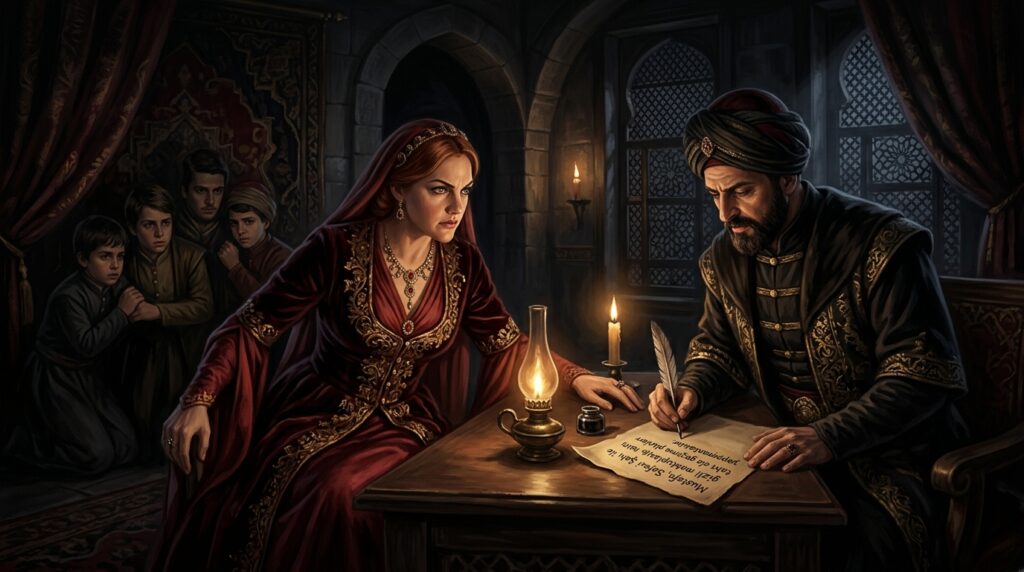
Hurrem understood this with perfect clarity. Mustafa was older, more experienced, more popular, and the army was behind him. If Suleiman died without removing Mustafa from the path, Hurrem’s sons were finished.
So what to do? If you cannot defeat him in the open, destroy him in the shadows.
The shadow war
The person who became the weapon in this shadow war was Rustem Pasha, the Ottoman Empire’s grand vizier and Hurrem’s son-in-law. He was intelligent, ruthless, and deeply embedded in the power structures surrounding Suleiman.
And in 1553, when Suleiman was leading a military campaign against Persia, Rustem Pasha sent a message to the sultan. The message claimed, and about this all sources agree, that Mustafa was in secret contact with the Safavid Shah of Persia, Suleiman’s enemy. That Mustafa, instead of waiting for his father’s death, was plotting to seize the throne by force. That the army’s love for Mustafa was not loyalty to the family, but the first stages of a rebellion.
None of this has any credible historical evidence of being true. Historians who examined the Ottoman sources of the era, Persian sources, and European diplomatic records, found nothing to support the treason charge. What they found is a mark of political maneuvering that goes straight back to Hurrem and Rustem.
But Suleiman believed it. Or maybe, and this is the dark possibility some historians raise, he found the accusation convenient enough to act on. He was growing old. The succession competition was creating instability. Mustafa was too popular to control and too capable to sideline.
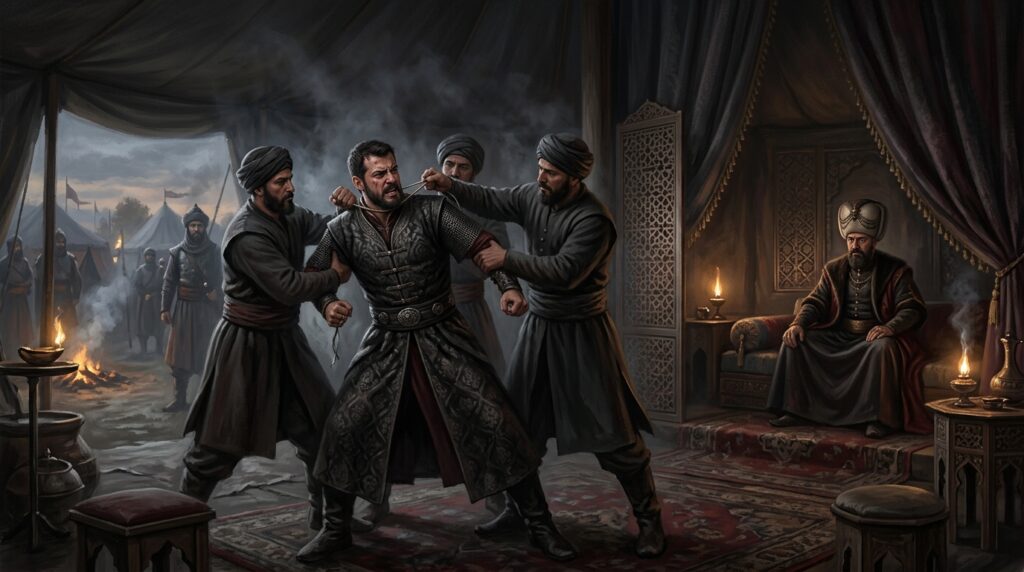
Whatever the full truth of his inner calculation, Suleiman acted. He summoned Mustafa to his tent in the military camp at Eregli in the autumn of 1553.
The tent at Eregli
And here is the detail that stays with you: Mustafa was warned. The people around him, advisors, soldiers, people who sensed the trap, forbade him to go. They told him something was wrong. And Mustafa still went.
Sources say he believed refusing his father’s invitation would itself look guilty: that if he had nothing to hide, he had nothing to fear. He went into his father’s tent with the belief that on some level blood relation matters, that a father will listen to him, that the connection between them is real enough to bear the accusation placed on him.
Inside the tent, mutes were waiting. In Ottoman tradition, the executioners appointed to kill members of the royal family were often deaf and mute servants: partly because royal blood hearing its death order was not considered dignified, and partly for the ruthless practical reason that they could not repeat what they saw.
Mustafa resisted. Historical traditions say he was physically strong, and that the struggle was not quick. Suleiman was reportedly watching from behind a curtain or partition in the same tent.
The bowstring was applied. Prince Mustafa, the most beloved Ottoman prince of his generation, the person half the empire expected to become its next sultan, died.
The erasure that failed
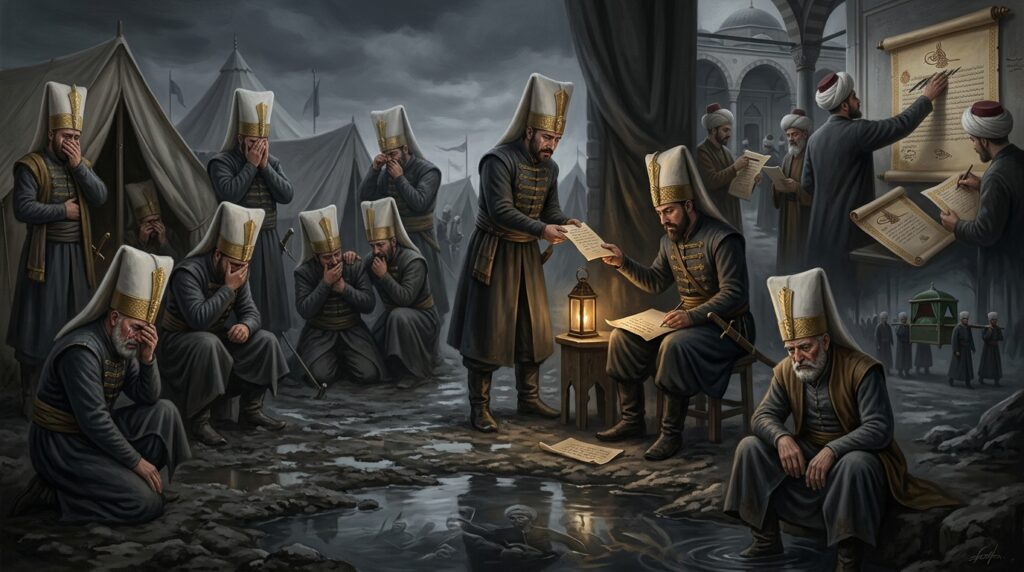
What happened in the days immediately after tells you how destabilizing this act was. The Janissaries came close to open rebellion. Soldiers openly wept in camp, which in the strict hierarchy of the Ottoman army was an almost unprecedented expression of grief.
A poet named Taslicali Yahya, breaking every rule of court culture demanding silence on politically sensitive deaths, wrote an elegy for Mustafa and spread it, which spread through the whole empire and expressed what common people and soldiers felt but were not allowed to say. Writing that poem was an act of real courage which could have cost him his life.
Rustem Pasha was temporarily removed from the grand vizier post, because public anger needed a visible sacrifice. He was restored within 2 years.
And then, the erasure process began. Mustafa’s name was removed from the Friday sermon, where the sultan and his expected successors’ names were read in every mosque of the empire. His picture, his records, his official presence in the administrative documents of the Ottoman state were systematically removed or suppressed. His young son, whose name was also Murad, was killed soon after, to eliminate any possibility of a future succession claim through Mustafa’s blood.
The Ottoman state, with the same organizational efficiency it brought to everything, began the work of making Prince Mustafa as absent from the official record as possible.
It did not fully succeed.
Memory is harder to kill than a man. Elegies and poems circulated underground. European ambassadors in Constantinople had already reported the execution with detail showing it was the talk of the city. And the Janissaries remembered.
The bitterness around Mustafa’s death, the feeling that in Eregli’s tent something rotten and cowardly happened, embedded itself in Ottoman military culture in a way that would surface again and again in the coming decades.
Ottoman history researchers often point to 1553 as a quiet turning point: not because the empire immediately weakened (it did not), but because by executing Mustafa, Suleiman removed the most capable candidate for succession, and left a future in which his sons Selim and Bayezid would fight a civil war against each other, which Selim would win.
Selim II, whom history knows somewhat ruthlessly as “Selim the Sot,” was not Mustafa. The Ottoman sultans who came after were not Mustafa. And the question of what the empire would have been like under the person the Janissaries loved and the people trusted is one of those historical imaginings about which thinking really hurts.
A prince erased from the record, a father who signed the order, a mother destroying someone else to protect her sons, and an empire that tried to bury the whole thing and then found that some things refuse to stay buried.
Read also: The Ottoman Empire: From the Fall of Constantinople (1453) to the Golden Age of Suleiman the Magnificent; and Read also: The Seven Sons of Orhan Gazi The Survivor Who Built the Ottoman Empire
1 thought on “Şehzade Mustafa The Prince Who Could Have Saved the Ottoman Empire”