Japan, the Land of the Rising Sun, is a nation famous for its technologically advanced cities, traditional cultural offerings, and immense natural wonders, which together make it one of the world’s most favorite tourist destinations, attracting millions of visitors every year. Surprisingly, however, this level of openness to outsiders is a relatively recent trend in the nation’s history. In fact, from the 17th to the 19th century, for more than 200 years, Japan’s borders were firmly closed to any outside visitors.
That closed period, known as Sakoku, witnessed the rise of Japanese culture, rapid economic development, and vibrant social developments never seen before. As a result, it gave the nation many of the famous cultural treasures whose legacy lives to this day. But how did this island nation pass through a period of relative isolation to become one of the world’s most developed and open countries today? This is the history of Japan, and its secret is that Japan has reinvented itself, again and again, each time forced by a shock from outside.
An island that learned from everyone
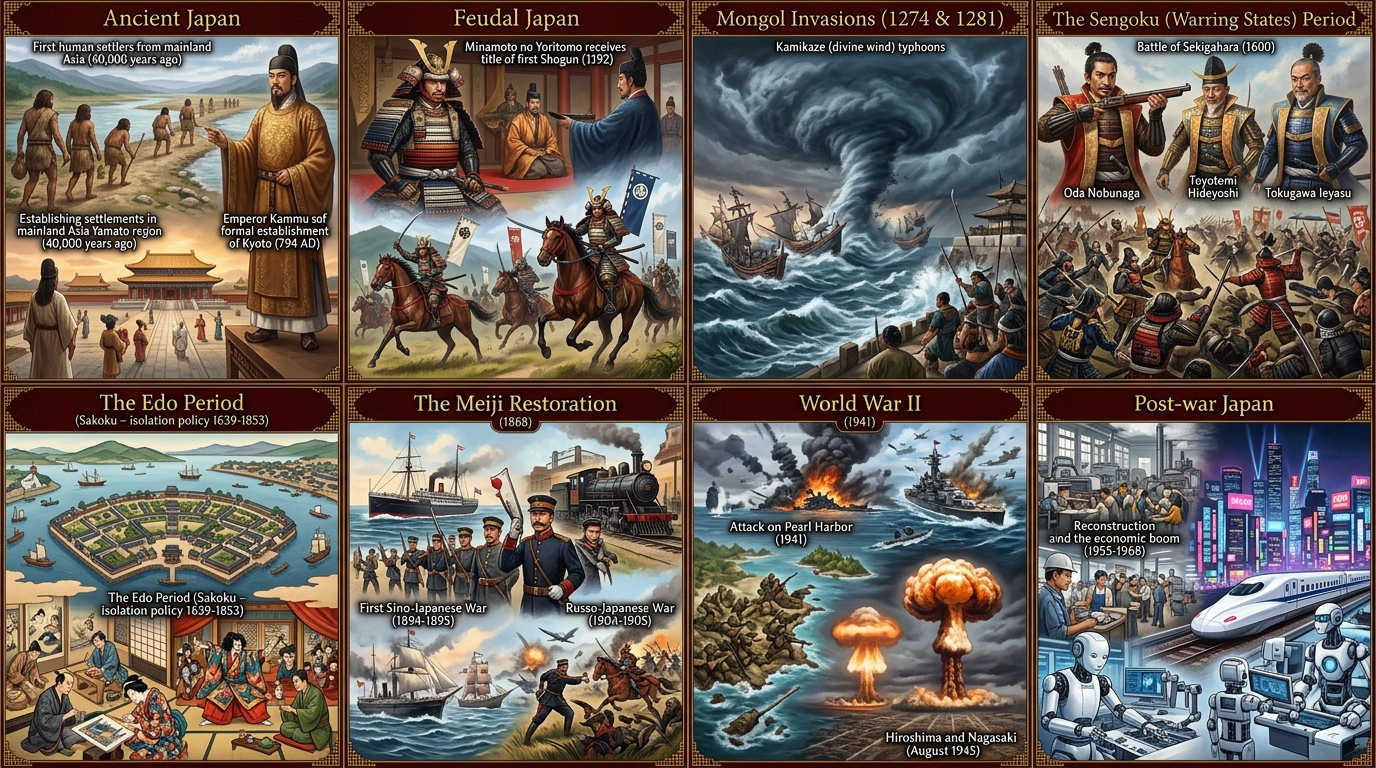
The islands that form modern Japan have been inhabited for almost 40,000 years, with the first human settlers migrating from mainland Asia. These early inhabitants brought with them skills such as agriculture and metallurgy, which established permanent settlements and eventually the foundations of early kingdoms.
By the third century AD, a significant part of southern Japan had been unified around the Yamato region under a system ruled by a king known as the emperor. Much of Japan’s early history was shaped and influenced by the cultures of mainland Asia, with Buddhism introduced from Korea in 552, and later a series of reforms known as the Taika Reforms implemented in 645 to reshape the country’s political landscape and mirror the Chinese system based on an imperial court.
This court initially had no permanent home and moved to a different location with each passing emperor, until in 794 Emperor Kammu decided to fix the capital in one place, present day Kyoto, thus beginning the Heian period, which lasted for almost 400 years.
Over time, however, the imperial court became magnificent and too focused on internal politics, neglecting the proper governance of the country outside the capital, and as a result greatly weakening its authority. Consequently, the land that was previously under the emperor’s control gradually slipped into the hands of local nobility, giving rise to a feudal system where power was decentralized and not centered on the imperial court in Kyoto.
This decline in the state’s central authority gave powerful regional warrior clans, such as the Taira and Minamoto, the opportunity to grow strong with the military power of their samurai warriors. They eventually succeeded in challenging the emperor’s dominance during the Heiji Rebellion of 1160, which began over the dispute of who should be heir to the imperial throne. This in turn grew into the Genpei War of 1180 to 1185, in which the Minamoto clan, under the leadership of its faction leader Yoritomo, eventually triumphed over its rivals and afterwards established a new and separate military government in the city of Kamakura, away from the imperial court in Kyoto.
Yoritomo went further and persuaded Emperor Go-Toba to grant him the title of Shogun, or great general, in 1192, making him effectively the de facto ruler of all Japan, and beginning an era of military rule called the Shogunate, which lasted for the next 700 years.
The divine wind that bought time
The samurai’s fighting abilities were to be tested once again at the beginning of the thirteenth century, when one of the largest empires in history turned its attention to conquering Japan. In 1265, the Mongol Empire, headed by Kublai Khan, demanded that Japan submit to it as a vassal, but when no answer was received, the Mongol leader began planning a full scale invasion of the country.
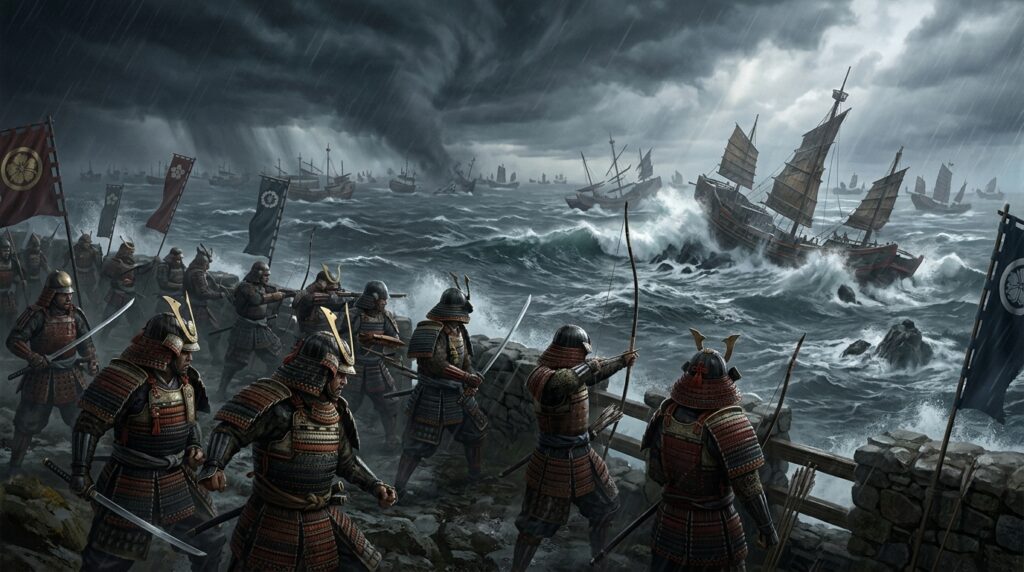
Mongol forces landed on the island of Kyushu in 1274, and were met by a determined, although significantly smaller, samurai army. Despite being heavily outnumbered, the tide of war turned in favor of the Japanese defenders when a powerful storm, called Kamikaze or divine wind, suddenly came to the region and practically destroyed the entire Mongol fleet. The Mongols tried to attack a second time in 1281, but surprisingly saw exactly the same fate that had befallen their predecessors 7 years earlier: their forces were swept away by another storm.
Although they had successfully averted the threat of invasion, Japan’s defensive efforts had nevertheless nearly bankrupted the shogunate’s treasury, and as a result many samurai were not paid for their services. This soured relations between the military government and the samurai clans greatly, and so in 1333 Emperor Go-Daigo began a rebellion aimed at returning power to him as emperor and to the imperial court in Kyoto.
Despite succeeding in this effort, this state did not last long, because only 5 years later, in 1338, Go-Daigo was himself deposed in another rebellion, which restored the power of the shogun under the new leadership of Ashikaga Takauji.
Although the shogun’s authority had been restored, real power within Japan remained with the regional samurai clans, whose feudal lords, called Daimyo, controlled the land directly for themselves. These clans often formed alliances and plotted against each other to change the balance of power within the country as they wished, which often resulted in open civil war.
The most violent of these conflicts began in 1467, with the Onin War fought to decide who would succeed the ruling shogun Ashikaga Yoshimasa. The daimyos took sides in this conflict and effectively caused the feudal system to collapse, turning the country into a cluster of small autonomous states.
This turbulent time, known in history as the Warring States Period or Sengoku Period, continued into the sixteenth century, and saw many important military developments, such as the emergence of the Ninja, who performed secret assassinations and espionage missions, as well as the deployment of warrior Buddhist monks, called Sohei, on the battlefield.
However, a pattern shift in fighting occurred in 1543, when a Portuguese trading ship strayed onto the island of Tanegashima just south of Kyushu. The three Portuguese merchants aboard were the first Europeans to set foot in Japan, and they quickly established trade relations as part of the wider Portuguese trade network spanning most of the Indo-Pacific region.
Once a year, the Black Ship, as the Japanese called the Portuguese ship, came to shore to buy and sell goods. Among them, the most important were European muskets. These weapons were previously completely unknown to the Japanese, and as a result they quickly proved popular among the quarreling daimyos seeking strategic advantage over their opponents, so much so that by 1556, more than 300,000 firearms were in use in the ongoing civil war.
Similarly, the Portuguese introduced Christianity to Japan, which greatly benefited their trade operations: new converts were given preferential treatment in the ability to buy guns, and in some cases direct military assistance was provided by the Portuguese themselves.
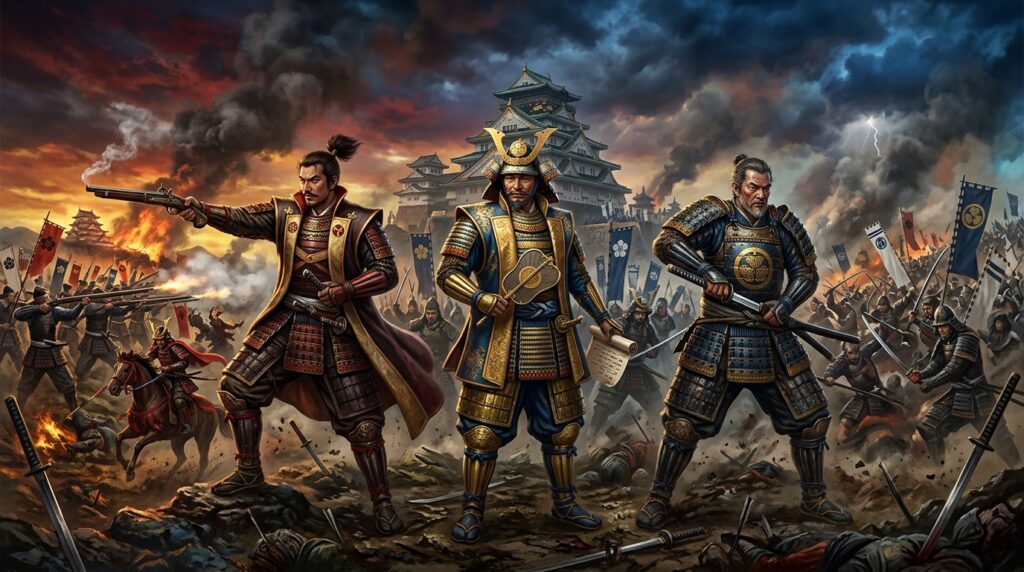
One of the most prominent daimyos cooperating with the Portuguese was Oda Nobunaga, who although he did not accept Christianity, used the technical superiority of European gunpowder weapons to great effect and began unifying Japan under his rule.
During the final stages of his power grab in 1582, however, Nobunaga was ambushed and killed. Immediately after, one of his followers, Toyotomi Hideyoshi, took his place, a man of humble peasant origin who rose through the ranks in the army to become a samurai daimyo, and who completed his former master’s ambitions and unified the country.
Despite being the de facto ruler of unified Japan, Hideyoshi did not take the office of shogun, perhaps because of his peasant background, and instead ruled as Kampaku, imperial regent, as well as Daijo Daijin, Chancellor of State. He intended to bestow these titles on his son Toyotomi Hideyori. However, since he was still only a child, Hideyoshi asked his five most trusted subordinates to remain loyal to his infant son until he was old enough to take power.
As soon as Hideyoshi died in 1598, however, civil war began once again among the Japanese daimyos, with Hideyori’s allies on one side, and those loyal to Tokugawa Ieyasu, who had previously been loyal to Hideyoshi, on the other side.
The decisive battle took place in 1600 at Sekigahara, in which Ieyasu triumphed over his rivals, beginning a new era for Japan under the Tokugawa Shogunate, which continued uninterrupted for 268 years.
The closed country that flourished
This period, also known by its Edo Period name, because the shogunate government had moved to the city of Edo, present day Tokyo, is perhaps the most definitive period of Japanese history. The relative peace and stability that came to the country allowed Japanese culture, arts, and economy to flourish in an era of prosperity.
This, however, came at a price, because the Tokugawa Shogunate introduced strict measures of harsh punishments to crush any possible form of social unrest, and imposed severe restrictions on the further spread of Christianity in Japan, before finally expelling it completely in 1638.
To prevent any other foreign influences from taking hold in the country, the third Tokugawa shogun, Tokugawa Iemitsu, introduced in 1639 the policy known as Sakoku, which effectively closed the country to outsiders, and prohibited any Japanese person from traveling abroad, returning from overseas, or building ocean-going ships.
Limited trade was allowed only with neighboring China and Korea, and the only Europeans given a trade license were the Dutch, who were confined to the small island of Dejima near Nagasaki.
The remainder of the seventeenth century saw Japan prosperous and flourishing under successive Tokugawa Shogunates, with the population doubling to 30 million, and the government building roads and schools to greatly improve the country’s socio-economic output.
However, by the late 1700s and early 1800s, cracks began appearing in the shogunate’s power. The rapid growth in agriculture, which had defined the early years of the Edo period, had stalled, and the government’s response to the devastating famines during the 1830s was severely inadequate.
While all this was happening, some Western ideas slowly began taking hold in the country, thanks to the introduction of Dutch books covering the latest European scientific discoveries, translated into Japanese and distributed from their trading base at Dejima.
The black ships that ended the world
Japan’s period of isolation ended abruptly in 1853, when a fleet of American warships led by Commodore Matthew Perry arrived in Edo Bay. The American government wanted Japan’s ports opened for international trade, and if necessary was prepared to use military force to achieve this purpose.
Unable to match the superior firepower of the American forces, the shogun reluctantly agreed to Perry’s demands and opened the country to American trade interests, later extending this policy to other Western powers, such as Britain and Russia.
This apparent submission to Western powers angered many within Japan, especially from the southern provinces of Choshu and Satsuma. They quickly formed an alliance, and in 1868 persuaded the young Emperor Meiji to issue an order ending the Tokugawa Shogunate.
The armies of Choshu and Satsuma then marched toward Edo, starting the Boshin War and ultimately ending the shogunate. Afterwards the emperor regained supreme power over the country, marking an important change in Japan’s governance.
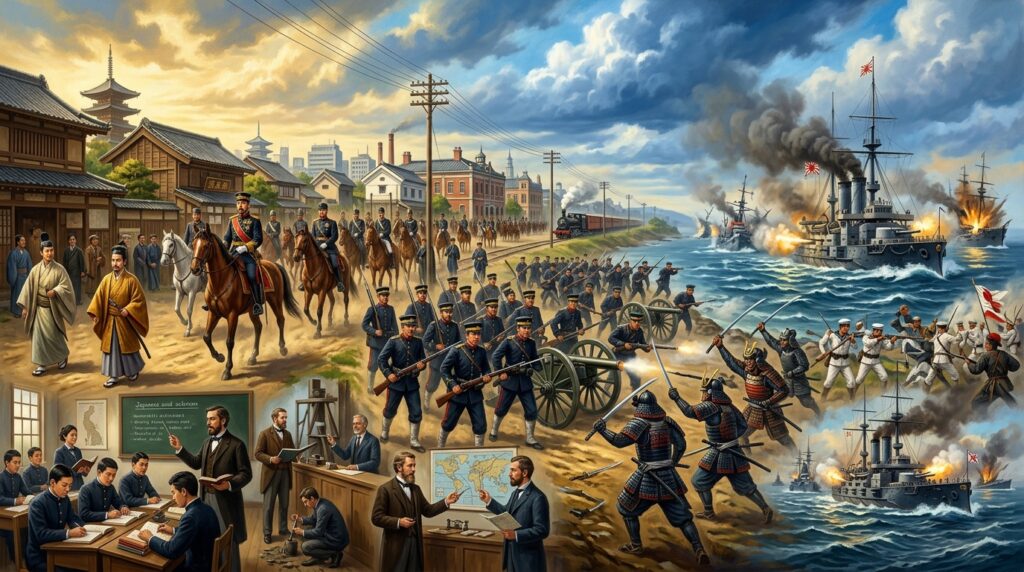
In 1869, the imperial court moved to Edo, which was renamed Tokyo, and officially signaled the start of the Meiji Restoration. It saw Japan embark on a new journey toward modernity, aiming to become a full nation-state equal to the Western powers.
Under the Meiji government, modernizing infrastructure was prioritized: railways, telegraph lines, along with the introduction of a universal education system, and the ban on Christianity was lifted. The government also acquired the expertise of hundreds of advisors from Western nations, who shared their knowledge in various fields such as mining, banking, law, and transport to further advance Japan’s modernization efforts.
A special area of focus was the military, which significantly adopted the latest Western strategies and technologies. In 1877, this updated army was deployed to crush the Satsuma Rebellion, started due to the grievances of local samurai who saw their role as the nation’s traditional warrior force made obsolete compared to the modern standing army.
Japan’s new military power was also used, in an attempt to replicate the colonial possessions of many Western powers of the time, to expand the country’s territory overseas. After gaining control of Hokkaido and annexing the Ryukyu Islands, Japan turned its attention to China and Korea.
In the First Sino-Japanese War of 1894 to 1895, Japan’s highly motivated and well-led forces won a splendid victory over the large army of Qing China, resulting in the successful annexation of Taiwan.
In 1902, Japan signed an important military alliance with Britain to counter the growing threat from Russian expansion in the region. The inevitable clash with Russia finally occurred in the Battle of the Yalu River, which marked the first time in decades that an Asian power had defeated a Western power.
The Russo-Japanese War of 1904 to 1905 concluded at the dramatic front of the Battle of Tsushima, in which Japan’s newly built navy practically annihilated its Russian opponents.
These military successes allowed Japan to annex Korea in 1910 and further consolidate its dominance across the region, thus positioning itself not only as a regional power, but now as a prominent Asian power globally.
Motivated by these recent military victories and desires for further expansion in the Asia-Pacific region, Japan joined the Allies in World War I, aiming to gain new colonies in the South Pacific nominally under German control.
After the war ended, Japan participated in the Treaty of Versailles and enjoyed international relations, further strengthened by its membership in the League of Nations.
However, like many other countries in the post-war period, a growing nationalist and fascist-influenced sentiment began taking hold within Japanese society, especially within the military, whose expansionist ambitions rapidly became bolder.
These ambitions triggered the start of the Second Sino-Japanese War in 1937, which saw further territorial acquisitions on the Chinese mainland and growing international distrust of Japan’s intentions in the region.
The second reinvention
Alarmed by this aggression and growing expansionism, the United States imposed severe economic sanctions on Japan to obstruct further war efforts.
With the start of World War II in 1939, Japan felt the need to geopolitically realign itself with other nations holding similar expansionist ideas, and as a result allied with Germany and Italy in 1940, which further worsened its relations with the United States.
Japan also alienated other Western powers, such as Britain, the Netherlands, and France, by seizing more territory in Southeast Asia and interfering in the colonial possessions of European powers.
Finally, however, under the leadership of Prime Minister and General Hideki Tojo, Japan’s government decided that it would need a preemptive strike against the United States if it was to end the economic sanctions imposed on it and secure its recent territorial acquisitions in the Pacific.
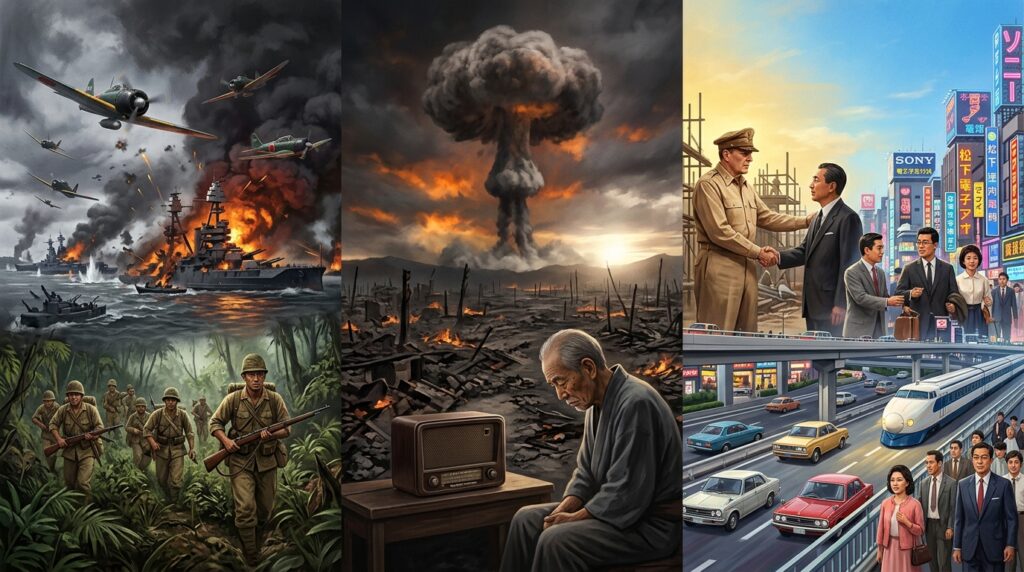
On 7 December 1941, the Imperial Japanese Navy launched a surprise attack on the American naval fleet stationed at Pearl Harbor, Hawaii. This attack provoked the United States to enter World War II on the Allied side and begin military operations against the Empire of Japan, which by then had also conquered other areas in Asia, including the Philippines, Malaya, Hong Kong, Singapore, Burma, and the Dutch East Indies.
The Allies, led by the United States, engaged in an intense and prolonged conflict against Japanese forces across the Pacific. One of the key objectives was securing small islands with strategically placed airfields, which could be used to launch bombing raids on the Japanese mainland.
However, the growing costliness and slow progress of the fighting made the United States realize that a land invasion of Japan itself would result in countless losses for their troops. As a result, they decided to use a newly developed secret weapon to force Japan to surrender.
On 6 and 9 August 1945, the United States dropped two atomic bombs on the cities of Hiroshima and Nagasaki, killing more than 100,000 people.
Japan’s surrender was communicated to the Allies on 14 August, and the next day Emperor Hirohito publicly announced it on national radio.
With the end of the war, Japan came under the occupation of Allied forces led by General Douglas MacArthur, who began the reconstruction process. The Japanese military was demilitarized, and the government went through a democratization process, although Emperor Hirohito was allowed to remain in office, but was required to publicly renounce his divine status, which had become a central pillar of the State Shinto religious system.
Under the guidance of Prime Minister Shigeru Yoshida, Japan turned its attention to economic development rather than pursuing an ambitious foreign policy.
By 1955, the Japanese economy had surpassed its pre-war level, and by 1968, it had emerged as the world’s second largest capitalist economy. In the following decades Japan established itself as a world leader in automobile manufacturing and a major player in the electronics industry, resulting in an economic boom supported by Japanese-made consumer goods.
All this post-war economic activity helped shape Japan into the successful nation it is today, a nation ranking high on almost every measure of global production and development, from economics to technology and even life expectancy. All this was due to the hardworking work ethic and perseverance of the Japanese people, who, after suffering during the final stages of the world’s most devastating conflict, decided to take a completely different path toward rebuilding a modern nation-state free of past rivalries, divisions, and inequalities.
Closed for 200 years, opened by force, rebuilt from ashes. Japan’s history is one country reinventing itself, again and again. The land of the rising sun keeps rising.