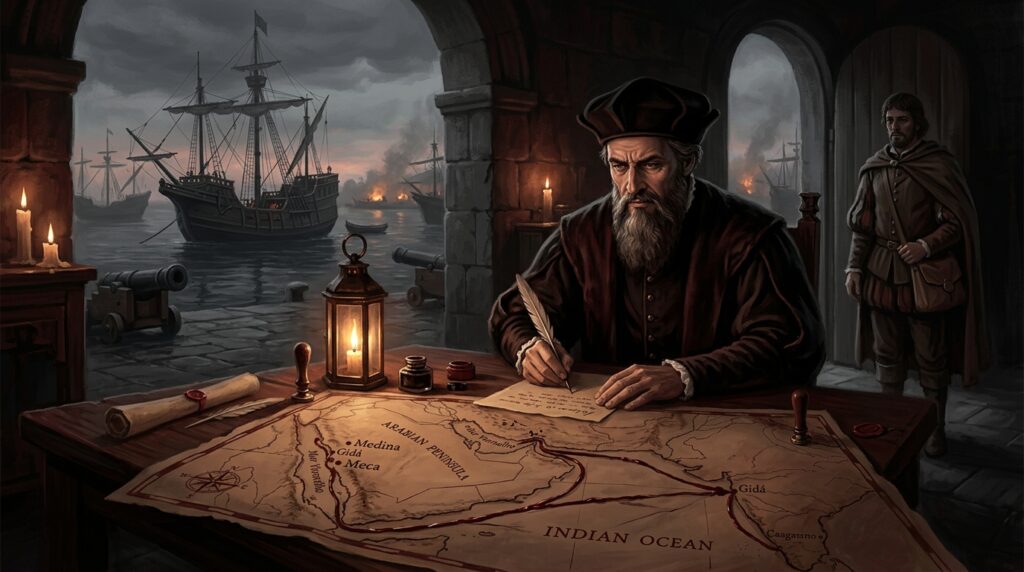
In 1513, the Portuguese naval commander Afonso de Albuquerque, off the coast of India, was writing a letter to his king, Manuel I, in Lisbon. That letter contained a plan that still makes the blood boil to read. The Portuguese commander intended to enter the Red Sea, attack Jeddah, and from there attack Mecca and Medina. Destroy both cities and take the blessed body of the Prophet Muhammad, peace be upon him, from the sacred tomb, and carry it away. And declare that until Muslims vacated the Holy Land, until they left Palestine, the Prophet’s blessed body would not be returned to them.
And do you know that in the Islamic world there was no power that could stop this diabolical plan? Mecca and Medina were under the protection of Egypt’s Mamluk sultanate, but they had no modern navy that could match the Europeans.
Yet this diabolical plan still failed. How? Because while this plan was being made, thousands of kilometers away, a king had reached Constantinople whom even his own people called Yavuz, meaning the Grim. He who had snatched the throne from his father, had all his brothers killed, and their children too, because he believed there is no kinship among princes, and the state stands above even blood relations.
This was the ninth Ottoman sultan, Selim I, whom history calls Yavuz Sultan Selim. His eight year reign redrew the map of the Islamic world, and this is why it mattered.
The letter that explains everything
Keep that letter in mind, because it explains Selim’s whole reign. The threat to the Islamic world in the early sixteenth century did not come from one direction. It came from three: the Safavids in the east, the Mamluks in the south, and the Portuguese at sea. And the man who stopped all three did it in just eight years.
It was the beginning of the sixteenth century. The map of the world was changing very fast, and the Ottoman Empire, which had become a great power after the conquest of Constantinople, now faced a power vacuum. The Conqueror’s dervish-like son Bayezid II sat on the throne, a peace loving man, Sufi by nature. But kingship does not run on dervishhood. It runs on power and fear.
When one family rules millions of people, many factors keep that rule in place, but the biggest reason is fear. A pious king like Bayezid had no idea which way the situation in the Middle East was heading, especially how great a threat the Safavid Empire was to the state.
Although Safavid proxies were fully active inside the Ottoman Empire, raising revolts, Bayezid, instead of fighting a direct war against them, believed in diplomacy.
And in these circumstances, the only person in the royal family who was not satisfied was Prince Selim. A man of a completely different mindset, who considered the Safavids the greatest threat to the Ottomans, and demanded that extreme measures be taken against them.
The son who deposed his father
But Bayezid did not listen. On the contrary, he decided to make his elder son Prince Ahmed the crown prince. Selim thought that if Ahmed became sultan, the state would grow weaker still, and this was proved in 1511, when the Shah Quli revolt broke out in Anatolia. Prince Ahmed then had the best opportunity: crush the rebels and prove his strength. But like his father, he believed in diplomacy.
Now it was completely clear to the Safavids that the Ottoman Empire was in no condition at all to clash with them. And Prince Selim could clearly see that if Ahmed became sultan, the empire would fall to pieces.
So he decided, and declared a revolt against his father. For the first time in Ottoman history, a sultan and a prince stood facing each other with drawn swords.
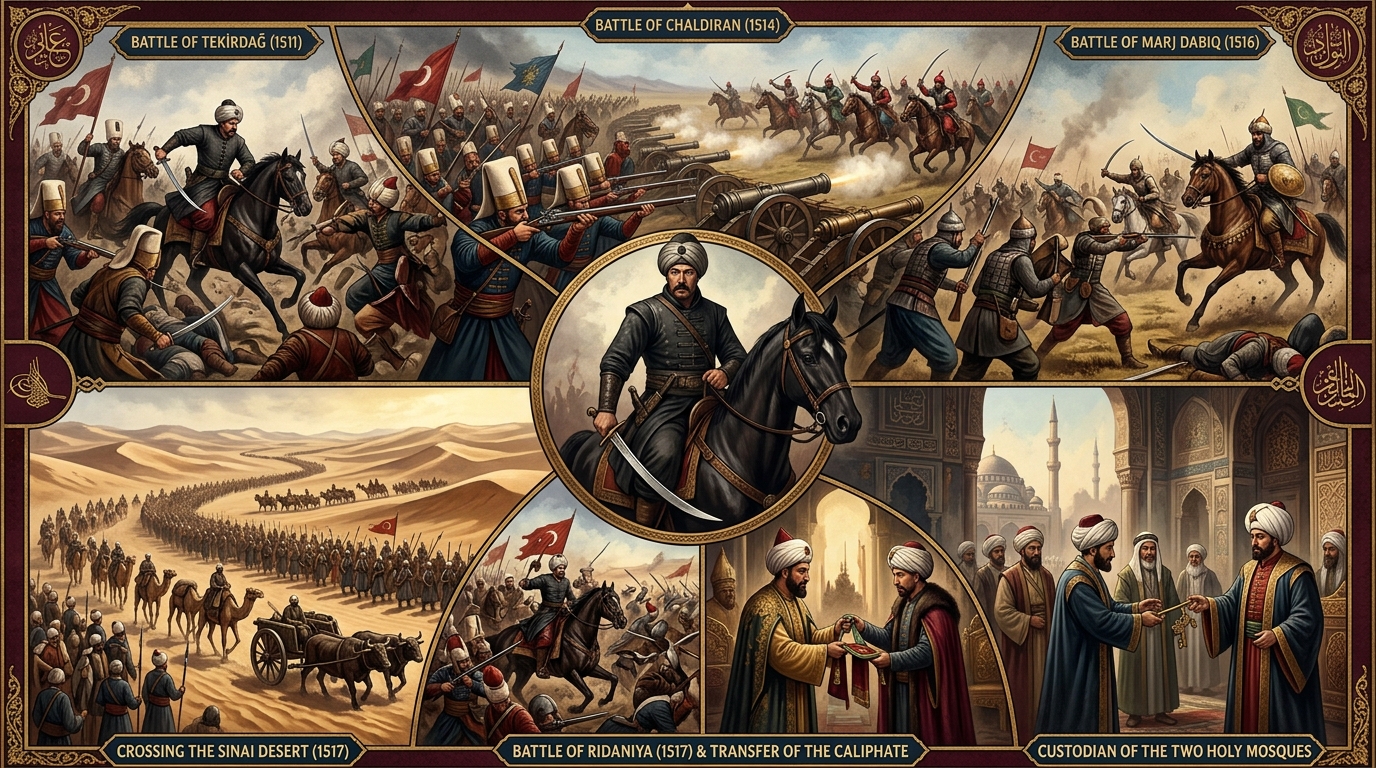
In August 1511, the Battle of Tekirdag took place. Selim was badly defeated. He barely escaped with his life. But who knew that this would be his first and last battle that he lost. Because that very defeat made Selim more dangerous than before.
And Bayezid II fully realized that if he delayed even slightly, the situation in Constantinople would change. He immediately summoned Prince Ahmed to the capital, so that by making him crown prince, Selim’s path could be blocked. But he did not know that there was an agent in his state who was with Selim.
The most powerful part of the Ottoman army, the Janissaries, the world’s first standing army, supported Selim over Ahmed. And before Ahmed could reach Constantinople, the Janissaries revolted in the city. In the streets there was only one slogan: “Our sultan is only Selim!”
Open clashes began between supporters of Ahmed and supporters of Selim. Understand it as an open war in the city, and before Prince Ahmed arrived, the capital was captured by the pro-Selim army.
In April 1512, Selim entered Constantinople triumphantly, and ended the rule of his father Bayezid. For the first time in Ottoman history, a son deposed his father from the throne.
In these circumstances, Selim’s brothers declared revolt. Prince Ahmed is said to have even begun efforts to ally with Shah Ismail Safavi. Now Selim had no choice but to fight his elder brother. And then he defeated all his brothers one by one, and gave the order for which the world still calls him Yavuz.
He had not only his brothers killed, but several nephews as well. This was an old Ottoman law, made by Selim’s grandfather Sultan Mehmed the Conqueror: that to save order and the state, a new sultan could kill his brothers.
Whatever the reason, no matter how great a scholar you ask, even the Sheikh al-Islam himself gave a fatwa: legally and morally, until a person descends into open rebellion, the state cannot touch him. But this was monarchy, brother. Whoever held power seized the throne, and then whatever left his mouth was the state.
So on the king’s order alone, brothers in the Ottoman Empire, and even infant children, were killed, only so that no revolt could happen in the future.
Selim’s reign had begun. Whoever could become a threat to his rule was killed, whether brothers, nephews, viziers, whoever came in the way of the state was eliminated.
Chaldiran, emotion against gunpowder
This was the era when the struggle for power in the region took a new form. The question was: who would be the region’s real power? The Sunni Ottoman Empire, or the Shia Safavid Empire?
Sultan Selim knew well that if the Safavids were not stopped, it would take only a few years, and their king Ismail I would be standing at the gates of Constantinople, and no one would be able to defeat him. Because he was young, charismatic, very brave too, and then he had an army that would give its life at his single gesture: the Qizilbash. No ordinary soldiers. Extremely emotional, fast, and extraordinary warriors.
And Selim’s danger was not only from Ismail’s military power. He was also worried because Ismail was using the angry elements present in their territory, interfering in the internal affairs of the Ottoman Empire, supporting Prince Ahmed against Selim. And many other factors had decided that now there would be a clash.
And before the battlefield, war happened between the two in letters. Selim wrote the first letter in Persian:
“We who are God’s caliph in this world, near and far, Solomon of glory, Alexander of greatness, conqueror in battle, victorious like Faridun, killer of the wicked and unbelievers, protector of the pious and righteous, fighter in the path of truth, defender of the faith, champion, conqueror, lion, son and grandson of the lion, banner bearer of justice and equity, Sultan Selim Shah son of Sultan Bayezid son of Sultan Mehmed Khan, address Prince Ismail, master of the land of tyranny and error, captain of the wicked, chief of evildoers, usurper Darius of the age, tyrant Zahhak of the age, equal of Cain.”
In this letter Sultan Selim accused Shah Ismail of destroying mosques, massacring Sunni Muslims, and gave him a final chance to repent, become Sunni, and hand his empire over to the Ottomans.
What answer should Ismail have given to this letter? Yes, eye for an eye. It was placed on an even higher level of narcissism. Ismail’s followers considered him not only the shadow of God, but God himself.
So he replied, and replied very quickly:
“Those were good days too, when Sultan Bayezid II was ruler. Ottomans and Safavids lived in peace. If I had wanted, I could have attacked Anatolia long ago, but I did not do so, because the people there are my subjects anyway, so what need is there to attack?”
And at the end he also wrote: “The tone of the letter is not a king’s. It seems as if written by a drunken clerk.” And with this letter he also sent a gold box containing the finest opium, saying: “If you are addicted to it, use this!”
Sultan Selim replied, attacking Ismail’s manhood, saying: “Come to the field wearing a veil like women.”
After such royal rhetoric, all paths to reconciliation were closed. Now all roads, all caravans were going in one direction: toward the plain of Chaldiran.
There was a problem in this war of egos between Selim and Ismail: thousands of kilometers lay between the two, flat Anatolian and then difficult mountain routes, and for Selim, taking a large army and maintaining supply lines to the border was no easy task.
This war was more a game of logistics than of swordplay, and here Selim proved that he was not an angry young man like Ismail, but a mind, a military genius.
He built a supply chain system such as no army of that era had. Along the border with Iran, he had depots of grain and weapons built, and through the sea route, via the Black Sea, he linked the supply lines to the land routes.
The logistics test was passed, and Selim set out with his army, and reached the plain of Chaldiran, which even today lies along the Turkey-Iran border.
Here on one side was Shah Ismail’s army, the Qizilbash, who had never lost a battle, who prided themselves on their speed, and above all, they had complete faith in Shah Ismail. Storms came before them, winds came, floods came. They were ready to crash into everything.
While on the other side was Selim, who had traveled more than 1,500 kilometers, dragging his army across all of Anatolia to stand at the enemy’s door. But he had not only passion, he also had a battle plan.
In August 1514, on the plain of Chaldiran, Selim had the most dangerous and lethal weapon of his age: gunpowder. And more dangerous than that was Selim’s mind.
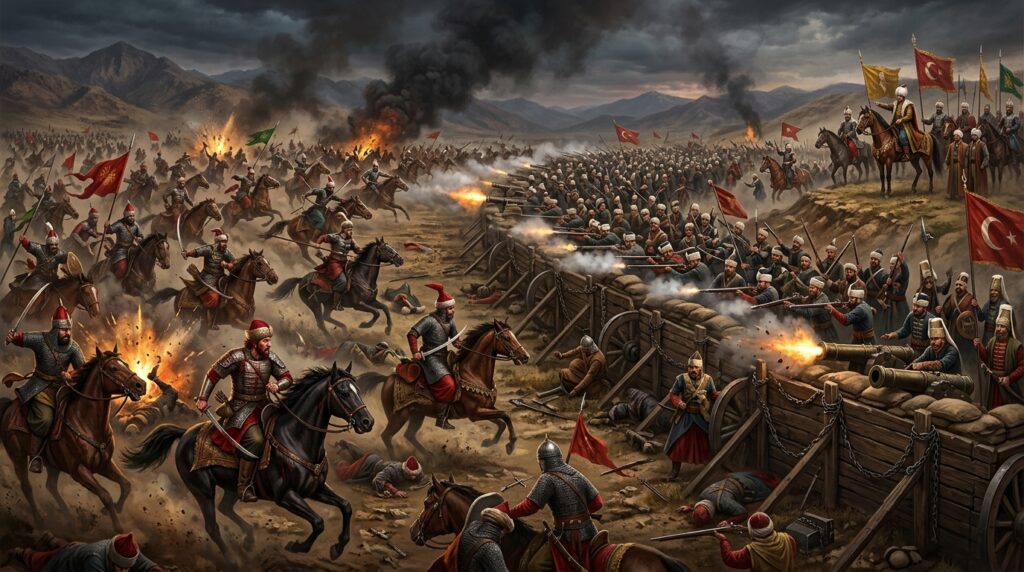
He adopted a brilliant tactic, called in English Tabur Cengi, the wagon fort. The ox carts carrying supplies were placed face to face, bound to each other with thick iron chains, and hidden between those same carts were Ottoman artillery and 12,000 Janissary soldiers with modern matchlock muskets.
Understand Chaldiran as a clash of emotion and technology.
Then the battle began. The Qizilbash broke upon the Ottomans like a storm! Their speed, their passion, and their bravery were such that wherever they went, they wreaked destruction. But Selim’s order was: hold the lines! Until the Safavid army came close, no one would attack.
And then that moment came. As soon as the Safavid cavalry came within Ottoman firing range, at a signal from Selim, thousands of explosions erupted from the wagon fort. Cannonballs from cannons and bullets from guns began to rain down. The field filled with explosions and smoke, and among them the brave Qizilbash fell one by one.
This was the death of the sword, and the beginning of modern warfare tactics.
Shah Ismail’s army, which had never lost a battle, was now forced to flee the field. Even Shah Ismail himself was badly wounded, and barely escaped with his life, leaving his army, his treasure, his tents, and even his favorite wife on the battlefield.
That is why the defeat at Chaldiran ended all the joys of Ismail’s life. He wore black clothes, drowned himself in wine, and died ten years later at the age of 36.
Selim had eliminated the greatest threat to his state, but the mission was not yet complete.
The desert no conqueror crossed
In this era there was another power on the map of the Muslim world, which considered the Ottomans not its rival but its subordinate. These were the ones whom even the Mongols could not defeat. These were the ones who held the keys of Mecca, Medina, and Jerusalem, and in whose grip the Abbasid caliph also was. These were the Mamluks of Egypt.
Between these two powers was a barrier, crossing which was like inviting death. That desert which even great conquerors could not cross. Could Selim cross it? Or would the Sinai desert become the graveyard of the Ottoman army?
The powerful Mamluk sultanate of Egypt and Syria considered itself the protector of Islam, and the Ottomans merely border guards. When war was going on between Selim and Ismail, the Mamluks were against the Ottomans. In fact, they had long been interfering in the internal affairs of the Ottoman Empire. When Selim’s father Bayezid II became sultan, Prince Cem Sultan had their full support against him.
Selim believed that as long as there were Safavids in the east and Mamluks in the south, we could never advance in Europe. So it was necessary that after dealing with one threat, the other should also be finished, and the path to Europe cleared.
So in 1516, the first great battle between the Ottomans and the Mamluks took place in today’s Syria: the Battle of Marj Dabiq, which decided that the Middle East now belonged only to the Ottomans. The keys of the first of the three holiest sites were now in Selim’s hands.
But the Mamluks were not finished yet, and could not be. For that, Selim would have to go to Cairo, but in between was the world’s most dangerous barrier: the Sinai desert.
Egypt’s new Mamluk sultan Tuman Bay was certain that the Ottomans would never make this mistake. Selim was not so mad as to step into the desert with such a large army and heavy artillery. But he had not the slightest idea that Selim really was mad.
In January 1517, he gave the order, and thousands of soldiers, horses, 12 cannons, with 15,000 camels carrying water, all marched toward Cairo, and in only five days they reached Cairo from Gaza.
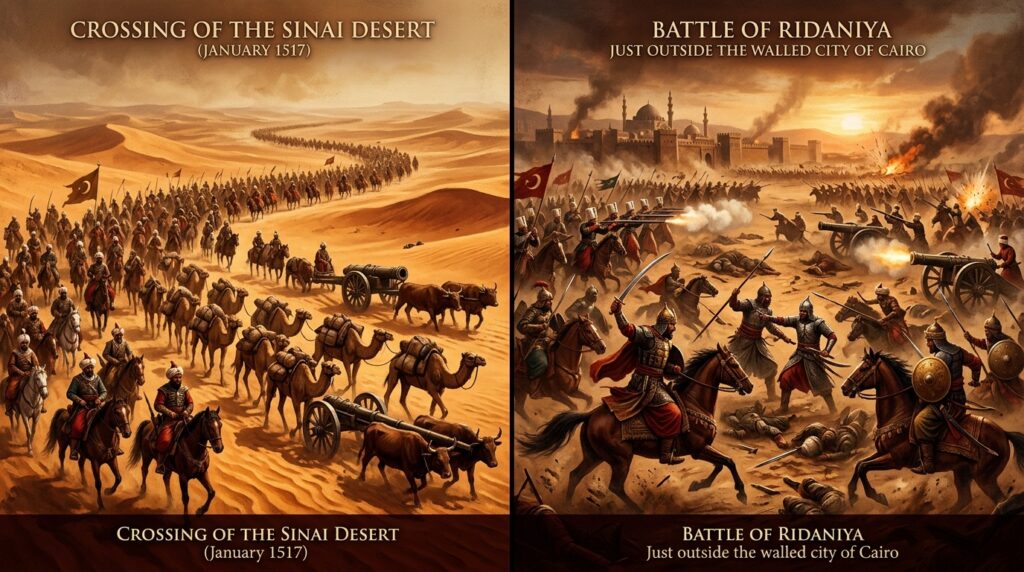
And then the two armies faced each other at Ridaniya. Tuman Bay and his army fought very bravely, so bravely that once Selim himself barely escaped death. But the truth is that there was no contest between the two armies. The Mamluks did not have a single gun, not a single cannon. They kept advancing, kept being cut down, kept dying, but like Shah Ismail, they considered even touching a gun cowardice, and suffered the consequences.
Ottoman firearms and Selim’s strategy ended the battle in just a few hours. Egypt was conquered, and another superpower lay at the Ottomans’ feet.
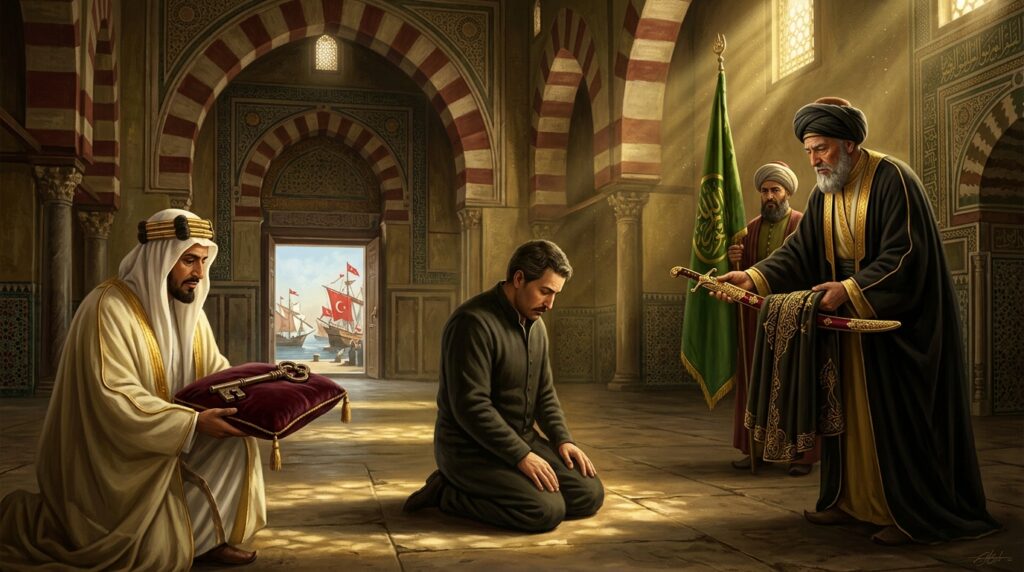
A few days later, Friday prayer was performed in Cairo’s mosque. A very precious carpet was laid for Sultan Selim, but he was a simple man. He had the carpet removed and prayed like ordinary worshippers.
Then right here, the last Abbasid caliph al-Mutawakkil III announced his abdication from the caliphate, and handed over a sword, a banner, and a cloak that he had to Selim. The caliphate passed from the Abbasids to the Ottoman house.
Then the Sharif of Mecca, Barakat ibn Muhammad, also presented Selim with the keys of the Kaaba, meaning Mecca and Medina had now come under Selim’s rule.
Now Selim was not just a sultan. He was Amir al-Mu’minin, the caliph of the Muslims, the Servant of the Two Holy Mosques. He had fulfilled the dream of Osman I: spread the empire across three continents, Europe, Asia, and Africa. Now he was the most powerful leader of the entire Islamic world.
The bill comes due
And believe it, at that time the Islamic world needed exactly such a leader. Why? Because at that time something was happening in the world that very few people knew about.
The fact is that if Selim had not conquered Egypt and Syria at that time, had not taken control of Mecca and Medina, perhaps today the history of Muslims would be something else.
Always keep one thing in mind when reading history: never read it in pieces. History is always connected. It is a very big puzzle, whose pieces can only be understood by putting them together.
Anyway, while Selim was fighting on the plains of Chaldiran and Ridaniya, in those very days, a very dangerous game had begun in the seas. After the fall of Granada in 1492, there was no one to stop Spain and Portugal. Their ships were searching for new sea routes. Trade routes were changing. But one thing is not told: that they did not just want to seize trade, they had started a new crusade.
The most dangerous commander of Portugal in this era was Afonso de Albuquerque, whose plan was something else entirely. Rather, it was a horrific and diabolical plan.
He wanted to enter the Red Sea, attack Jeddah, and then from there attack Mecca and Medina. His intention was to take the blessed body of the Prophet Muhammad, peace be upon him, from the Prophet’s Mosque, and declare that until Muslims vacated Palestine, until they left Jerusalem, we will not return it to them.
This is not a conspiracy theory. Albuquerque’s letters still exist today. This plan is mentioned in many books. The Christian world still calls him Afonso the Great, Lion of the Seas, Caesar of the East, Lord of the Indian Ocean, and what not, but in reality he was Islam’s greatest enemy.
Could a dying empire like the Mamluks have matched Afonso? They had no notable navy, while in contrast the Portuguese had modern ships fitted with cannons.
Now just think: if Selim had not conquered Egypt, had not taken control of Mecca and Medina, what would have happened? Those Portuguese who roamed freely in the Indian Ocean, who massacred Muslims on the coasts of Africa, who had reached India and captured Goa, and even further, camped at the Strait of Malacca in Indonesia, trying to take every important route into their grip, the Strait of Hormuz in the Persian Gulf, Bab el-Mandeb in Yemen. Would it have been difficult for them to attack Jeddah? Not at all.
But Selim’s success blocked the Portuguese path forever. Ottoman control of Egypt and the Hijaz, then the arrival of the Ottoman fleet in the Red Sea, made it very difficult for anyone to attempt any such move.
Whatever Selim was, whatever he did, his conquests saved not only the Ottoman Empire, but also the honor of the entire Muslim world.
In September 1520, after conquering the east and the south, Selim finally turned his steps toward the west. He started a campaign against Europe, but before that he fell ill. A boil had formed on his thigh. The royal physicians kept forbidding him, saying that in this condition you should not sit on a horse. But who could stand before Selim’s stubbornness? He did not want to show anyone that he was weak, so he rode out on horseback.
And only a few days into the journey, he died, at exactly the same spot where he had once fought his first battle against his father, and lost. Where Selim lost his only battle, at that same place he also lost the battle of life. At only 49 years of age.
Selim who was a warrior, Selim who was Yavuz, Selim who was also a poet. He once said:
“I am the king of the land of pain, calamity is my refuge. This boundless and endless grief is my army. Selim has become equal to dust in your street. You may say that he is the dust of my path.”
Sultan Selim loved a completely simple life, wore simple clothes. Once, seeing his son Suleiman, he said: “Son! If you wear such clothes, what will your mother wear?”
Yes, this is the same Suleiman who later took the Ottoman Empire to its peak, whom the world calls Suleiman the Magnificent, and that era is today called The Magnificent Century. It was the era whose foundations were laid in Selim’s eight year reign. If he had not existed, perhaps not only the Ottoman Empire’s, but the entire Islamic world’s map would have been something else.
But Sultan Selim’s name is still controversial in history today. Some people call him a murderer, a tyrant man, and one who shed the blood of his own people. But some people consider him the person who saved the Islamic world from falling to pieces. If he had not raised the sword against his own people, perhaps the empire would have broken apart. If he had not crossed the desert to go to Egypt, perhaps the holy places might not have remained safe.
The truth is that Selim paid the heavy price of kingship, bore the burden of his conscience, heard history’s curse, only so that his nation and his empire could survive, and his religion could live on.
Selim’s history also tells us another truth: that if a nation’s survival is at stake, it can only survive not as a dervish, but as a warrior.
Eight years, three threats, one empire saved, and a man who paid for it with his name.
Read also: The Mamluks The Slave Soldiers Who Saved Islamic Civilization from the Mongols