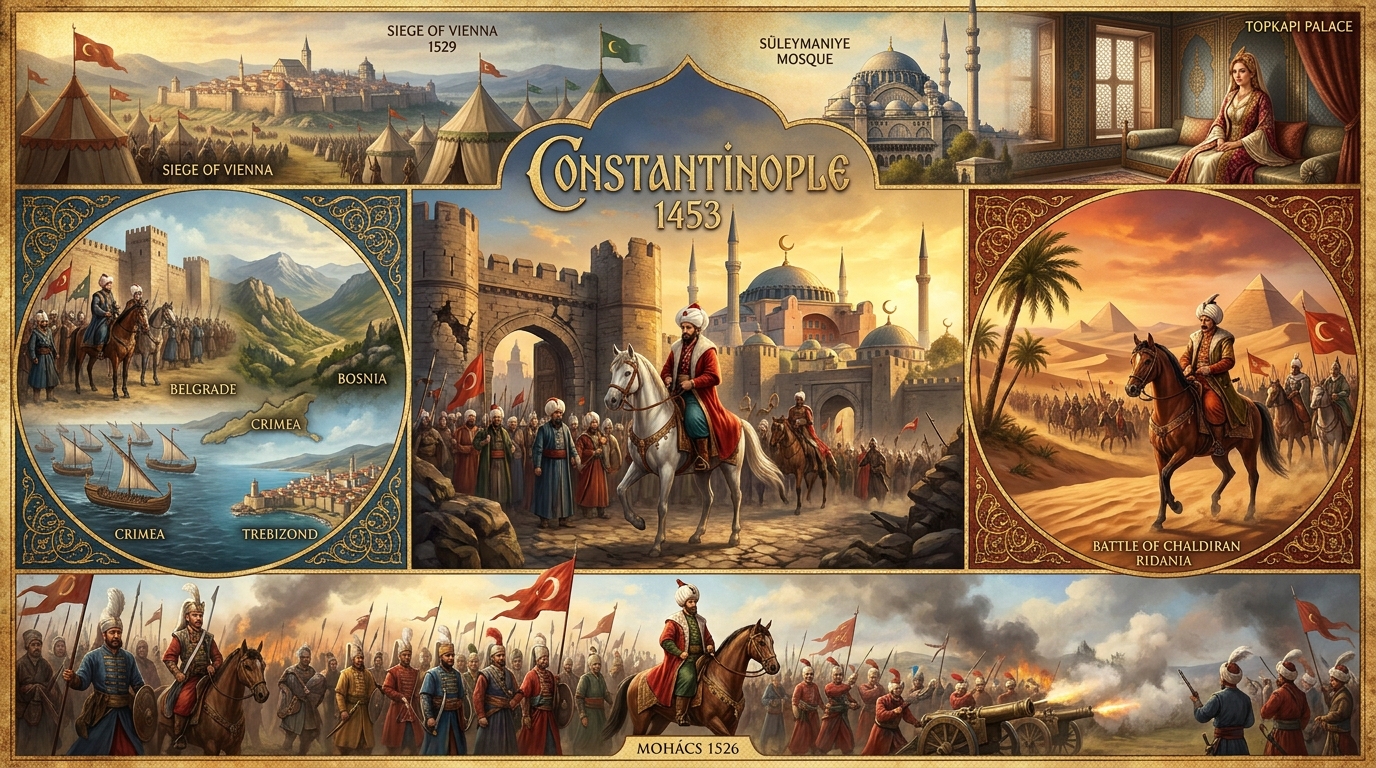
Suleiman’s reign is called the golden age of the Ottoman Empire. But the most interesting thing about it is not the conquests. It is that the same reign contains both the peak and the first cracks: the law, the art, and the wealth, and at the same time the palace politics that would poison succession and the first defeat that showed the war machine could be stopped. This article tells the story from the fall of Constantinople in 1453 to the end of Suleiman’s reign in 1566, and it shows how the golden age ended not with a collapse, but with a shift.
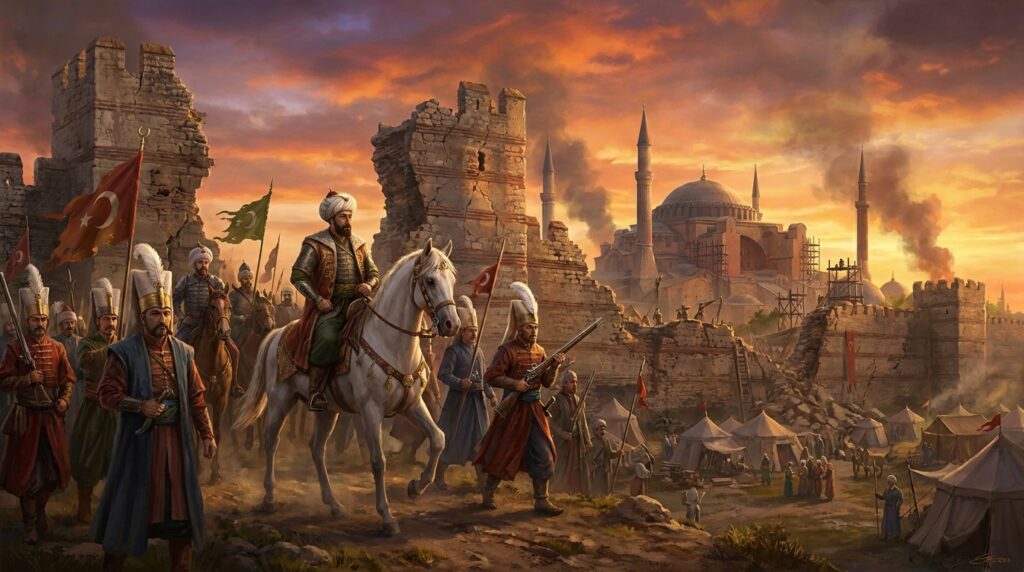
The city that became the world, 1453 to 1520
Mehmed II rebuilt and repopulated the new capital after 1453 and began to add glorious Islamic monuments to Constantinople’s rich architectural fabric, including the Topkapi Palace, the Grand Bazaar, and the Fatih mosque complex. His successors kept building. By the middle of the 1500s, Istanbul had once again become the heart of Mediterranean trade, as it had been in Byzantine times. The chief Ottoman architect Mimar Sinan turned the capital into a real jewel. His greatest masterpiece was the Suleymaniye Mosque, not only a place of worship but a symbol of the sultan’s power and the empire’s cultural superiority. Sinan also built the Sultan Suleiman Bridge in Istanbul and the Selimiye Mosque in Edirne.
By the middle of the 1500s, Istanbul was truly a global city. Turks, Greeks, Armenians, Jews, and Arabs lived together there. Different peoples, languages, and religions mixed, creating a unique environment of cultural exchange that no European capital could match. During this period, poetry, calligraphy, and the art of decoration flourished. Topkapi Palace was not only the sultan’s residence, but also a center of science and culture, home to the greatest artists and scholars of the age.
The lawgiver
Suleiman was more than a military leader. His title Kanuni speaks for itself. He created the Kanunname, a legal code that codified Ottoman law and brought reforms in administration and taxation, so that the empire would remain stable for centuries to come. By the middle of the 1500s, the Ottoman Empire had taken over vast territories. Suleiman became the most famous Muslim ruler and the most powerful king in Europe. In wealth and power, he even surpassed the rulers of Spain and the Holy Roman Emperor Charles V of Habsburg.
The Ottoman system, although strictly hierarchical, was relatively tolerant of different peoples and religions. The millet system maintained stability, which became the basis of the empire’s power. When the sultan focused on internal affairs, the empire’s borders remained secure. That tolerance and that law were the real machinery of the golden age, more durable than any single victory.
The conquests that made the peak
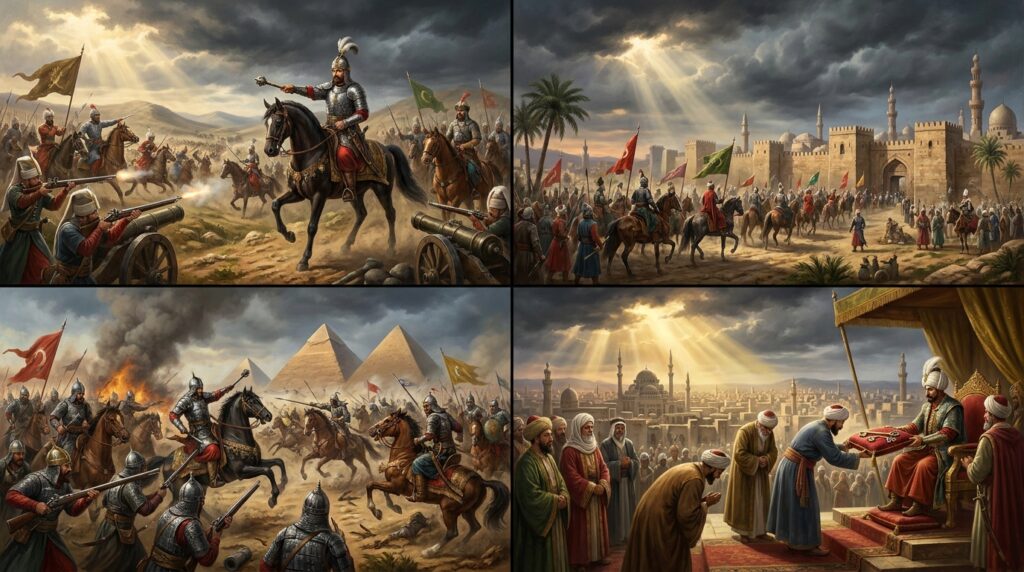
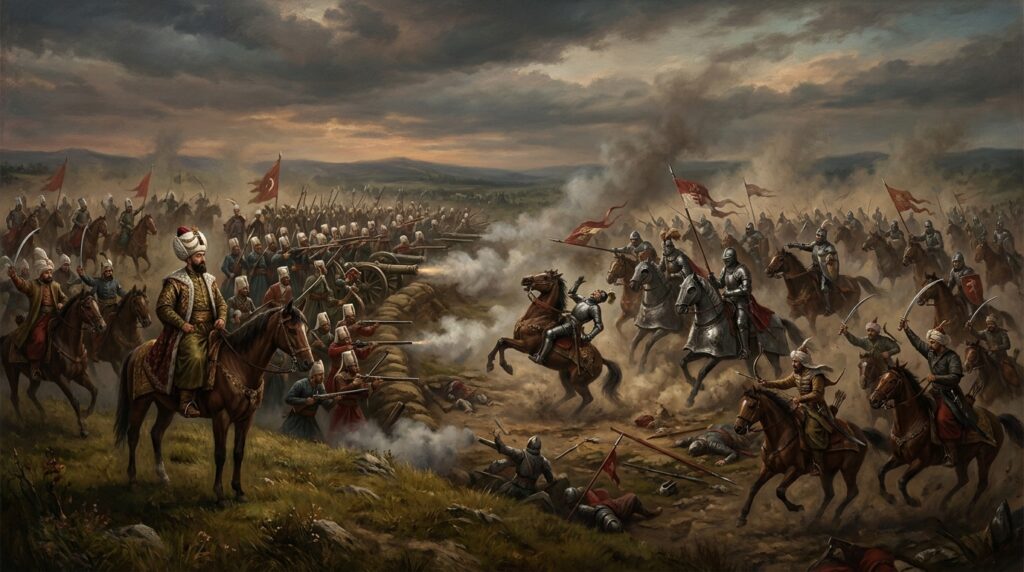
The foundation was laid by Selim I, called the Grim, who reigned from 1512 to 1520 and anchored Ottoman prestige in another great conquest, this time to the east, when he took control over Syria, Iraq, Egypt, and the holiest places of Islam, Mecca and Medina, in 1516 to 1517. Under his son Suleiman, who reigned from 1520 to 1566, the empire reached its greatest geographical expansion. Suleiman completed the conquest of most of the Balkans, took Belgrade in 1521 and Rhodes from the Knights of St John in 1522, shattered Hungary at Mohacs in 1526, and led his armies to the gates of Vienna, which he unsuccessfully besieged in 1529. He seized Tripoli in North Africa in 1551 and expanded into the Arabian peninsula and Iraq. By the end of his reign, Ottoman rule stretched from Hungary and the northern shores of the Black Sea to Egypt and Oman in the south, and from Algeria in the west to the shores of the Caspian Sea in the east.
The palace politics that poisoned succession
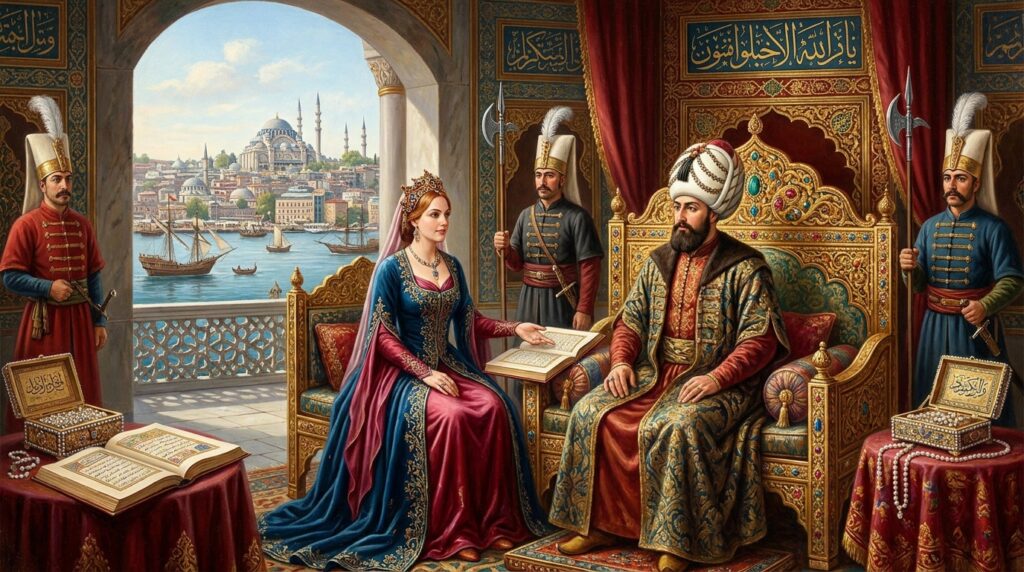
The first crack appeared inside the palace. It was Roxelana, Hurrem Sultan, who played an important role in the fall of the grand vizier Pargali Ibrahim Pasha, Suleiman’s most trusted advisor, who was executed in 1536 after 13 years of service on the sultan’s orders. Roxelana was also implicated in the incident of Prince Mustafa, Suleiman’s beloved son and popular heir, who was executed in 1553 in a military camp near Eregli. All these conspiracies were driven by Roxelana’s desire to put her own son Selim on the throne, and she succeeded. The story of Hurrem Sultan’s influence showed that even the most powerful ruler of his time could not escape the intrigues and enmities brewing inside his own palace.
That is the point that matters. For a century, Ottoman succession had been settled by the system: the strongest prince, the army, and the administration. Under Suleiman, succession began to be settled by harem intrigue. The empire would pay for that change for the next hundred years, as sultans raised inside the palace, guarded by favorites, replaced sultans raised on campaign.
The limits appear, 1550 to 1566
The second crack appeared on the battlefield and at the borders. In his final years, the tired Suleiman focused more on consolidation than expansion. In the 1550s, Suleiman strengthened Ottoman influence in North Africa, parts of Hungary, and the Red Sea. His long wars against Safavid Iran ended with the Peace of Amasya in 1555, which brought relative calm to the eastern provinces. The empire was no longer pushing outward on every front. It was managing what it held.
But not all campaigns were successful. During the Siege of Malta, the Ottoman army faced its first major defeat in decades. The Knights Hospitaller, who had previously been expelled from Rhodes, resisted the sultan’s power. This failure was the first sign that the Ottoman war machine could be stopped. Suleiman died in 1566, still on campaign, but the empire he left behind was different from the one he had inherited: larger, richer, more cultured, and already carrying the two weaknesses that would shape its future, succession by intrigue and an army that was no longer unstoppable.
The golden age was real. The law, the city, the art, and the tolerance were achievements no rival could match. But the peak contained its own ending, and that is why Suleiman’s reign is the right place to understand both the height of Ottoman power and the beginning of its long, slow change.
Read also: Mehmed II After 1453: The Conquests History Forgot
4 thoughts on “The Ottoman Empire: From the Fall of Constantinople (1453) to the Golden Age of Suleiman the Magnificent”