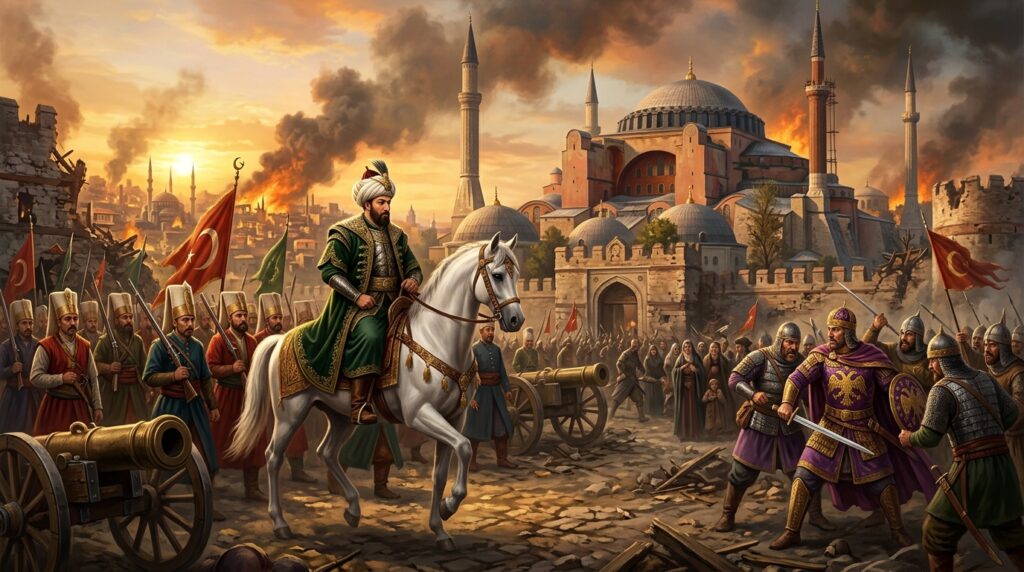
Mehmed II had just broken Constantinople, a city that had held off enemies for a thousand years. His armies kept moving, and fear worked in the sultan’s favor. Then, near Targoviste, the Ottoman army stopped. Before it stretched a field of death: 20,000 bodies on sharp stakes. This was not the aftermath of a battle. It was a warning. This land could never be conquered by war. The man who built that forest lost his throne months later to his own younger brother. The story of Mehmed versus Vlad is not a duel. It is a story about two boys raised in the same Ottoman court who learned opposite lessons.
Two boys in the sultan’s court, 1442 to 1448
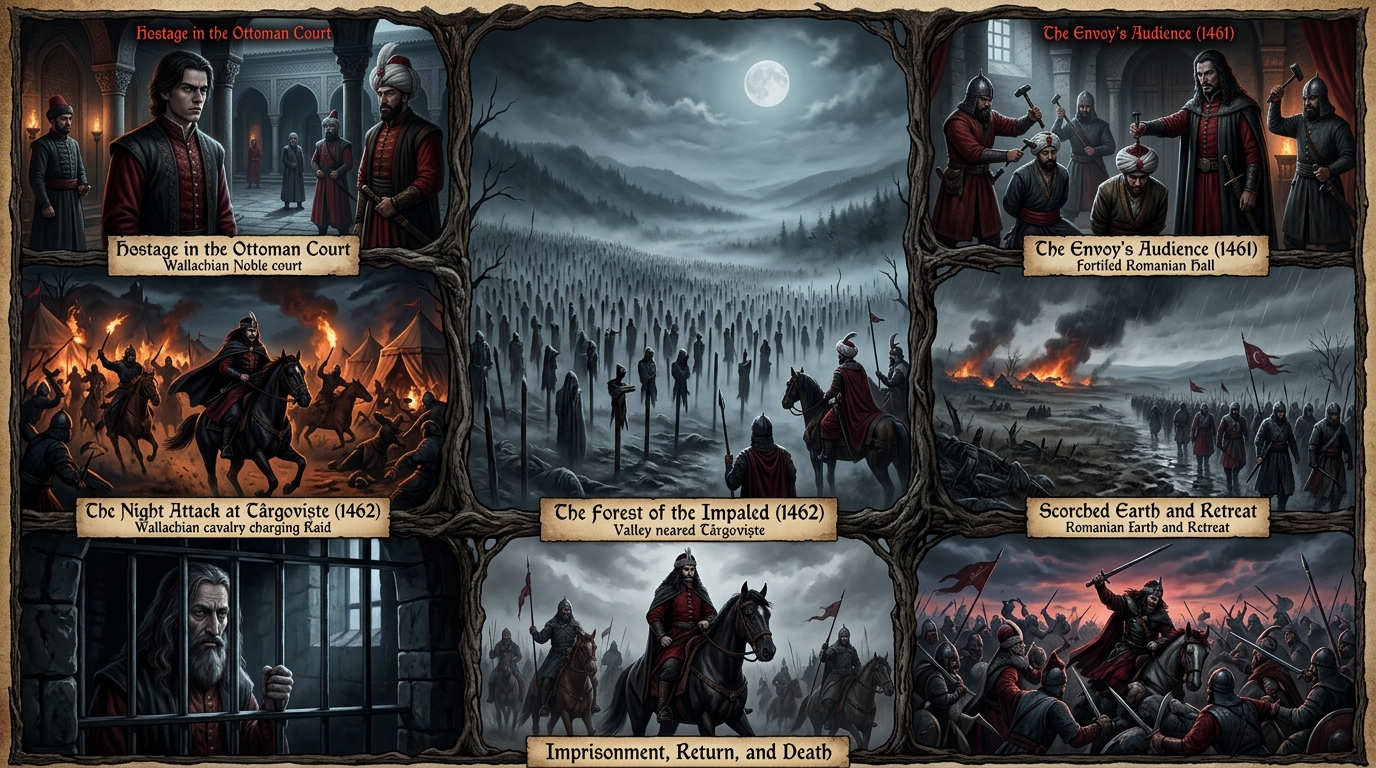
In 1442, the young Wallachian princes Vlad and his brother Radu found themselves at the court of the Ottoman Sultan Murad II, as hostages and as guarantees of Wallachia’s obedience. There they were shaped: the Turkish language, military drill, court intrigue, and the constant demand for loyalty to the sultan. For Vlad, this period was decisive. He saw how the Ottomans subjugated the Balkan peoples, and how Christian princes bowed under Ottoman pressure.
While Vlad was in captivity, the Wallachian boyars betrayed and murdered his father Vlad II and his elder brother Mircea. The news became a lifelong trauma for him. In that same period, the cruelty that later became the center of his rule took shape.
The two brothers learned opposite lessons from the same court. Vlad learned that the empire rules by fear. Radu, charming, gentle, and ready to compromise, learned in Istanbul that people are subdued not by fear, but by promises of stability. That difference would decide the fate of Wallachia.
The prince who chose terror, 1456 to 1461
After his return from Ottoman captivity, Vlad III understood he would never be a vassal of the empire. In 1456, after a long struggle and shifting alliances, he regained the throne of Wallachia with the support of John Hunyadi, the Hungarian regent and one of the greatest Christian commanders of the age, who had stopped Mehmed II’s siege of Belgrade and given him his first major defeat after the fall of Constantinople.
Wallachia was in deep crisis. Hungary tried to increase its influence over Wallachia and stop the Ottoman advance, but failed, because it was itself exhausted by constant wars. Inside the country, chaos reigned. Boyar families fought each other, loyalties shifted, and oaths were sworn in turn to the sultan and to the Hungarian king.
So with Vlad’s return to the throne, fundamental changes began. He relied on the harsh centralization of power, the restoration of discipline, and the ruthless suppression of the rebellious aristocracy. For a border state caught between two fires, there was no other way to survive. The key aim of Vlad III’s policy was to make Wallachia a stronghold of Christian resistance, the first serious obstacle on Mehmed II’s path in Europe.
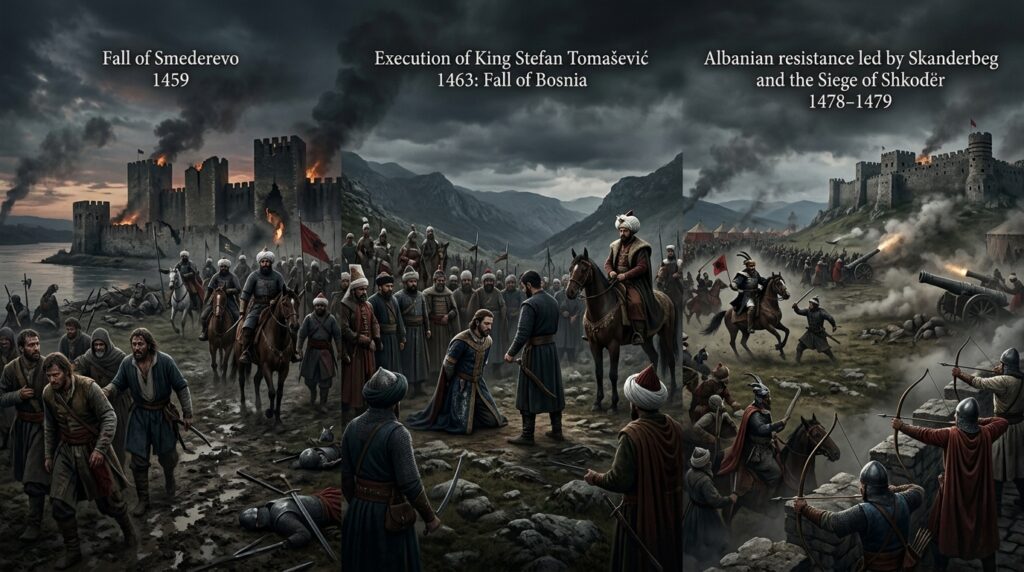
Meanwhile Mehmed was securing his rear. The Serbian Despotate, exhausted by internal strife and constant wars, faced its final blow in 1459. Under Mehmed II, the Ottomans besieged Smederevo, the last stronghold of free Serbia. In 1459, Smederevo fell. The sultan did not merely take land. He destroyed the aristocracy, deported the population, and turned the kingdom into a province. By 1460, the Balkan shield was broken. Wallachia found itself in a cage.
The fall of Serbia forced Vlad III Dracula to begin a harsh policy of internal discipline, which contemporary chronicles call the great purge. At Easter 1459, Vlad ordered the boyars suspected of disloyalty to gather. Some were executed at once. Others were forced to watch their relatives die. The display of cruelty marked a new order. After that, the prince’s power was absolute and unquestionable, and fear and discipline became his main instruments.
In 1461, Mehmed II left Wallachia no choice: obedient vassalage or become the next target. A sultan’s delegation arrived in Targoviste, not on a diplomatic mission, but with an outright ultimatum. The Ottomans presented three demands: resume paying the jizya, the humiliating tax that marked the submission of nonbelievers; hand over 500 boys for the Janissary corps, the most painful demand, because it would destroy Wallachian families and turn their children into the sultan’s weapons; and finally, personally reaffirm obedience before Mehmed II, effectively admitting that Dracula’s power existed only by the sultan’s grace.
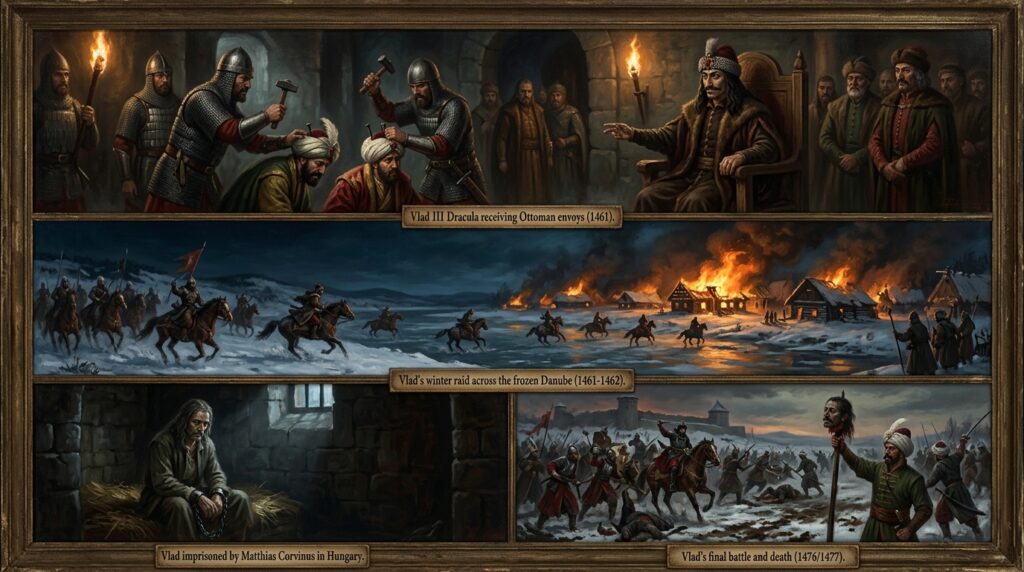
Vlad the Impaler understood that accepting these terms would strip Wallachia of its freedom. He deliberately turned the official visit into a display of his authority. At the reception, the prince demanded that the envoys remove their turbans as a sign of respect. They refused, explaining that their religion forbade them to uncover their heads. In response, Dracula said: if your turbans are held so firmly, let them stay so forever. The envoys were seized and their turbans were nailed to their heads. Those who survived were sent back to the sultan with the nails still in their skulls. The message was unprecedented: I am not a vassal. I am an enemy.
The night the conqueror blinked, 1462
After the execution of the Ottoman envoys, Vlad knew only one option remained: strike first, before the sultan could gather a revenge army. Winter offered a unique opportunity. The Danube, the natural barrier between Wallachia and Ottoman territory, was locked in ice. Under cover of night, Dracula crossed the Danube with his army. This was not a random raid. It was a planned campaign against Ottoman infrastructure in Bulgarian lands under the sultan’s control: communication lines, garrisons, supply depots, and the settlements that fed Mehmed’s army.
Vlad’s forces advanced rapidly, crushing small garrisons, burning Turkish and Bulgarian villages, and destroying the fortified estates of the sipahis. In February 1462, Vlad sent King Matthias Corvinus a detailed report on the raid’s results: 23,884 Turks and Bulgarians killed, recorded with unusual precision, as if copied from registers. Some historians consider this number exaggerated. Still, the letter sent a clear message: it was Vlad who held the southern shield of Christian Europe.
In the spring of 1462, the sultan announced the start of a punitive campaign larger than most campaigns of the 15th century. According to Ottoman and Western European chronicles, Mehmed gathered 150,000 soldiers, a very large army even allowing for exaggeration, including Janissaries, sipahis, akinji raiders, and artillery. The campaign’s main goal was the destruction of Vlad III and the conversion of Wallachia into an Ottoman sanjak.
Mehmed advanced slowly. Such a large army needed supplies, fodder, crossings, and prepared roads. That became Dracula’s opportunity. He knew his country well and had no illusions. In open battle, his forces could not match the sultan’s power. So Vlad relied on wearing the enemy down and adopted a scorched earth strategy. His orders were strict and systematic: burn all villages and settlements in the path of the Ottoman advance; remove or destroy all supplies so they would not fall into enemy hands; poison wells and water sources, cutting off Ottoman cavalry and supply wagons from water; move the population into forests and mountains, leaving the sultan’s army without guides, carts, or any local help.
At the same time, constant guerrilla attacks continued: night attacks, ambushes in narrow passes, destruction of reconnaissance units, and attacks on foraging supply detachments. The strategy produced results. The chronicles wrote that a large army marched behind Mehmed, while ahead lay a dead, deserted land. The Ottoman forces pushed deep into Wallachia, but instead of loot and submission, they faced hunger, thirst, and constant night attacks.
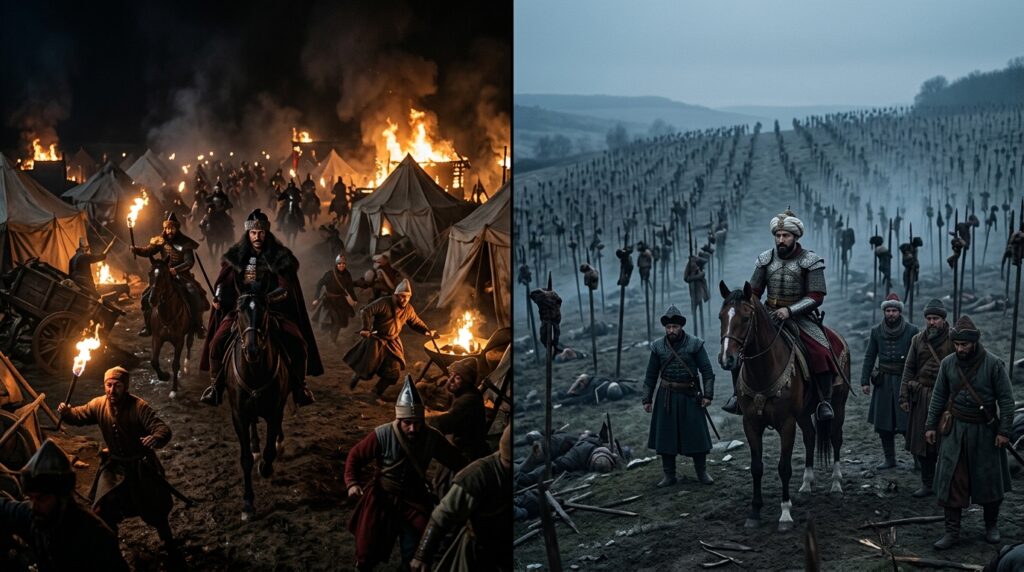
Then Vlad staked everything on one bold gamble: a night attack on the heart of the enemy, aimed at killing the sultan himself. He gathered his 7,000 to 10,000 most trusted fighters. Thanks to intelligence, Dracula had precise information about the Ottoman positions and the layout of the sultan’s tent. The plan was simple: break into the center of the camp and kill Mehmed. Success could have ended the war in a single night.
Under cover of darkness, the Wallachian detachments broke into the camp and advanced along three axes. The first attack was sudden. The Ottoman troops could not withstand the attack. They retreated, spreading panic throughout the camp. Vlad himself led the central column. In the darkness, amid fire and smoke, his fighters reached the central position several times. They tried to find the sultan’s tent, but Mehmed’s personal guards intervened in time. The battle turned into a dark night massacre. Dracula killed several high ranking Ottoman commanders, but he failed to reach the sultan. The fire blazing in the camp lit the battlefield and robbed the Wallachians of the advantage of darkness. Realizing that the main goal could not be achieved and the risk of encirclement was growing, Vlad ordered a retreat. The Ottomans managed to consolidate their defenses. Yet the results of the night were solid. Despite the failure of the assassination attempt, the attack showed Mehmed that this campaign would be far more difficult than he expected.
When Mehmed II approached Targoviste with his main forces, he expected a capital ready to surrender, or at least offering conventional resistance. Instead, one of the most terrifying sights of the 15th century opened before the Ottoman army. The valley of death. Thousands of sharp stakes arranged in rows, uniform like a military formation. On each, a body: a Turk, a Bulgarian, a traitor, a criminal, a captured soldier, or a peasant suspected of collaborating with the enemy. According to Ottoman estimates, about 20,000 people. This was a planned demonstration for Mehmed II: this is the price of advancing into my land.
The night massacre and the exhausting march through scorched lands broke the Ottomans’ fighting spirit. The Janissaries, hardened in Anatolian and Rumelian campaigns, felt for the first time that they faced an enemy who was not only fighting, but ready to destroy everyone his power touched. The sultan called a council with the pashas to assess losses, army fatigue, and siege prospects. After that, the sultan made an unexpected decision: he withdrew, not because of exhaustion, but because the loss of combat effectiveness could lead to disaster. The 1462 campaign ended without the conquest of Wallachia, one of the rare occasions when Mehmed II, the conqueror of Constantinople, returned without trophies. Quoting the Byzantine historian Laonikos Chalkokondyles, the chronicles reported that the sultan admitted it was impossible to take the land from a man capable of such terrible deeds.
The brother who won without a battle, 1462 to 1479
Mehmed’s retreat did not mean Vlad’s victory. On the contrary, it was after the Ottoman army left that the most dangerous phase began. Wallachia was devastated: villages burned, crops destroyed, and the population frightened, both by the Turkish advance and by their own prince’s ruthless methods.
Vlad’s younger brother took advantage of this. Radu the Handsome had also grown up for years at the sultan’s court. Unlike Vlad, Radu was charming, gentle, and ready to compromise. In Istanbul, he had learned the lesson that people are subdued not by fear, but by promises of stability. At the beginning of August, Radu entered Wallachia with a detachment of Janissaries and Ottoman commanders. His campaign was not a frontal clash but a political victory. Radu the Handsome sought support from the boyars who had survived the great purge and the Easter massacre. They had not forgotten how their elder brother’s disobedience had ended. So many boyar families went over to Radu. In him they saw their chance to stop the policy of terror.
Vlad found himself in a delicate situation. His army had shrunk. The support of bloodied peasants had weakened, and holding the throne became harder than fighting the Turks. By late autumn, he controlled only part of the territory, while most fortresses let Radu the Handsome in without resistance. In November and December, the situation worsened further. Radu’s detachments moved toward Targoviste, forcing Vlad to leave the country. He crossed the Carpathians and went to Transylvania, hoping for help from his former ally, Hungarian King Matthias Corvinus. But instead of the support he hoped for, imprisonment awaited him. Matthias ordered his arrest on the basis of forged letters, allegedly testifying to Dracula’s treason. The former ruler of Wallachia became a political prisoner. The struggle for the throne ended for him in exile and imprisonment, and Wallachia passed to the rule of Radu the Handsome, who was an Ottoman protectorate.
While Vlad III was in prison, the Ottoman Empire continued to take over the Balkans. Mehmed II took advantage of the moment when Hungary and Venice were entangled in their own conflicts. Ottoman troops quickly passed through Bosnian lands, captured King Stephen Tomasevic, and executed him. Bosnia, recently an independent European state, became an Ottoman eyalet. The fall of Bosnia was of great importance. Mehmed II gained a springboard for constant pressure on Hungary’s southern borders and forced Matthias Corvinus to constantly invest additional resources.
The last resistance to the Ottomans in the south was offered by George Kastrioti Skanderbeg, the genius of guerrilla warfare, who had held the sultan back for 25 years. But in 1468, George died. Without his authority, the Albanian princes could not resist the Ottomans. Mehmed II methodically took city after city. Albania, recently a stronghold of Christian resistance, effectively fell. The Christian front was breaking apart joint by joint. Serbia destroyed. Bosnia annexed. Albania tired and surrounded. No strong Christian center remained in the Balkans that could stop the sultan’s northern advance.
And at that very time Matthias Corvinus decided to use Vlad as a military tool against the Ottomans. After more than a decade in prison, Vlad III received a small army and returned to Wallachia. He managed to drive out the Ottoman garrison and briefly restore his rule. But this was a different Wallachia: drained of blood, divided with treacherous boyar groups. Both Ottoman detachments and internal rivals rose against Vlad. After several months of fighting, Vlad III was killed in battle, according to various sources either in an ambush or in open battle. His head was sent to Istanbul, where it was hung on a stake as proof of Dracula’s death.
The last Christian stronghold in the south was the fortress of Shkodra in northern Albania. In 1478, the sultan personally led a campaign against the city. The Ottomans built siege works, artillery batteries, and raised platforms to attack the walls. The bombardment lasted for weeks. Stone balls broke the towers, but the fortress held. The defenders, a Venetian garrison and Albanian detachments, fought in complete isolation. They lacked supplies, ammunition, and men. They held the fortress for almost 2 years.
In 1479, the situation changed at the negotiating table. Venice, tired of war and with no support from Europe, signed peace with the Ottoman Empire. Under the terms of the treaty, Shkodra was handed over to the sultan. With its loss, the final subjugation of Albania was completed, and with it the centuries long process of the Ottoman conquest of the Balkans.
Mehmed lost the war of fear and won the war of politics. Vlad’s terror made him a legend. Radu’s charm made him a ruler. The empire did not need to beat Vlad in battle. It only needed to offer Wallachia a prince it could live with.
Read also: Mehmed II After 1453: The Conquests History Forgot