There is a street in Istanbul you can still walk today. It starts at the Golden Gate, runs past the old forums, and ends at Hagia Sophia. It has had several names across the centuries, but the route never moved. Every empire that ruled this city paved it, built on it, and marched on it. To walk it is to walk the whole history of Constantinople, layer by layer, from a Greek harbor town to the Ottoman capital.
The Greek harbor town
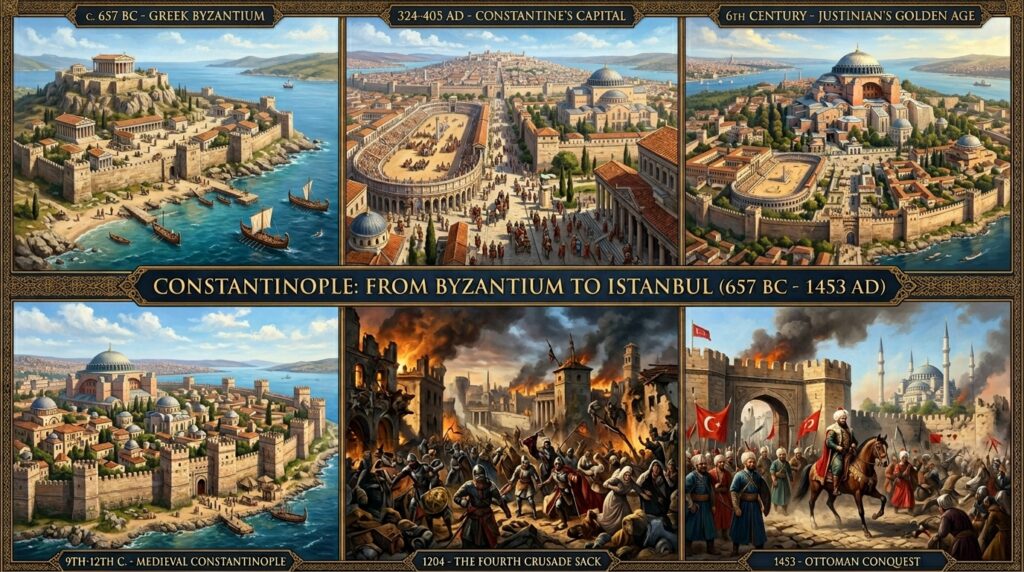
According to legend, the city that would one day become Istanbul began around 600 BC, when a Greek explorer named Byzas led settlers from the city of Megara to a new settlement at the entrance of the Bosphorus strait. Before his journey, Byzas consulted the oracle of Delphi, which mysteriously advised him to settle his new city opposite the land of the blind. Only upon reaching the Bosphorus did Byzas understand the message. On the Asian shore stood the town of Chalcedon, whose founders he declared blind because they had not chosen the clearly better site on the European shore. It was on a triangular peninsula that Byzas founded the city of Byzantion, the ancient predecessor of modern Istanbul.
Whatever the truth of the legend, the early city grew into a thriving Greek trading center, occupying a strategic site with a natural harbor and a commanding view over the sea route between the Black Sea and the Mediterranean. It adopted the typical features of the classical Greek city states of the era: an acropolis, temples, market places, and strong walls for protection.
The fortunes of Byzantion rose and fell with the power struggles of the ancient world. It came under the control of the Persian Achaemenid Empire in 513 BC and was later fought over by Spartan and Athenian forces during the Peloponnesian War in the late fifth century BC. The city’s so called freedom effectively ended when it was absorbed into the expanding Roman Republic during the second century BC, after which it took the Latin form of its name, Byzantium. The city then became part of Rome’s vast imperial territories, although it retained a degree of local autonomy and Greek character.
But in 193 AD, during one of Rome’s countless civil wars, Byzantium foolishly sided with the wrong faction and incurred the vengeful wrath of Septimius Severus, who eventually emerged as emperor. Severus besieged Byzantium and captured the city in 196 AD, breaking its defenses and inflicting great damage in revenge. The city was briefly renamed Augusta Antonina before reverting to Byzantium, and it was soon reshaped with a Roman grid layout including fora, baths, an arena, and the first version of the hippodrome, the grand stadium for chariot racing that would become a central landmark of the city in later years.
Constantine’s New Rome, 324 to 405
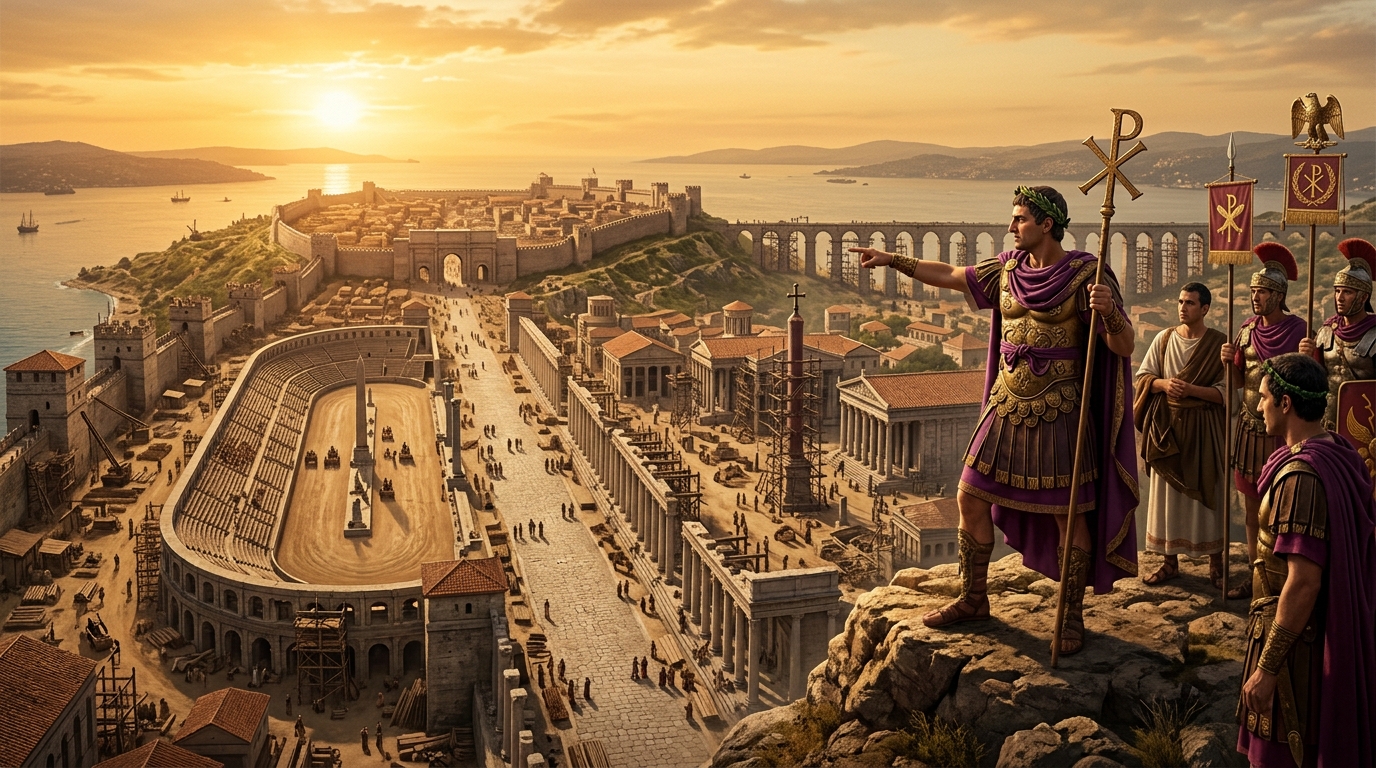
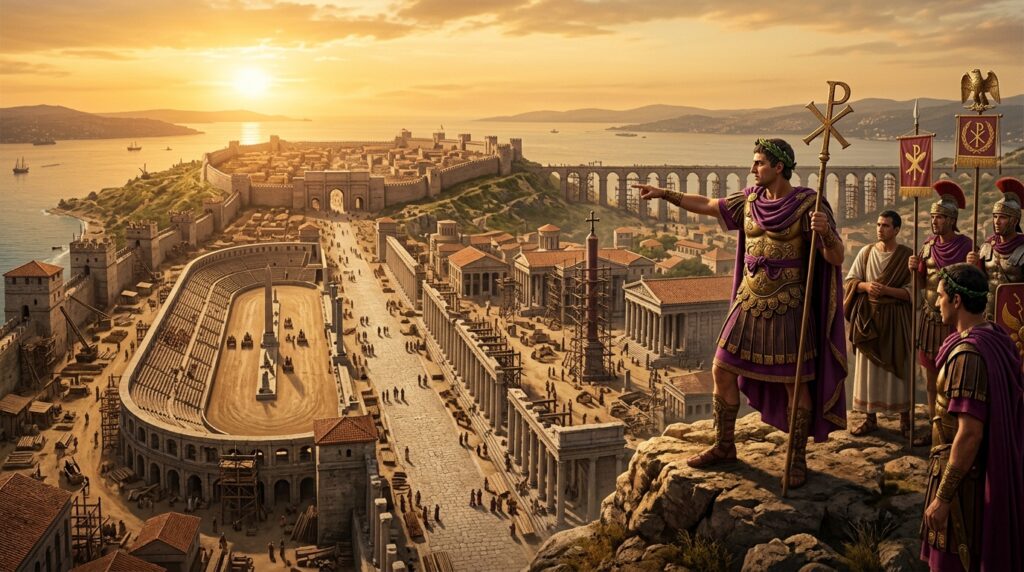
The first real turning point in the history of Byzantium came when Constantine the Great became the sole ruler of the Roman Empire in 324 AD after another civil war. In search of a fresh start and a strategic administrative center, Constantine chose ancient Byzantium as the site of a new imperial capital to rule the eastern provinces of the empire. In 330 AD, the city was renamed Constantinopolis, introducing the famous name Constantinople that would endure for the next 1,600 years.
Constantine chose the strategically placed Byzantium as his New Rome. The city took his name. From its foundation in 324 to 405, the former Greek colony was transformed beyond recognition. Constantine and his successors equipped the city with all the trappings befitting the imperial majesty of the Roman crown.
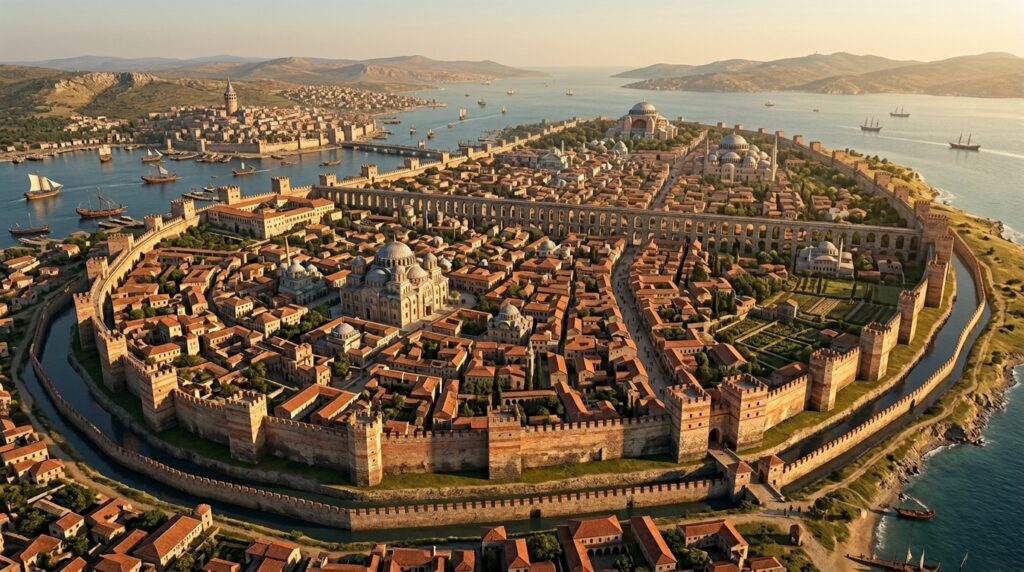
The city area expanded greatly. A new wall was built that enclosed a much larger area than the old fortress wall. A great palace was built overlooking the Sea of Marmara. Public baths and a large hippodrome with a capacity of 80,000 spectators were built to entertain the city’s people. Harbors and grain warehouses were built to support the rapidly growing population. A large aqueduct running through the center of the city, completed in 373 under Emperor Valens, was built.
A very large boulevard called the Mese ran from the Golden Gate, the city’s marble adorned and magnificent ceremonial gate, to the center of the city. The Mese passed through several large fora, which were designated as market and trade places: Forum Bovis, Forum Tauri, and the Forum of Constantine, in which there was a Senate house. Alongside the Mese stood the Praetorium, the seat of justice, before this large boulevard ended at the Augustaeum, a newly built official square, on the eastern side of which stood the central Senate house or Curia.
Constantinople soon acquired all the characteristics of a great city of the ancient period. This was a deliberate move by Constantine, who knew well that transferring the imperial capital from Rome was a controversial move. The emperor even announced that free bread rations would be distributed in his new city in 332, exactly as in old Rome.
But there was a new element that did not exist in the old cities before, which Constantine and his successors clearly introduced in Constantinople: churches. At this stage, churches were generally not built in their own special districts. This means they were either absorbed into neighborhoods for greater access, or included in civil complexes, in their own special areas. In this first phase of development, the two most famous churches of Constantinople were built: Hagia Irene and Hagia Sophia.
The walls that made a thousand years, fifth century
The second phase of Constantinople’s development, during the first half of the fifth century, was explained by the growing insecurity of the regions behind it. At the end of the fourth century, the arrival of the Huns in Eastern Europe and the imprints of both the Western and Eastern Roman Empires, especially under Attila in the 440s and 450s, accelerated defensive changes in Constantinople. The city’s water supply was seen as particularly vulnerable during a siege, because the aqueduct had spread outside the walls.
To solve this problem, Emperor Theodosius II launched a project to build a new wall system: a 60 foot high, triple defensive structure, about 3.5 miles long, with a wide moat and 57 towers, which enlarged the city to 1,400 hectares. This fortress, called the Theodosian land walls, remained impregnable until the arrival of gunpowder weapons. The Mese was extended to the circuit of the new walls, and a new Golden Gate was built.
With the fall of the Western Empire in 476, Constantinople entered a new era as the undisputed capital of the Romans. This, combined with relative political stability and economic strength, caused an increase in population, which by the reign of Justinian the Great had grown to about 500,000 people.
The Christian metropolis and the dome, 527 to 537
This economic prosperity brought another era of building projects with it, including many of the most famous buildings that are closely associated with Constantinople and still stand in Istanbul today. Additions to the Great Palace strengthened its status as the official and administrative center of the empire. The Julian harbor on the Sea of Marmara was decorated and remained a major commercial harbor for the next 300 years. Constantinople continued its urban expansion, because every kind of secular architecture spread there.
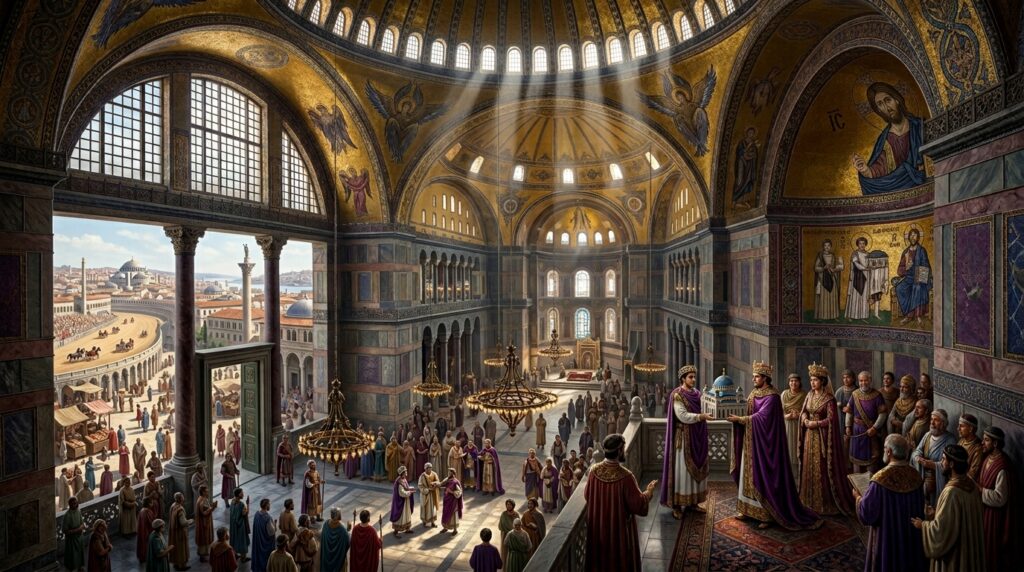
This is also the time when Constantinople transformed from a classical ancient city into a true Christian metropolis. Justinian, famous for his legal reforms and successful reconquests of lost Roman territories in the West, undertook the rebuilding of the church of Hagia Sophia, which had been damaged in the Nika riots of 532, into a much larger and astonishingly beautiful building that still stands today. Upon its completion in 537, it boasted the largest indoor space in the world and became the spiritual center of the city, a magnificent example of Byzantine architecture, with its huge hanging dome.
The street that changed its name, 1453 to today
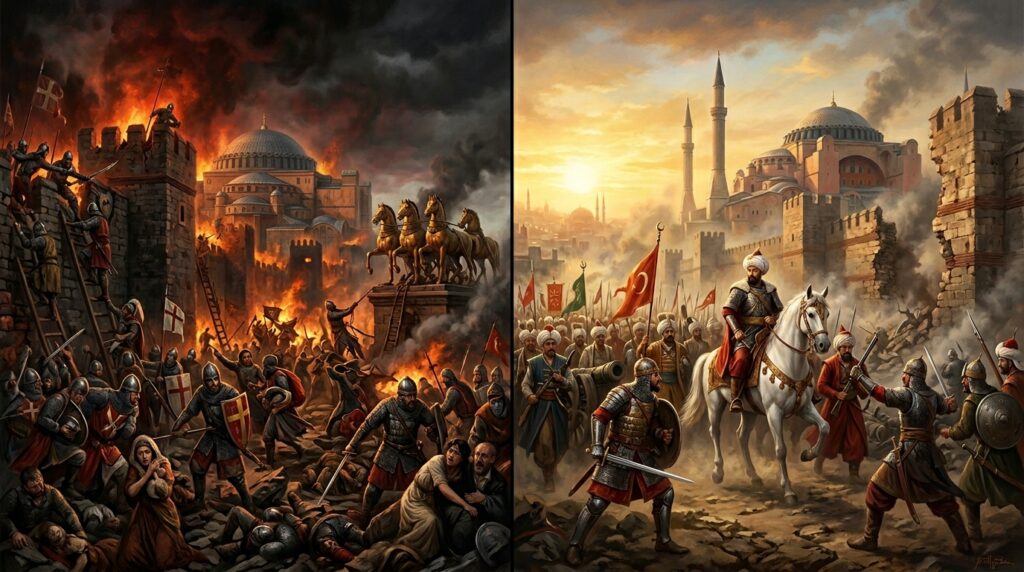
The city survived sieges, riots, earthquakes, and the sack of 1204, when a crusader army turned on Christian Constantinople itself and looted it for three days. It survived because its walls, its harbors, and its position never stopped being valuable. In 1453, Mehmed II took the city, and the street changed its name again.
As Byzantine power waned, the Mese slowly fell silent. Yet its legacy was reborn after the Ottoman conquest in 1453. The new rulers chose the same ceremonial heart for their own empire, building Topkapi Palace near the old Byzantine palace complex, and the ancient Mese once again became the route of dignitaries and processions.
In Ottoman times, the avenue became known as Divan Yolu, the Road to the Divan, named for the imperial council that met in Topkapi Palace. The road flourished once more, lined with splendid mosques, libraries, tombs, and fountains. Landmarks such as the Firuz Aga Mosque, the Koprulu Library, and the tombs of Sultans Mahmud II, Abdulaziz, and Abdulhamid II still grace the street today, silent witnesses to centuries of power and devotion.
Conquerors change names. Byzantium became Constantinople, and Constantinople became Istanbul. But the street stayed. Walk from the Golden Gate to Hagia Sophia, and you walk through every layer of the city: a Greek harbor, a Roman capital, a Christian metropolis, and an Ottoman seat of power, all on one road.
Read also: The Ottoman Empire: From Founding (1299) to the Fall of Constantinople (1453)
1 thought on “The Evolution of Constantinople From Byzantium to Istanbul”