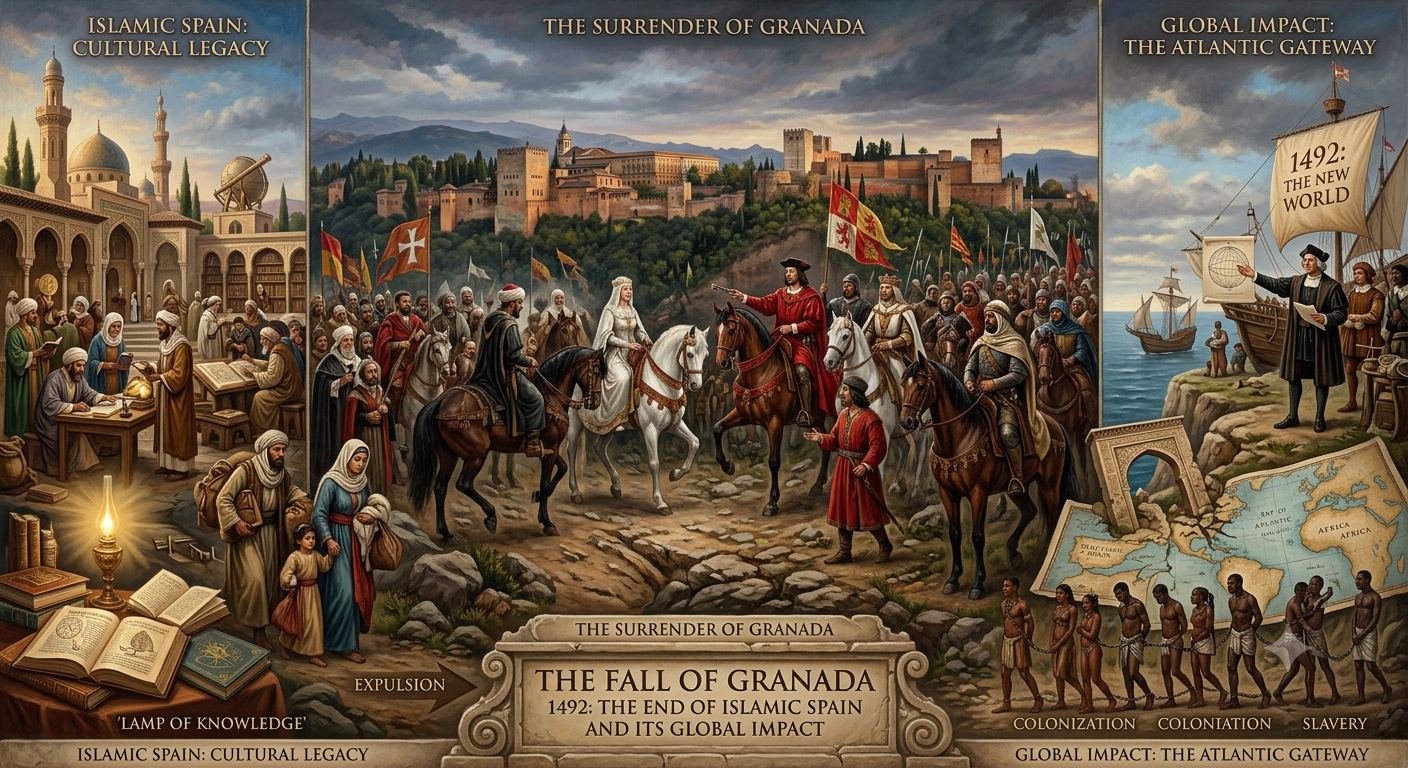
Explore the historic Fall of Granada in 1492. Discover how the collapse of Al-Andalus ended 800 years of Islamic rule in Spain and reshaped world history.
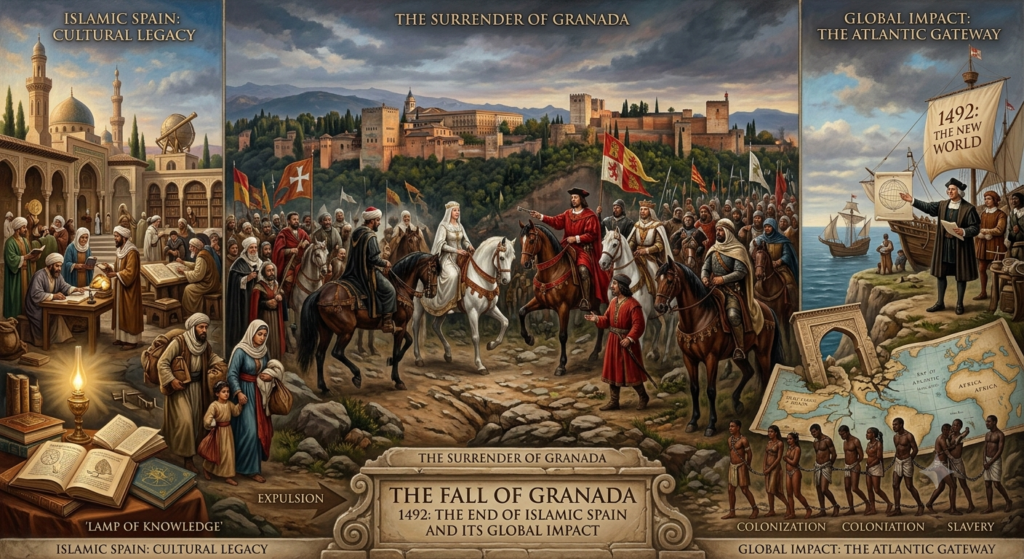
On January 2, 1492, a momentous event took place in the snow-capped shadow of the Sierra Nevada mountains in southern Spain. Sultan Muhammad XII (known to Europeans as Boabdil) surrendered the keys of the magnificent Alhambra palace to King Ferdinand II of Aragon and Queen Isabella I of Castile.
The Fall of Granada marked the end of Al-Andalus—the glorious era of Islamic rule in the Iberian Peninsula that had endured for nearly eight centuries. It was a tragic turning point for Islamic civilization, but its geopolitical tremors reshaped the Atlantic world, European colonialism, and Ottoman naval expansion.
The Golden Age of Al-Andalus: A Beacon of Light
To understand the tragedy of Granada’s fall, one must appreciate what Al-Andalus represented. Ever since Tariq ibn Ziyad crossed the Straits of Gibraltar in 711 AD, Islamic Spain developed into one of the most advanced, prosperous, and intellectual civilizations of the Middle Ages.
- Center of Learning: Cities like Córdoba, Seville, and Granada boasted grand libraries, paved roads, street lighting, and advanced hospitals at a time when much of Europe was plunged into the Dark Ages.
- Cultural Renaissance: Muslim scholars, alongside Jewish and Christian intellectuals, made pioneering advancements in algebra, astronomy, medicine, agriculture, and architecture.
- Coexistence (Convivencia): Under Islamic law, Christians and Jews were protected subjects (Dhimmi) who contributed significantly to administration, philosophy, and trade.
The Fracturing of Muslim Spain and the Reconquista
The decline of Al-Andalus did not happen overnight; it was a slow collapse caused by internal divisions and external pressure:
- The Collapse of the Umayyad Caliphate: In the early 11th century, the centralized Caliphate of Córdoba collapsed into dozens of small, warring Muslim city-states called Taifas.
- Internal Rivalries: Instead of uniting, rival Muslim princes frequently allied with Christian kingdoms against each other, drastically weakening their collective power.
- The Rise of the Reconquista: The northern Christian kingdoms initiated the Reconquista—a centuries-long military campaign to expel Muslim rulers from the peninsula. Over time, major centers like Córdoba (1236) and Seville (1248) fell one by one.
By the late 15th century, the Emirate of Granada, ruled by the Nasrid Dynasty, was the very last Muslim stronghold remaining in Spain.
The Final Siege of Granada (1491–1492)
The fate of Granada was sealed when King Ferdinand of Aragon married Queen Isabella of Castile, uniting Spain’s two most powerful Christian monarchies. Their combined forces turned their full military attention toward eliminating the final Islamic state.
Granada was a formidable, heavily fortified city surrounded by mountains and protected by the fortress of the Alhambra. However, internal family feuds within the Nasrid ruling family severely crippled Granada’s defense.
The Blockade and Starvation
In 1491, Ferdinand and Isabella built a permanent siege city called Santa Fe right outside Granada’s gates, cutting off all trade and agricultural routes:
- Severe Famine: Over eight months of continuous siege, food supplies dwindled, leaving the civilian population starving.
- Isolation from Help: Sultan Boabdil sent desperate pleas for military aid to Muslim rulers in North Africa and Ottoman Sultan Bayezid II, but geographic distance and naval limitations prevented timely relief.
Realizing that continued resistance would lead to the total massacre of his people, Boabdil secretly negotiated terms of capitulation, officially surrendering the city in January 1492.
The Aftermath: The Treaty of Granada and Broken Promises
Initially, the surrender agreement—known as the Treaty of Granada—guaranteed generous terms for the Muslim population (Moorish inhabitants):
- Freedom of religious worship and practice.
- Retention of property, laws, and traditional clothing.
- Right to emigrate or stay without forced conversion.
However, these promises were quickly broken within a decade. Under the influence of Cardinal Ximénez de Cisneros, Islamic books were publicly burned in Granada’s squares, mosques were converted into churches, and Arabic was banned. By 1502, Spanish Muslims were forced to choose between forced conversion to Christianity or exile. Those who converted superficially while secretly practicing Islam were known as Moriscos, and they were eventually expelled entirely from Spain in 1609.
Global Consequences and the Connection to 1492
The Fall of Granada in 1492 triggered a ripple effect across world history:
- Ottoman Humanitarian Rescue: Ottoman Sultan Bayezid II dispatched the Ottoman navy, under the command of admirals like Kemal Reis, to rescue hundreds of thousands of Sephardic Jews and Muslim refugees fleeing Spanish persecution, resettling them across Ottoman lands in Salonica, Istanbul, and North Africa.
- The Age of Discovery: With the conquest of Granada complete, Ferdinand and Isabella had the financial resources and confidence to fund Christopher Columbus’s expedition in August 1492, leading to European contact with the Americas.
- Rise of Ottoman Sea Power: The plight of North African and Andalusian Muslims fueled the rise of Muslim privateers and naval admirals like Hayreddin Barbarossa, shifting the focal point of the Islamic-Christian conflict from Iberian land to the Mediterranean Sea.