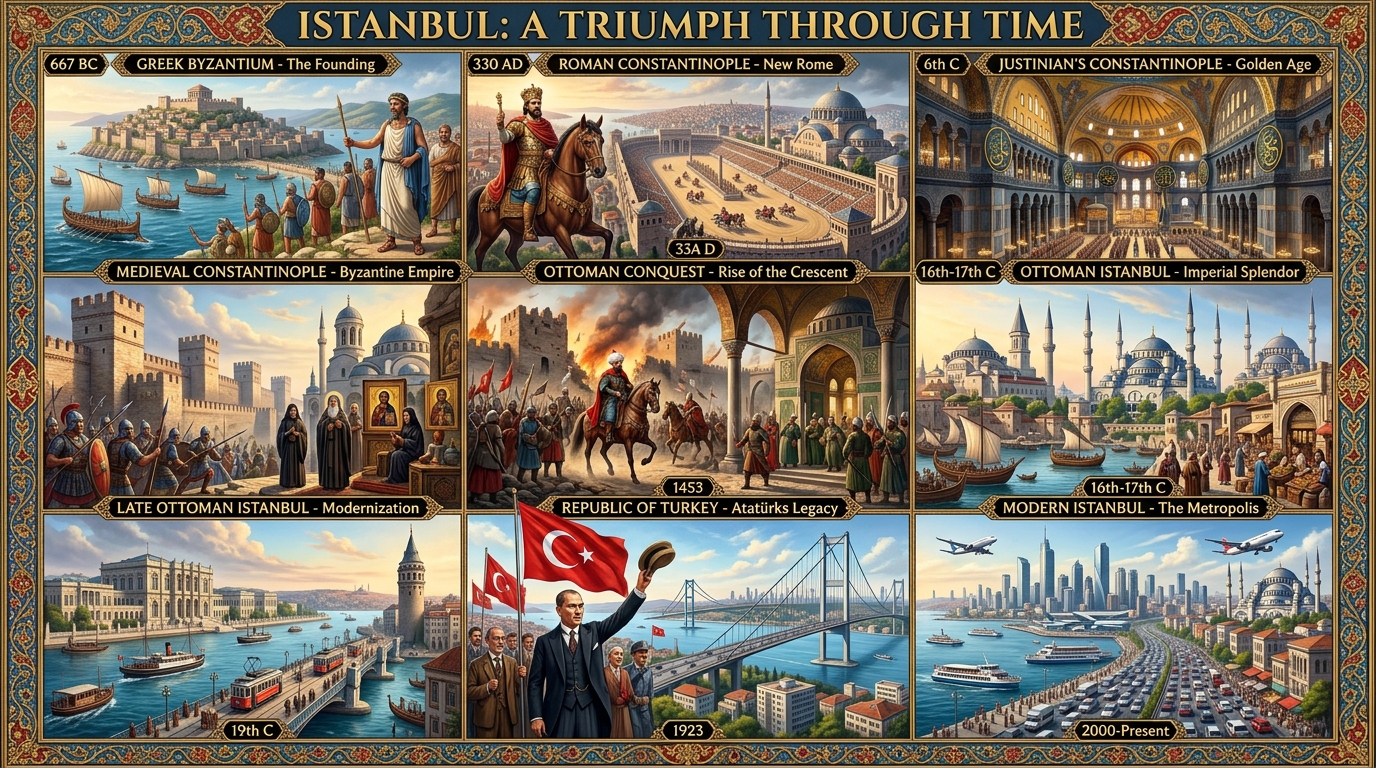
Ask a tourist in Istanbul what city they are standing in, and the answer depends on the century. A Greek sailor would have said Byzantion. A Byzantine priest would have said Constantinople. An Ottoman merchant would have said Konstantiniyye. A modern Turk says Istanbul. Same peninsula, same strait, same harbor, but three different cities, each with its own language, its own religion, its own skyline, and its own idea of what the place was for. This is the history of Istanbul, told through the three names it lived under, and the three lives it lived.
Byzantion, the Greek merchant town
According to legend, the city began around 600 BC, when a Greek explorer named Byzas led settlers from the city of Megara to a new settlement at the entrance of the Bosphorus strait. Before his journey, Byzas consulted the oracle of Delphi, which mysteriously advised him to settle his new city opposite the land of the blind. Only upon reaching the Bosphorus did Byzas understand the message. On the Asian shore stood the town of Chalcedon, whose founders he declared blind because they had not chosen the clearly better site on the European shore. It was on a triangular peninsula that Byzas founded the city of Byzantion.
Whatever the truth of the legend, the early city grew into a thriving Greek trading center, occupying a strategic site with a natural harbor and a commanding view over the sea route between the Black Sea and the Mediterranean. It adopted the typical features of the classical Greek city states of the era: an acropolis, temples, market places, and strong walls for protection.
The fortunes of Byzantion rose and fell with the power struggles of the ancient world. It came under the control of the Persian Achaemenid Empire in 513 BC and was later fought over by Spartan and Athenian forces during the Peloponnesian War in the late fifth century BC. The city’s so called freedom effectively ended when it was absorbed into the expanding Roman Republic during the second century BC, after which it took the Latin form of its name, Byzantium.
But in 193 AD, during one of Rome’s countless civil wars, Byzantium foolishly sided with the wrong faction and incurred the vengeful wrath of Septimius Severus, who eventually emerged as emperor. Severus besieged Byzantium and captured the city in 196 AD, breaking its defenses and inflicting great damage in revenge. The city was briefly renamed Augusta Antonina before reverting to Byzantium, and it was soon reshaped with a Roman grid layout including fora, baths, an arena, and the first version of the hippodrome, the grand stadium for chariot racing that would become a central landmark of the city in later years.
Byzantion was a merchant town that happened to sit on the best real estate in the ancient world. Its first life ended when an emperor decided the peninsula deserved something bigger than a trading post.
Constantinople, the Christian capital
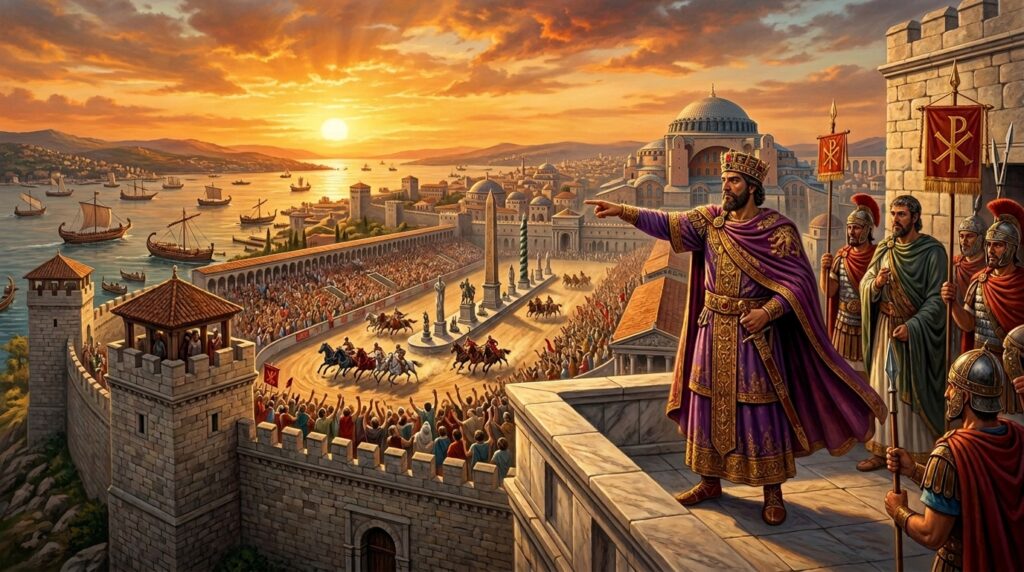
The first real turning point came when Constantine the Great became the sole ruler of the Roman Empire in 324 AD after another civil war. In search of a fresh start and a strategic administrative center, Constantine chose ancient Byzantium as the site of a new imperial capital to rule the eastern provinces of the empire. In 330 AD, the city was renamed Constantinopolis, introducing the famous name Constantinople that would endure for the next 1,600 years. The old Greek town was reborn as New Rome.
Constantine’s new planners dramatically expanded the old Greek town, extending its boundaries to enclose the whole peninsula. New land walls were built to protect its western side, the only side not naturally protected by water. Within those walls, Constantinople was laid out in a manner befitting an imperial city, with magnificent colonnades and public buildings.
Constantine built his great palace next to the old Severan hippodrome, which he also enlarged to hold even larger crowds. The hippodrome became the beating social heart of the city, where people gathered to watch the notorious chariot races put on by the rival circus factions of the Blues and the Greens. The emperor himself often took part in the spectacle from the imperial box to energize the crowd.
Constantine certainly left his mark on the city, not only in name, but also through the grand forum he established at its center, crowned by a memorial column with his own statue. Yet perhaps his most important cultural legacy was his decision to embrace Christianity, which laid the foundation for Constantinople to become one of the foremost centers of the new faith.
By the end of the fourth century, Emperor Theodosius I had declared Christianity the official religion of the empire, and Constantinople secured its place as the seat of a powerful patriarch, the leading bishop of the Eastern Church, second only to the pope in Rome, thus establishing itself as the foremost city of Eastern Christianity.
Despite the official division of the Roman Empire into separate eastern and western units in 395 AD and the subsequent collapse of the western half by 476 AD, Constantinople continued to thrive, now standing as the sole imperial capital. By the beginning of the sixth century, under Emperor Justinian I, the city was at its peak and had become the largest city in the world, with more than 500,000 inhabitants, a cosmopolitan mix of Greeks, Romans, Armenians, Syrians, and many others gathered from across the empire.
Then, in 532, Justinian faced a massive uprising known as the Nika riots, which began with dissatisfaction over the chariot racing factions and erupted into a city wide revolt against the emperor’s rule. Much of Constantinople was set on fire by rioters, including the old Hagia Sophia cathedral, which was razed to the ground before Justinian brutally crushed the revolt. Afterward, an estimated 30,000 people lay dead, and half the city was turned to ash.
Seizing the opportunity for large scale rebuilding, Justinian began what would become Constantinople’s most famous building: the new Hagia Sophia. Completed in 537 AD, this cathedral was a revolutionary domed basilica that dwarfed anything built before it. Adorned with shining mosaics and marble, it became the spiritual and architectural crown of Constantinople, a symbol of both the power of the Christian Eastern Roman Empire, also called the Byzantine Empire, and its cultural sophistication.
Alongside Hagia Sophia, many other projects were started during this period, including the Basilica Cistern, a vast underground water reservoir supported by hundreds of columns, as well as new aqueducts, hospitals, and the Church of the Holy Apostles rebuilt as a grand shrine for the tombs of emperors.
At this time Constantinople was not only the administrative capital of the Byzantine Empire, but also a thriving center of world trade and a cultural crossroads between East and West. Thanks to its strategic location, it occupied key trade routes between Europe and Asia. Its harbors on the Golden Horn were filled with merchant ships carrying silk from China, spices from India, grain from Egypt, furs from the steppes, and wine and olive oil from the Aegean. Education and arts also flourished. Constantinople had the empire’s foremost university and libraries, which preserved classical Greek and Roman knowledge.
After the golden age of Emperor Justinian, however, the city of Constantinople and the wider Byzantine Empire faced new emerging threats. In the seventh and eighth centuries, waves of Persian and later Muslim Arab forces moved toward the city, having rapidly conquered Syria, Egypt, and North Africa from Byzantine control. The Umayyad Caliphate twice besieged Constantinople, first in 674 and again in 717, but ultimately failed to take the city, partly because of its secret weapon, Greek fire, an incendiary liquid fired from a flamethrower like device that could burn almost anything.
But it was not only external threats that endangered Constantinople. Internally, the city was forced to endure numerous political and religious upheavals during this period. Byzantine emperors came and went with dizzying frequency, often as a result of palace coups or military revolts. One severe conflict was the iconoclast movement of the eighth and ninth centuries, during which several emperors, beginning with Leo III in 726, outlawed the veneration of holy images of Christ and the saints. For decades, the city witnessed the destruction or removal of intricate mosaics and paintings, with a rift growing between iconoclast emperors and iconophile devotees. Eventually, the icon supporting party prevailed, and with the Triumph of Orthodoxy in 843, the use of icons was restored, resulting in new mosaics shining once again in the ceiling of Hagia Sophia.
The ninth century began with the rise of the Macedonian dynasty of emperors, under which Constantinople saw a revival and a second golden age. The empire was stabilized and even regained some of its former territories. The city’s population grew once again as wealth flowed in and cultural exchanges flourished as people from remote corners of the known world came into contact with Constantinople.
Across the Black Sea, the emerging Kievan Rus began to establish relations with the city. Although these were initially hostile, including a failed attempt to seize Constantinople and its wealth, the Rus later sought to establish peaceful relations through trade and diplomacy. The Rus were a mixture of Norse settlers and Eastern Slavs who settled in the area of today’s Russia and Ukraine. The contacts established through the Rus brought Constantinople into the wider orbit of the Viking world during the ninth to twelfth centuries, in which the city itself became known in Old Norse as Miklagardr, the great city.
These Scandinavian and Rus traders traveled along river routes, bringing furs, wax, amber, and slaves down the Dnieper and Don to the Black Sea, in exchange for silk, wine, and coins from Constantinople. From this connection emerged in the late tenth century the Varangian Guard, the Byzantine emperor’s elite axe bearing personal bodyguard, formalized around 988 under Basil II. These warriors were initially recruited from Kievan Rus, but the Guard became so famous for its ferocity, iron discipline, and personal loyalty to the emperor that it soon drew recruits from the Viking homelands of Scandinavia as well, and in later years also exiled Anglo-Saxon warriors after the Norman invasion of England in 1066.
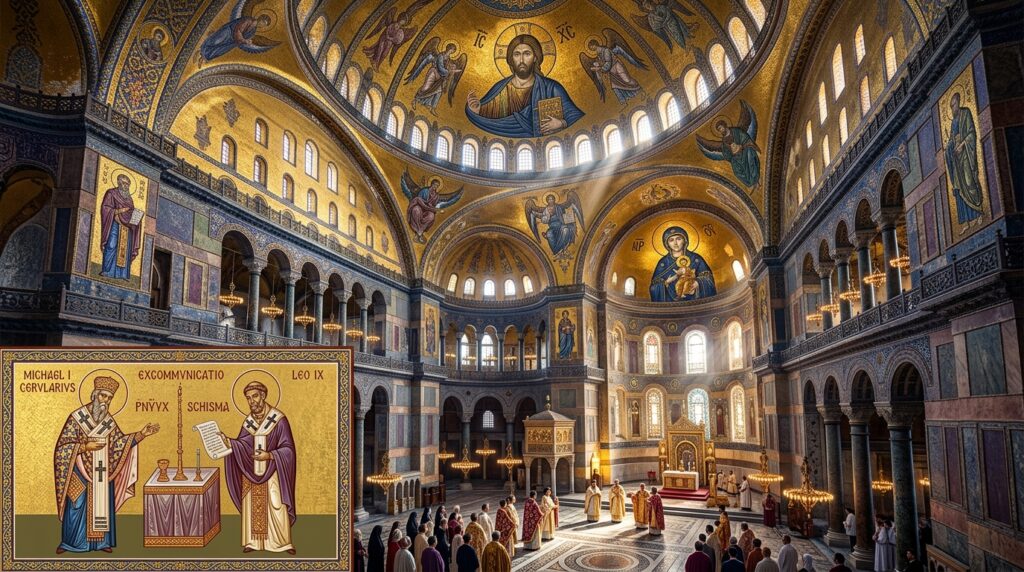
Yet beneath the displays of power and prosperity, cracks were beginning to appear in Constantinople at the start of the new millennium. In 1054, the Christian world officially split into two parts, an event known as the Great Schism. What began as disputes over theology quickly grew into political rivalry, culminating in the division of the Church: the Roman Catholic West centered on Rome and the Orthodox East based in Constantinople. Although at the time many considered it little more than a minor religious quarrel, the unintended consequences of the Schism were so profound that they set in motion a chain of events that would ultimately seal the fate of the city of Constantinople in the coming centuries.
After the Byzantines’ devastating defeat at the hands of the growing Seljuk Turks from the east at the Battle of Manzikert in 1071, Constantinople suddenly found itself very close to a hostile frontier. In response to Turkish pressure, Byzantine emperors sought military help from Western Europe. But this request inadvertently started the Crusades.
Encouraged by their desire to retake Jerusalem from Muslim control, waves of Latin Christian armies began to pass through Constantinople on their way to the Holy Land. Initially, relations between the Catholic Latins and the Orthodox Greeks were somewhat friendly, with Emperor Alexios I Komnenos ferrying the Crusaders across the Bosphorus strait during the First Crusade of 1096 to 1099.
However, as contact between the two groups increased during the twelfth century, so did mistrust, fueled by deep cultural and religious differences. In 1202, the Fourth Crusade was launched to once again retake Jerusalem from Muslim forces who had taken control of the holy city in 1187. The campaign’s initial intent was to go to Egypt and from there on foot to Jerusalem. But a series of economic and political events resulted in the Crusader army being diverted to Constantinople instead.
Hostility and tension between Western Europeans and the Byzantine Empire had been stoked in recent years by the Republic of Venice, which had organized the Crusader army’s sea transport. And when the fleet arrived off the coast of Constantinople, it attacked the city. What followed was the looting and destruction of the greatest city of the Christian world by a Christian Crusader army. For 3 days in April 1204, they ruthlessly looted and vandalized. Churches were stripped of their golden relics. The holy Hagia Sophia was desecrated. Palaces and houses were looted and burned. And countless citizens were killed. Priceless treasures, from classic statues to Christian relics, were carried off by the invading Crusaders. Many of these relics ended up in the churches of Western Europe, including the famous bronze horses of the Hippodrome, which were sent back to Venice and installed to decorate the entrance to St Mark’s Basilica.
The city of Constantinople, which had stood for 9 centuries as the proud capital of the Eastern Roman Empire and one of the most magnificent sights in the whole Christian world, was left a smoking ruin. After the looting, the Crusaders established the Latin Empire over most of the former Byzantine Empire, with Constantinople remaining the capital. Roman Catholic priests replaced Orthodox priests in Hagia Sophia for a time. However, the Latin Empire was unstable and deeply unpopular among the local Greek population. It did not last long.
In 1261, exiled Byzantine forces led by Michael VIII Palaiologos succeeded in retaking Constantinople and restoring the Byzantine Empire, albeit as a shadow of its former self. So much of the city had been turned to ruins or even fields that its population, which had been around half a million before the events of the Fourth Crusade, had fallen to perhaps 50,000. The restored Byzantine emperors tried to revive the capital during the thirteenth and fourteenth centuries. They repaired churches, restored the famous Theodosian walls, and encouraged people to return to the city.
Despite their best efforts, however, Constantinople and the remnants of the Byzantine Empire remained dramatically weak politically and economically. By the end of the fourteenth century, the Byzantine Empire was effectively surrounded on all sides by the expanding Ottoman Turks who had emerged from Anatolia, leaving Constantinople an island of Christian rule in a Muslim Ottoman sea.
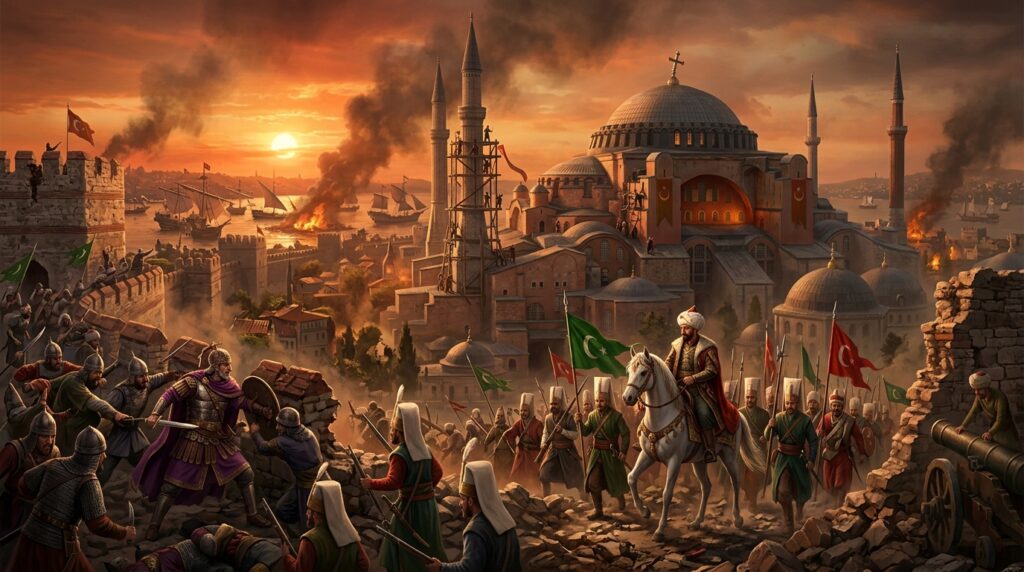
The Turks launched several failed campaigns to capture the city in the early fifteenth century. But in 1453, the inevitable finally came. The young and determined Ottoman Sultan Mehmed II began the siege of Constantinople that ended the Byzantine Empire. On 6 April, Mehmed’s large army, estimated at more than 100,000 men, began bombarding the land walls with large cannons. The Byzantines, led by Emperor Constantine XI Palaiologos, were vastly outnumbered, perhaps only 7,000 defenders. Yet they defended the city bravely.
After a seven week siege, the final assault came on 29 May, when Mehmed’s forces broke through the walls and entered the city. In the bitter fighting that followed, it is said that Emperor Constantine XI took off his imperial purple cloak and threw himself into the thick of the fight before dying in the struggle. With his death, the city of Constantinople, the capital of the Byzantine Empire, after almost 1,100 years of continuous existence, came to an end.
Konstantiniyye, the Ottoman capital
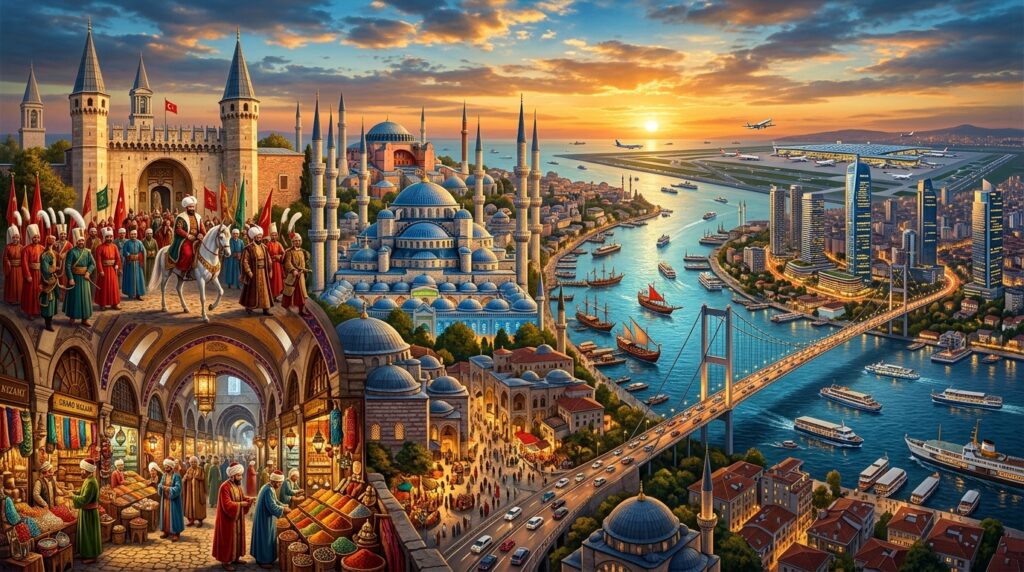
With the Ottoman conquest of 1453, a new era began for the city, and a new name took hold. Immediately, Mehmed II declared Constantinople the new capital of his growing Ottoman Empire. Standing amazed under the dome of Hagia Sophia, Mehmed ordered the cathedral converted into a mosque, symbolically changing the city’s religious identity. The city would officially remain Konstantiniyye, the Ottoman form of Constantinople, for many years. But gradually, “eis tin polin,” a phrase long used by the Greek population meaning “to the city,” became the more common name Istanbul.
Sultan Mehmed II immediately set to work repopulating and rebuilding the city. He invited, and in some cases forcibly moved, people from all over his empire, settling Muslims, Christians, and Jews alike in different neighborhoods to bring life back to the city’s empty streets. From a low of perhaps 50,000 inhabitants at the time of the conquest, Istanbul’s population multiplied within a few decades as the city opened as the capital of a new dynamic empire that soon spanned three continents.
The conquering sultan had a new palace built for himself not far from the old Byzantine acropolis: Topkapi Palace, construction of which began in the 1460s and was greatly expanded by successor sultans over generations. Unlike European palaces, Topkapi was not a single monumental building, but a sprawling complex of courtyards, gardens, and pavilions, a serene seat of power with views of the Bosphorus strait.
Mehmed II also established the city’s Grand Bazaar during this period, which eventually grew into a vast covered market, a labyrinth of shops where merchants traded jewels, spices, textiles, and every imaginable luxury item, making it the beating commercial heart of the city, as it still is today. The sultan also sponsored the construction of mosques, schools, baths, and caravanserais, laying the foundations of an Islamic city, but one that also included and honored its Byzantine heritage. Notably, Mehmed allowed the Greek Orthodox Church to continue its presence in the city, although under Ottoman supervision, and similarly the Armenian Church was invited to establish a patriarchal seat. The Jewish community was also welcomed, especially after 1492, when the Spanish expulsion forced many Sephardic Jews to seek refuge in Ottoman lands. Thus, Istanbul remained a cosmopolitan multi ethnic center, now under Muslim rule, but still home to significant Christian and Jewish populations.
The beginning of the 16th century marked the rise of the glory of Ottoman Istanbul. The city became one of the largest cities in the world, with its population estimated to reach 600,000 to 700,000 by the middle of the 16th century, rivaling and even surpassing many European capitals of the time. Sultan Suleiman the Magnificent presided over this golden age and was a great patron of art and architecture.
It was during his reign that the architect Sinan, probably the greatest Ottoman architect, rose to fame. Sinan began as a Janissary officer but discovered his talent for construction, and after being appointed chief royal architect, he designed hundreds of structures across the empire and in Istanbul. His masterpiece was undoubtedly the Suleymaniye Mosque complex, completed in 1557, a magnificent domed mosque built in honor of Sultan Suleiman on the city’s third hill.
Other notable mosques soon followed, with Sultan Ahmed I ordering the construction of the magnificent Blue Mosque in the early 17th century. Such pious foundations and architectural patronage filled the city with domes and minarets, creating a distinctive skyline where Ottoman aesthetics merged with Byzantine remains.
Life in Ottoman Istanbul was vibrant. Topkapi Palace was filled with royal ceremonies. Great viziers and officials held council in the Divan. Janissary guards patrolled the grounds, and in secluded courtyards was the royal harem where the sultan’s family and concubines lived in luxury.
In the greater city, streets were filled with a diverse population. Turkish officials and soldiers, Persian and Arab scholars, Greek and Armenian merchants, Venetian and French diplomats in their fine clothes, dervish Sufis, and craftsmen and laborers of every race. Coffeehouses became popular social centers in the 16th and 17th centuries where people met to talk, listen to storytellers or poets, and drink the stimulating beverage that had traveled from Arabia.
But like the Byzantines before them, the Ottoman Empire began to decline after centuries of dominance. By the late 17th century and into the 18th, military defeats and administrative stagnation forced European contemporaries to call it the sick man of Europe. Istanbul experienced this decline in different ways: economic strain, technological backwardness, and occasional unrest. Yet the city remained the seat of power and adapted to changing times.
During the 18th and 19th centuries, Ottoman rulers launched reforms to keep pace with the modern world and prevent the partition of the empire. Istanbul as the capital became a showcase of the Tanzimat reforms and Western influences. Sultans such as Mahmud II and Abdulmejid I tried to modernize all aspects of Ottoman society, including introducing European style architecture and facilities to the city.
Alongside traditional wooden Ottoman houses and modest urban buildings, magnificent European neoclassical administrative buildings, baroque style mosques, and theaters began to appear. The Beyoglu district near the Golden Horn became a fashionable quarter where many European diplomats and merchants lived. The famous Galata Tower, originally a medieval Genoese watchtower built in 1348, now stood among new buildings housing foreign banks and Western style businesses, showing the blend of old and new.
The sultans also tried to modernize their residential arrangements during the 19th century. In 1856, Sultan Abdulmejid I moved the royal residence from Topkapi Palace to the newly built Dolmabahce Palace on the Bosphorus shore. It was designed in a European neoclassical and baroque fusion style with crystal chandeliers, grand staircases, and ornate ballrooms modeled on the royal residences of Paris and Vienna.
Technological progress also came to the city. In 1875, Istanbul inaugurated a short underground funicular line called the Tunel, the second oldest subway in the world after London. Horse drawn trams began running in the streets in the late 19th century, later replaced by electric ones in the early 20th century. The first photographs taken in the city’s streets show scenes where women in Victorian era clothes and men in frock coats walk alongside Ottoman men in fez and traditional dress.
The Ottoman intellectual scene in Istanbul was also buzzing with new ideas. Newspapers began to circulate, some in Turkish, others in French or minority languages, debating reforms, nationalism, and science. Politically, by the 19th century, Istanbul was a hotbed of intrigue. The once absolute authority of sultans was rapidly being challenged. In 1876, Sultan Abdulhamid II briefly allowed a constitution and the convening of a parliament to please reformers, only to suspend it and soon rule autocratically. As a result, secret societies formed and reformers conspired in the shadows to limit the sultan’s power and modernize the empire.
Istanbul, the city that outgrew its empire
With the arrival of the 20th century came further upheaval. In 1908, the Young Turk Revolution broke out, led by progressive elements within the army and bureaucracy, forcing Sultan Abdulhamid II to restore the constitution. Istanbul briefly rejoiced at the promise of democracy and reform, but the following years were even more turbulent for the city as the Ottoman Empire was dragged into the devastation of the First World War in 1914.
As the nation’s capital, Istanbul saw wartime mobilization and even some battles fought nearby, such as the attack by invading Allied forces at Gallipoli in 1915. Overall, the war was disastrous for Istanbul and the Ottoman Empire. After being defeated on virtually all fronts, the Ottomans agreed to an armistice in October 1918, and British, French, Italian, and Greek Allied forces occupied Istanbul in November.
For the next several years, the city remained under de facto foreign control, with Allied soldiers patrolling the streets and warships standing menacingly in the Bosphorus strait. The once supreme Ottoman government was now under the supervision of victorious foreign powers, and negotiations were underway to divide the remains of the Ottoman Empire among them under the harsh Treaty of Sevres of 1920, which envisaged Istanbul itself under an international zone.
Although even during the occupation of Istanbul, the seeds of a Turkish resistance were sprouting. Mustafa Kemal Pasha, later known as Ataturk, an Ottoman military officer and hero of the Gallipoli campaign, gathered nationalist forces across the country and led the Turkish War of Independence, which began in 1919. Istanbul, for the most part, remained relatively unaffected by this conflict, largely because of the large number of foreign forces occupying the city.
However, by 1922, Turkish nationalists had defeated invading forces across Anatolia and forced a new round of peace negotiations on better terms. The Allies, tired and facing determined Turkish unity, agreed to withdraw, and after the signing of the Treaty of Lausanne in July, ended their occupation of Istanbul in October 1923, which formally recognized the new Republic of Turkey.
Moreover, in a dramatic historical break, the Ottoman Empire was abolished, with the last sultan Mehmed VI leaving Istanbul on a British ship, thus ending the 623 year old dynasty.
The Republic of Turkey was proclaimed on 29 October 1923, and Mustafa Kemal Ataturk became its first president. Importantly, the new republic made the historic decision to move the capital from Istanbul to Ankara, the first time in 600 years that the city was not a capital.
After that, Istanbul suddenly found itself reduced in political status and no longer the seat of government. The population declined significantly, to perhaps around half a million people, a sharp decline from more than one million inhabitants in 1914. This demographic shift also included the departure of most of the Greek Orthodox population. Although Istanbul’s Greeks were exempted from the highly disruptive Greek-Turkish population exchange of 1923, which moved Greeks from Anatolia and Turks from Greece, life for all minorities within the city became difficult under the rising wave of Turkish nationalism. Thus Istanbul, once famous for its cosmopolitan mix of peoples, became much more homogeneously Turkish Muslim in character.
Meanwhile, under Ataturk’s leadership, Turkey pursued rapid modernization and secularization, and Istanbul certainly felt its effects. Religious schools were closed, and secular law replaced sharia courts. Ataturk emphasized a break with the Ottoman past. The Arabic script of the Turkish language was replaced in 1928 with a new Latin alphabet, which Istanbul’s press and newspapers quickly adopted.
Importantly, Constantinople officially became known as Istanbul on 28 March 1930, when the Turkish government passed a postal law mandating the use of the new name. Women were also given civil rights and encouraged to unveil, and the once ubiquitous fez was banned. Istanbul’s role transformed into Turkey’s commercial and cultural center while Ankara took over power and politics.
This pace of modernization continued through the rest of the 20th century, with the city undergoing major urban changes. Wide boulevards were cut through ancient neighborhoods. Taksim Square was laid out, and the first Bosphorus Bridge opened in 1973, connecting Europe and Asia by road for the first time.
Starting in the 1960s, Istanbul experienced explosive population growth. Waves of migrants from Anatolian villages came to the city seeking jobs in its growing factories and businesses. The result was rapid, often uncontrolled expansion. Entire new neighborhoods sprang up to accommodate the growing population, which grew from 1.5 million in 1960 to more than 10 million by 2000.
The city developed further in the early years of the new millennium as modern skyscrapers and business centers were built in the northern districts, transforming Istanbul into Turkey’s economic powerhouse.
Today, Istanbul stands as one of the world’s largest megacities, with more than 15 million people. Although in recent years, it has found itself at a kind of crossroads as more contemporary attitudes are adopted in the rest of the country, the city’s political, geographical, and historical position ensures that whatever direction the future takes, Istanbul will continue to shape and be shaped by the forces that have defined it for millennia, standing as always between continents and civilizations, where East meets West.
Three names, three lives, one peninsula. Byzantion traded, Constantinople prayed and ruled, Istanbul builds and sells. The names changed because the city kept changing what it was for. That is why it is still here, and why it will probably outlive the next name too.
Read also: The Complete History of Constantinople/Istanbul: From Greek Byzantium to the Ottoman Capital
Read also: The Evolution of Constantinople From Byzantium to Istanbul