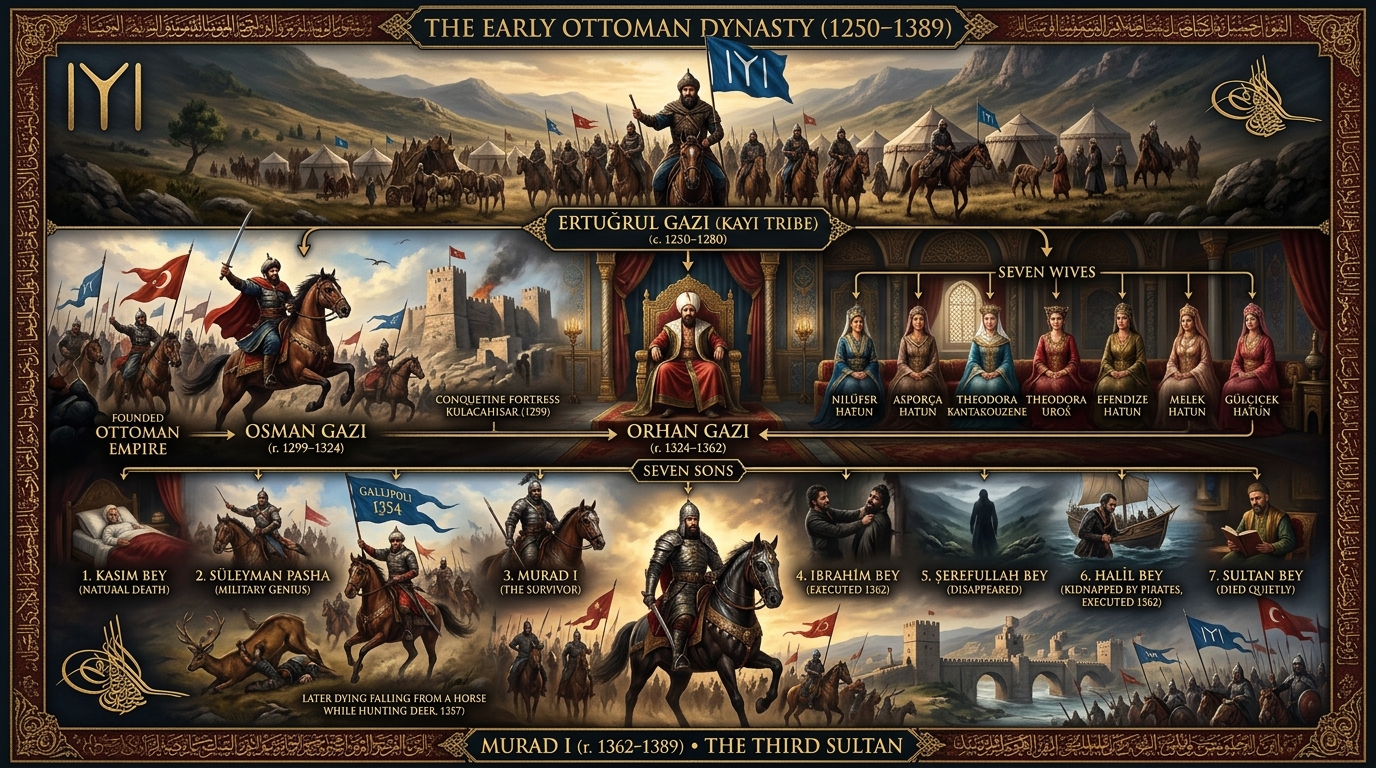
One father, seven sons, one throne. And when the dust settled, only one man stood. This is no TV show. This is real history.
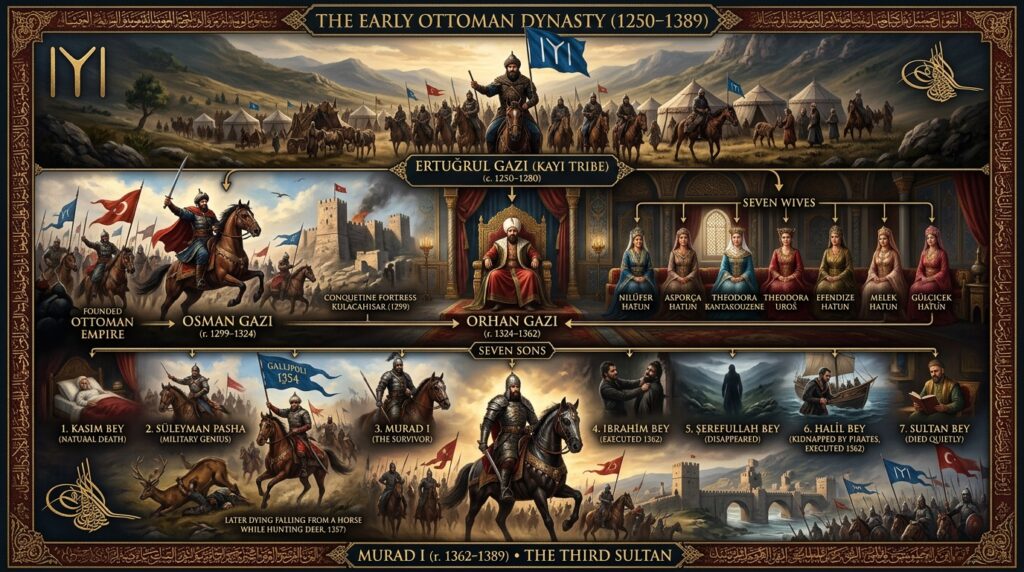
Let us start from the beginning. Because to understand what Murad did and why, you must first understand the family he came from. And believe me, this family is unlike anything you have ever seen. Today, we will go through it together, starting right here, from the very top.
The family at the top
This person, Ertugrul Ghazi. This is where everything begins. He is the grandfather of our central character today, and he led a small Turk tribe, the Kayi tribe, somewhere in the hills of Anatolia. He died around 1280, and he transferred everything to his son.
His son, Osman Ghazi. And if that name sounds familiar, it should. The word Ottoman literally comes from Osman. This person took his father’s small tribal organization and turned it into a real state. He declared himself ruler in 1299, began conquering Byzantine cities, built a government, made laws. He is the true founder of the Ottoman Empire.
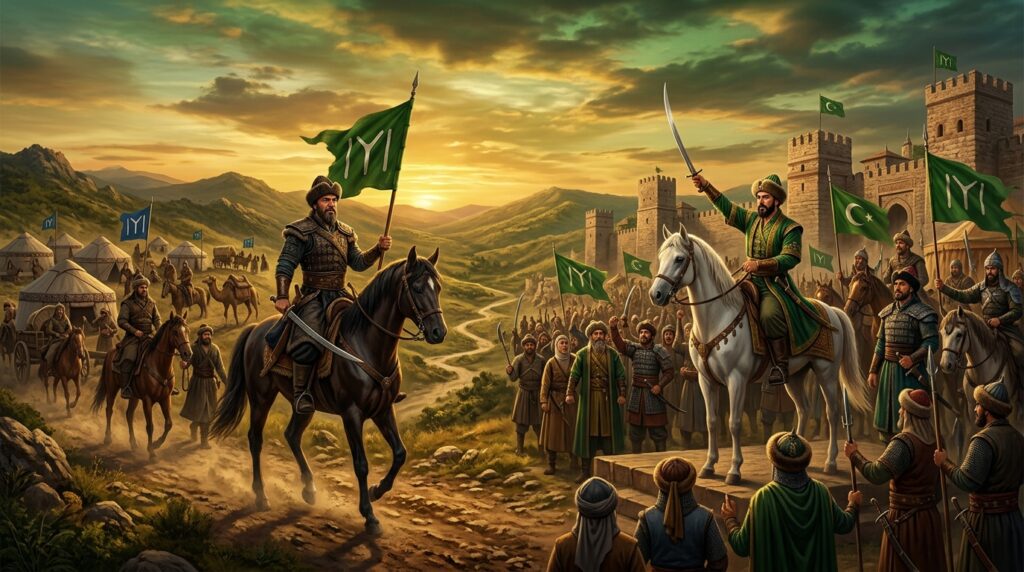
Now, Osman had two wives, Mal Hatun and Bala Hatun. And from them many children were born. But the one most important for our story today is his son, Orhan. Right here.
Orhan Ghazi. This is our central character, born in 1281. He took power from his father around 1324 and ruled until 1362, almost 40 years on the throne. And in those 40 years, he took the land left by his father and made it six times bigger, six times! He is the first Ottoman ruler who formally called himself sultan. The famous Arab traveler Ibn Battuta met him and said: “This person is the greatest among all Turkmen rulers.” This is big praise from a person who had traveled the whole known world.
Seven marriages, seven mothers
Now, look at all these women in this row. These are Orhan’s seven wives and concubines, seven. And every marriage was strategic.
You have Nilufer Hatun. She was actually a Byzantine woman called Holophira. And Orhan married her. She accepted Islam, changed her name, and became one of the most respected women in early Ottoman history. She built mosques, a bridge, a lodge, and she lived so long that she saw her son become sultan. She is considered the first Valide Hatun, the queen mother of the empire.
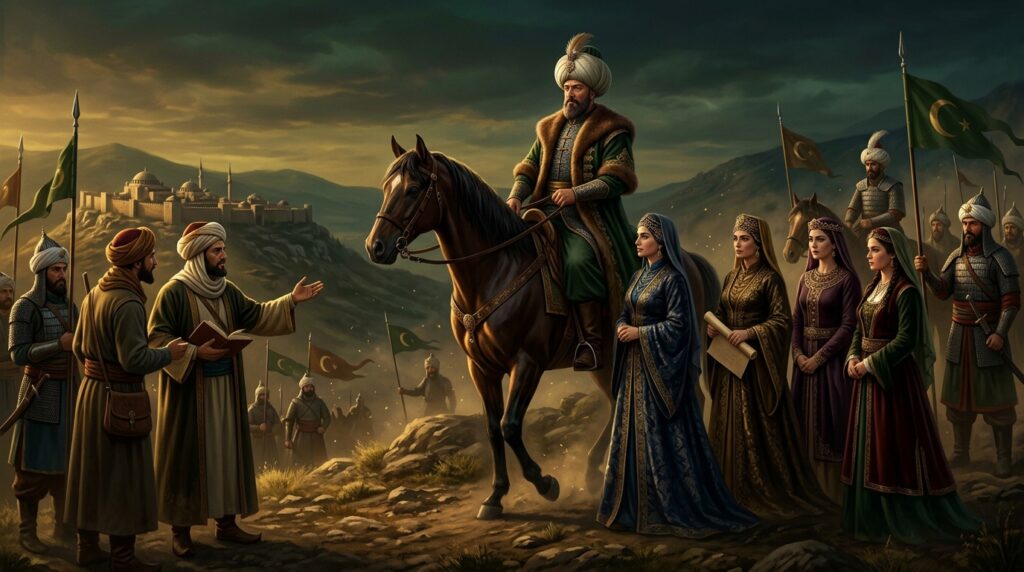
Then Aspurca Hatun, a Byzantine princess, whose 1323 marriage document is literally the oldest Ottoman document existing today.
Theodora Kantakouzene, the daughter of the Byzantine emperor himself, married Orhan in 1346 as a political deal. She never converted religion, remained Christian all her life, and Orhan was completely happy with her.
And then a Serbian princess, who married him around 1351 when Orhan was almost 70 years old, 70! This person was making political alliances even in his 70s.
The seven sons, one by one
This is where it really gets interesting. Come down here. These are the sons with Orhan Ghazi. And each one’s story is completely different.
Start from the left: Qasim Bey. His mother was Nilufer Hatun, that famous Byzantine woman who had accepted Islam. He died in 1346, quietly, from natural causes, during his father’s lifetime. Natural death. Buried in Bursa. Another son Orhan himself had to bury. Gone before the real war even began.
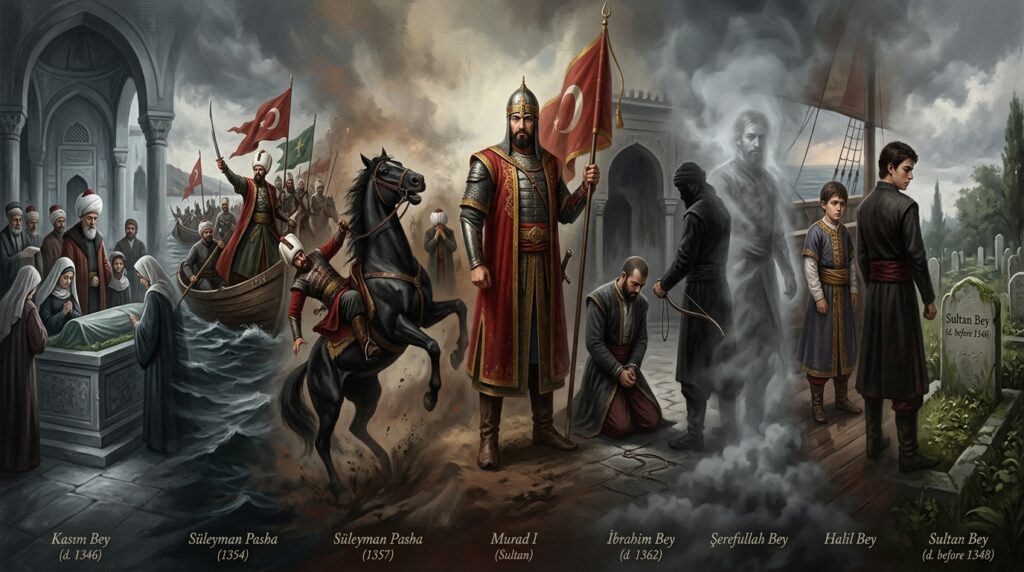
Right beside him, and this is really important, Murad I. He is also Nilufer Hatun’s son. The same mother as Qasim. He watches as every brother falls one by one, and he still stands, the survivor. The one who changes everything. Remember this name.
Moving on: Suleyman Pasha. His mother was Efendize Hatun, Orhan’s own cousin. And this son is the star of the whole family tree, a military genius. Made vizier. In 1354, he enters Europe with 10,000 soldiers, the first permanent Ottoman crossing into Rumelia. He never returned, not because he was defeated, but because he chose to stay there and continue conquests. Everyone assumed he would be the next sultan. Then a hunting accident: he fell from his horse in 1357. Just like that, ended. And Orhan was completely broken. Historians say he mentally collapsed after losing Suleyman. He never really recovered.
Next: Ibrahim Bey. Son of Aspurca Hatun, that Byzantine princess whose marriage document is literally the oldest Ottoman document. Ibrahim served as governor of Eskisehir, a strong administrator, did his work, kept his head down. But when the throne became vacant, none of this mattered. We will come back to him.
Then: Sharafullah Bey. He is also Aspurca Hatun’s son, the same mother as Ibrahim. He is mentioned in a few basic documents and then disappears from history. No record of his death or where he went. Fate completely unknown, the mysterious son.
And next: Khalil Bey. His mother was Theodora Kantakouzene, the daughter of the Byzantine emperor himself. His story is really the most sensational. As a small child, he was kidnapped by Genoese pirates, snatched from the Izmir coast. And Orhan had to arrange a ransom through the Byzantine emperor to get his own son back. He came home, but his own brother ordered him executed.
And at the far right: Sultan Bey. His mother was Malik Hatun, one of Orhan’s lesser-known concubines. He is the first son whose name appeared in an official Ottoman document, a 1324 decree. But this is all we know. He died quietly before 1348, during his father’s lifetime. The firstborn, the first forgotten. But that safety was temporary.
One father, different mothers, completely different ends.
1362, the year of the throne
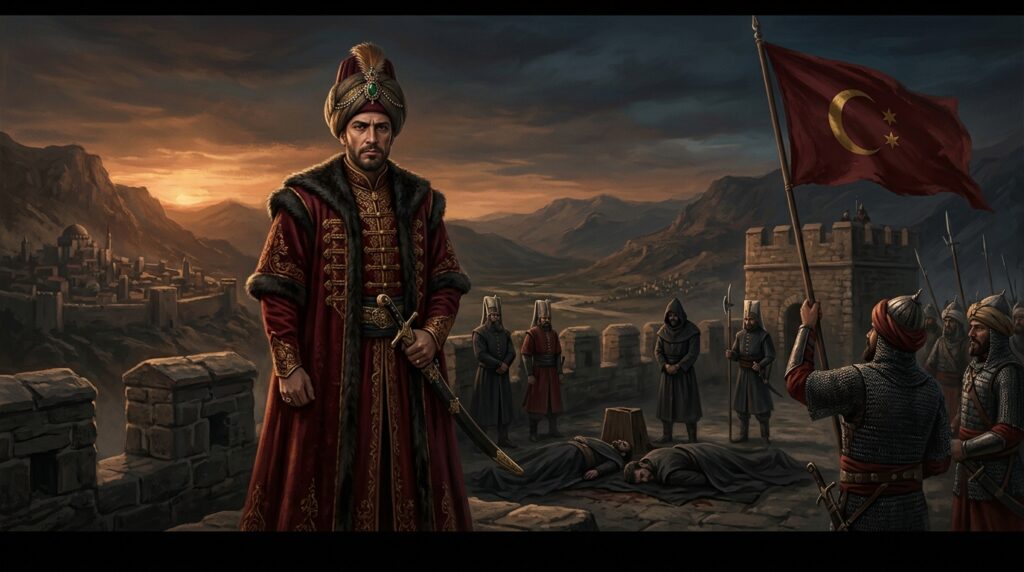
So what happens here when Orhan dies in 1362. He was 79 years old. His best son Suleyman was already dead. His other sons, some died natural deaths, some were still alive. And now there is a throne to be taken.
Murad I steps forward. He is Nilufer Hatun’s son, that Byzantine woman who had accepted Islam. He is experienced: he is fighting in Rumelia. He knows the army, he knows politics. He is ready. And as soon as he takes the throne, he moves fast: Ibrahim Bey executed, Khalil Bey executed. Both half-brothers ended in the same year, 1362.
Now, before judging this as mere cruelty, this was actually an established practice in the early Ottoman world. The idea was simple and ruthless: one throne, one ruler, no rivals. Leave your brothers alive and you open the door to civil war, rebellion, the empire breaking apart. Murad did not enjoy it, but he did it. And it worked.
The count
So when you look at this whole family tree and ask: “What happened to Orhan Ghazi’s seven sons?”
Two died natural deaths, before anyone fought for the throne. One died in a horse riding accident, and never got his chance. Two were executed by their own brother as soon as he became sultan. One disappeared completely from history. And one, only one, became sultan, expanded the empire into Europe, and kept the family alive for five and a half more centuries.
That one was Murad I. And the Ottoman Empire he inherited from his father Orhan would go on to produce 36 more sultans, conquer Constantinople, and rule for more than 600 years. All this began right here: from Ertugrul’s small tribe, Osman’s vision, and Orhan’s 40-year patient, magnificent expansion.
Read also: The Entire History of the Ottoman Empire: Origins, Osman Gazi, and the First Victories
Read also: The Ottoman Sultan Who Defeated Europe’s Crusaders but Lost to His Own Ego Against Timur