At the end of World War I, the Ottoman Empire paid a heavy price for choosing the wrong side. The victors, Britain and France, moved forward and began cutting it to pieces. Then an army emerged from somewhere, drove the invaders out of their land, and declared the Republic of Turkey. All this happened because of one person: Mustafa Kemal, or as he later became famous, Ataturk, father of the Turks.
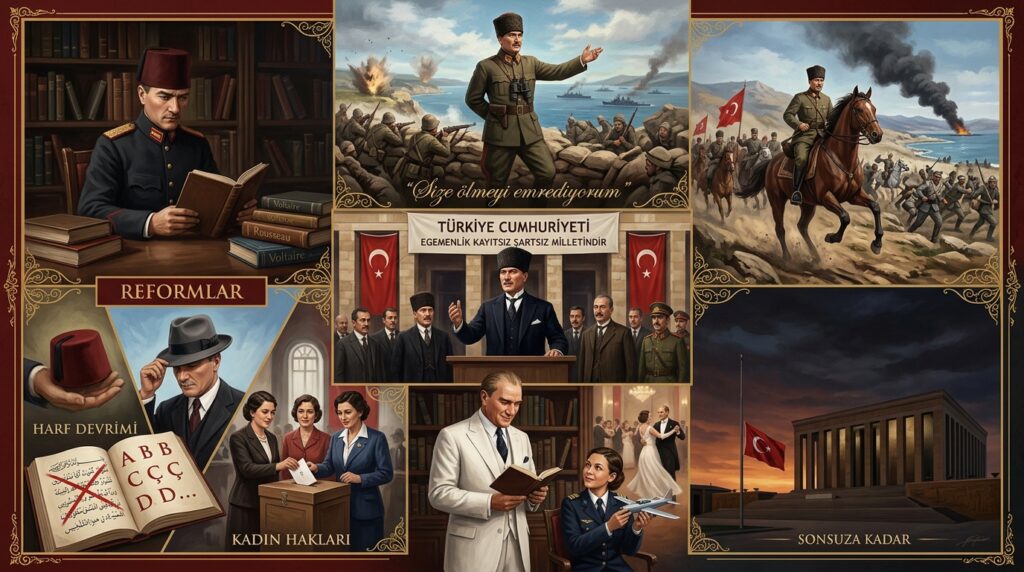
Ataturk had immense ambitions for himself and his people. He considered freedom only a beginning. He would change not only the government, but the people’s dress, worship, writing, and way of naming, individually and as a nation.
Ataturk fell on Turkish society like an atomic bomb, a flood, or an earthquake. No metaphor can fully capture the extent with which he changed Turkish society and his astonishing resolve. This is the first country where a majority Muslim population adopted a secular system. He said: OK, this will be the principle, this will be our future, and our future will be a democratic and secular state.
Ataturk was committed to the concept of a republic. He wanted the people to govern themselves. Yet in many ways he was an elitist: he believed the elite must change society for the people’s good. His political party’s slogan was: “For the people, despite the people.”
The sick man and the boy who watched it die
Young Mustafa was born on the edge of a dying Islamic empire, vanishing before his eyes. In the 1600s, the vast Ottoman Empire, with its diverse Muslim, Christian, and Jewish populations, was looked upon with fear and envy throughout the world. But by the late 1800s of Mustafa Kemal’s childhood, it had lost more than half its lands to rival empires and Christian nationalists in the Balkans. With each new defeat, more poor, illiterate Muslim refugees kept coming to Anatolia, the Ottoman center. Neighboring states began calling the Ottoman Empire the “sick man of Europe.”
Ataturk was growing young when Muslims began asking each other: what happened? Last time we looked around the world, Europeans lived in caves and wore animal skins. And we had telescopes, we were studying mathematics, and we were writing sophisticated poetry. And then we focused on our affairs for a few centuries, and now we are behind.
One after another, reform groups emerged. Believing he was born for greatness, young Mustafa moved toward the empire’s most reformist, most prestigious institution: the army, whose military schools offered higher education. There, he absorbed the writings of the great French philosophers. These were very dangerous books because they talked about freedom. In contrast, in the Ottoman Empire people grew up under the Quran. The Quran was a sacred thing, you cannot criticize it, you cannot interpret it, you cannot ask questions about it. So they thought Islam was part of the problem.
Gallipoli made him
The more Mustafa Kemal compared East and West, the more he questioned the direction of his government. And he was not alone. In 1908, a reform group, called the Committee of Union and Progress, took over the government, and made the traditional ruler, the sultan, a symbolic figure. The world would know these reformers as the Young Turks.
The Young Turks’ basic aim was to save the empire. They were brave, revolutionary, but also too attached to the status quo. Kemal joined the Young Turks, but never entered their inner circle. He criticized when they decided to enter World War I on Germany’s side, hoping to regain lost territory and prestige. And he criticized even more when they began issuing disastrous orders. Their abilities never matched their ambitions. But Mustafa Kemal’s abilities could.
The world first learned this in an area called the Dardanelles, on the Gallipoli peninsula. The Dardanelles strait connected the Mediterranean to the Black Sea, and Western Europe to Eastern Europe and Russia. Whoever controlled it would probably win the war. The First Lord of the Admiralty sitting in London, Winston Churchill, was looking at the map and understanding that we need to control these straits. By then, in Europe, Turks had been considered for a century a declining, tired race, and in Churchill’s or his aides’ minds there was no doubt that this was a war they could win.
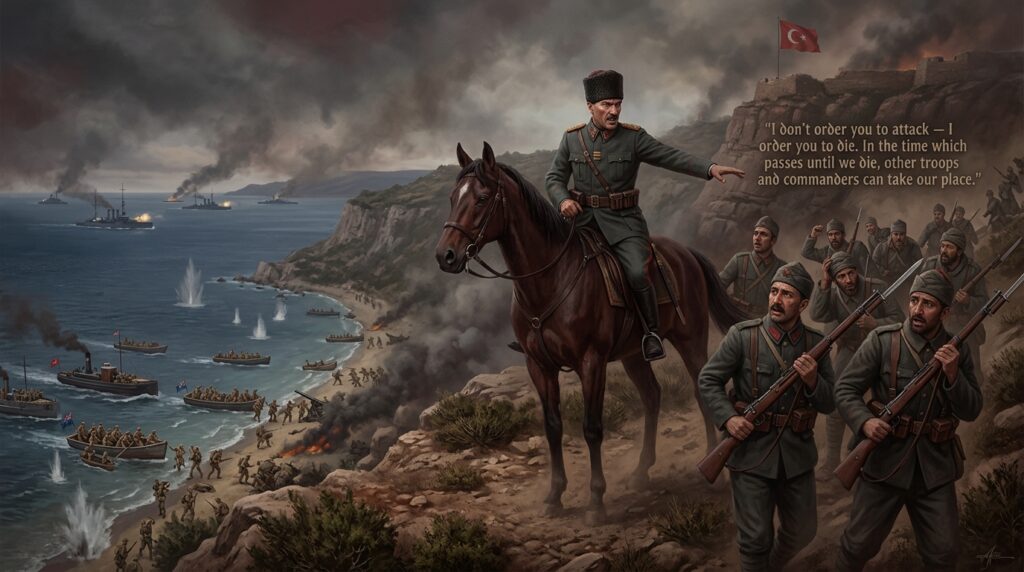
On 25 April 1915, 500,000 British, Australian, and New Zealand troops landed at Gallipoli, one of the largest amphibious attacks ever. As they advanced, Ottoman soldiers ran out of ammunition and scattered retreating. Only one lieutenant colonel, Mustafa Kemal, alone stopped the Ottoman retreat. If they did not have bullets, they had bayonets. “I do not order you to attack,” he said. “I order you to die.” For the whole world, and certainly for Winston Churchill, the shocking thing was that the Turks, with great steadfastness, not only held the peninsula, but finally drove out all Allied forces.
Gallipoli’s victory of Mustafa Kemal made everything after possible.
But his path was complicated by a horrific campaign started by the Young Turk government, which left an indelible mark on world public opinion. While Kemal was fighting British and Allied forces on the western edge of the empire, the government unleashed its wrath in the east on its own subjects, the Armenians. The Armenians, a large ethnic community, a minority, a Christian minority in eastern Anatolia, wanted independence. The Turkish response was absolutely zero tolerance. They decided to deport the Armenian communities. And this deportation turned into a great massacre. Between 800,000 and one million Armenians, perhaps even more, died. Many were deliberately killed, many died of hunger or cold. The Ottoman Empire’s famous ethnic and religious tolerance died with the Armenians.
From death sentence to a republic
When World War I ended in the complete defeat of the Ottomans, the treaty that followed, called the Treaty of Sevres, confirmed Kemal’s worst fear. The punishment imposed on Turkey was extremely harsh. The Turkish homeland, what we today call Turkey, was to be cut and divided among the victorious Allied powers. Provisions were made for a possible Armenian state, a future Kurdish state, and the Turks were to be left a small, mountainous area around Ankara.
When the Young Turk leaders fled abroad, the sultan bowed before his new masters, Britain and France. He ordered his royal army disbanded, and sent Mustafa Kemal to the back areas of Anatolia for supervision. Instead, Kemal, as he did at Gallipoli, seized the opportunity and did what he thought was right. He mobilized soldiers and began training them for the war of independence.
When the sultan learned, he sentenced Kemal to death. Kemal’s response was to establish an alternative government, with elected representatives, and sovereignty reserved for the people, a radical idea for the sultan’s long-time subjects. Then Kemal began mobilizing the people to fight for freedom.
But after four years of war, deprivation, and death, an old farmer answered on behalf of many people. He said: “General, I lost one son in the snows of the Caucasus, and a second son in the hell of Arabia. I have nothing to give. Until the enemy comes to this corner of my field, I will do nothing.” Mustafa Kemal told them they would above all be fighting for the future of this small piece of their land, because without this fight, the Greeks, Armenians, British, French, those imperial powers that won World War I, would conquer their land.
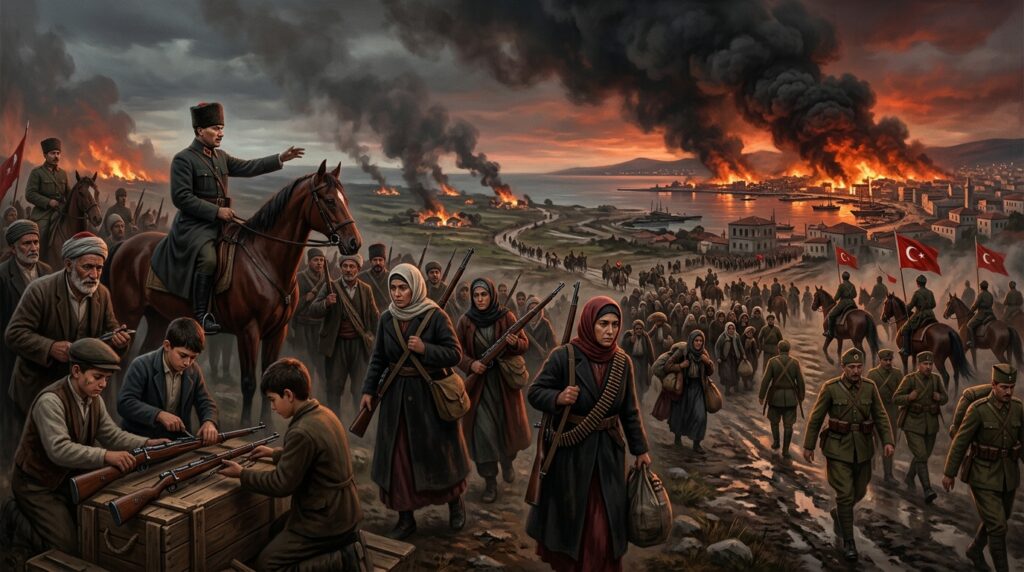
The greed of World War I’s victors played into Kemal’s hands. British soldiers occupied Istanbul, while Greece, once an Ottoman province, sent its army inland to destroy Ataturk’s forces. Western powers will come in and we Turks will become a minority on our own land: this feeling united everyone. Old men and boys collected rifles and guns by hand, women carried weapons on their backs, volunteers trained, and the army grew strong. Then they attacked.
In two decisive battles, Ataturk’s soldiers stopped the Greek advance. But the Greek army’s retreat left a mark of death and destruction. They adopted a scorched earth policy: burned many villages, destroyed crops. Many ethnic Greeks, who for centuries were Ottoman subjects, joined the retreating Greek army. In anger, Turks turned against them. It was full of brutality: Greeks taking revenge, Turks taking their revenge.
In September 1922, after three years of bitter fighting, Ataturk’s forces drove the Greek army into the Mediterranean at the city of Izmir. Most of the city was razed. Thousands died, millions became refugees. Amid chaos and destruction, one thing was clear: the Turkish victory was complete. The invaders left, the borders were secured, and Ataturk was ready to make peace.
Ataturk had rebelled against the whole Allied power, and effectively ended the Treaty of Sevres. He said: I have now changed the facts on the ground. You no longer control Anatolia, we control it. In 1923, a new treaty, Lausanne, was established, and the Republic of Turkey came into being.
Ataturk then turned away from the Ottoman Empire’s 700-year imperial ambitions and wars, and told the world Turkey would stay within its borders. His world politics slogan was: “Peace at home, peace in the world.”
To guarantee his desired peace, Ataturk had to end the blazing hatred between ethnic Greeks (Christian) and their long-time Muslim neighbors. The governments of Turkey and Greece together found a harsh solution: a population exchange. Millions of ethnic Greeks and Turks were forced to leave their only homes. The Greeks of Anatolia, who were there since ancient times, had to go. Yet the alternative was civil war.
The second revolution
When Mustafa Kemal established his new government, after ten continuous years of war, his country had lost a fifth of its population from war, ethnic cleansing, hunger, and exile. And what was once a multicultural empire had become a republic 98 percent Muslim. Most Greek and Armenian Christians had left, and with them, most of the educated middle class. Almost every person living in Turkey was an illiterate peasant. There were no roads, no schools, no hospitals, no industrial base, no factories, no exports. Nothing. Turkey was a shattered, backward country.
But Turkey’s terrible experience proved a golden opportunity for Ataturk. The vision, decision-making, and resolve he had shown before paled compared to what he was about to do. He basically uprooted Turkish society from its roots, and turned it away from the Middle East completely toward the West, Europe.
Ataturk first abolished both institutions, the sultanate and the caliphate, separated the mosque from the state, and deprived Islam of its political power. One of the first laws was that the Sharia part of the Quran was abolished: keeping four wives, cutting the hand of a thief, and all other Sharia laws were abolished, and modern laws were brought. Ataturk was above all a secularist. He believed the power of religion over public life must be broken before people can progress.
To counter Islam, Ataturk presented the ways and ideas of the same people he had been fighting for three years as a model. He called it not modern or Western, but “contemporary.” For him there was no clash of civilizations, only one universal civilization, and Turkey had to catch it.
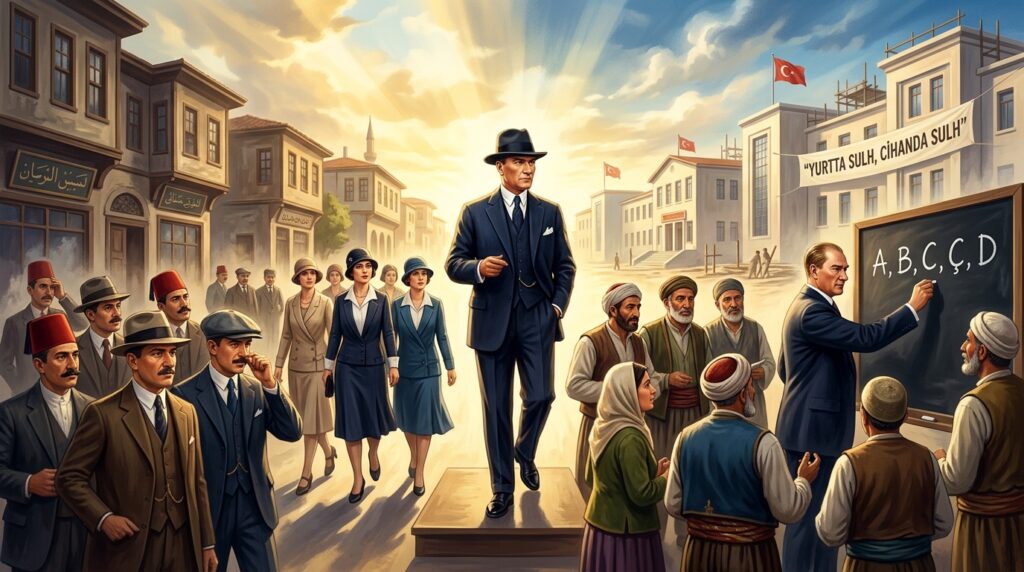
Between 1924 and 1934, Ataturk closed all religious schools and courts, and replaced them with a state education and judicial system. He banned the fez and forced men to wear Western hats. He gave women equal rights and the right to vote. Since most Turks had only one name, he ordered everyone to add a surname. And he changed the numbers and the alphabet.
Ataturk called his reform campaign a war against the “black cloud of ignorance” he saw hanging over his nation. Experts claimed the language change would take six years. Ataturk ordered it finished in six months.
During Ataturk’s 15-year rule, when he first became president, the literacy rate was 10 percent, and his new nation could not even make matches. When he died in 1938, the literacy rate had doubled, industries were producing everything from textiles to cement, and Turkey was exporting crops to Europe.
The dictator who built a republic
But Ataturk was a dictator, there is no doubt about it. He could not achieve in a democratic framework what he did. His response to rebels and Kurds was swift and harsh. The Kurdish language was banned, and Kurds were publicly called “mountain Turks.”
Yet, by the time of his death, Ataturk’s praise had spread far beyond Turkey’s borders. The West welcomed Turkey’s stability and its lack of desire for regional expansion. The Greek prime minister, who had fought against Ataturk before, nominated him for the Nobel Peace Prize.
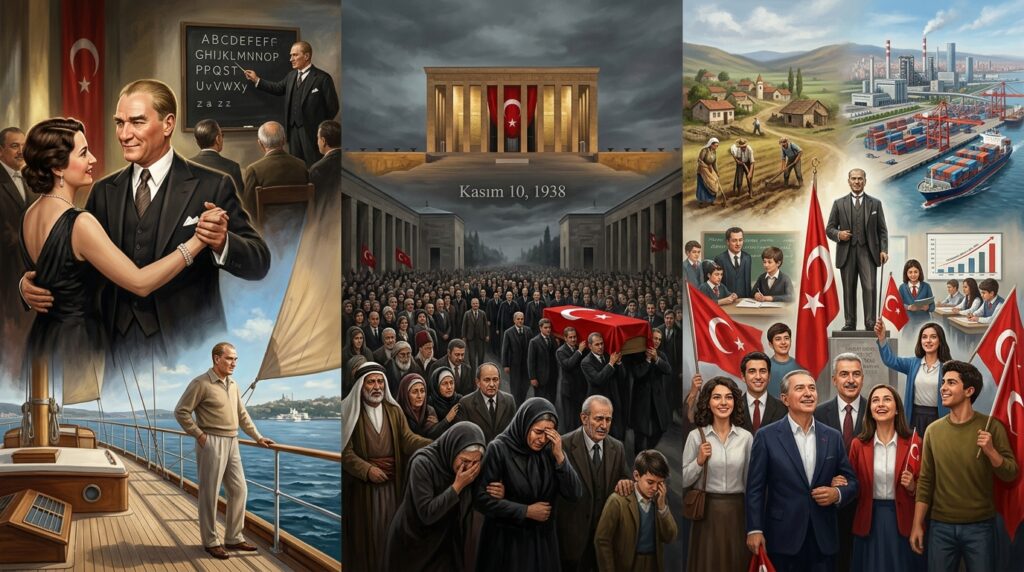
On 10 November 1938, Mustafa Kemal Ataturk died. He was 58 years old.
Today, Turkey is a nation-state. It is mostly secular, as secular as can be in the Islamic world. Turks are very nationalist: they love their country, they love their state, and they love Ataturk.
Read also: The Ottoman Empire: Decline, Reform, and the Birth of Modern Turkey (1804-1923)