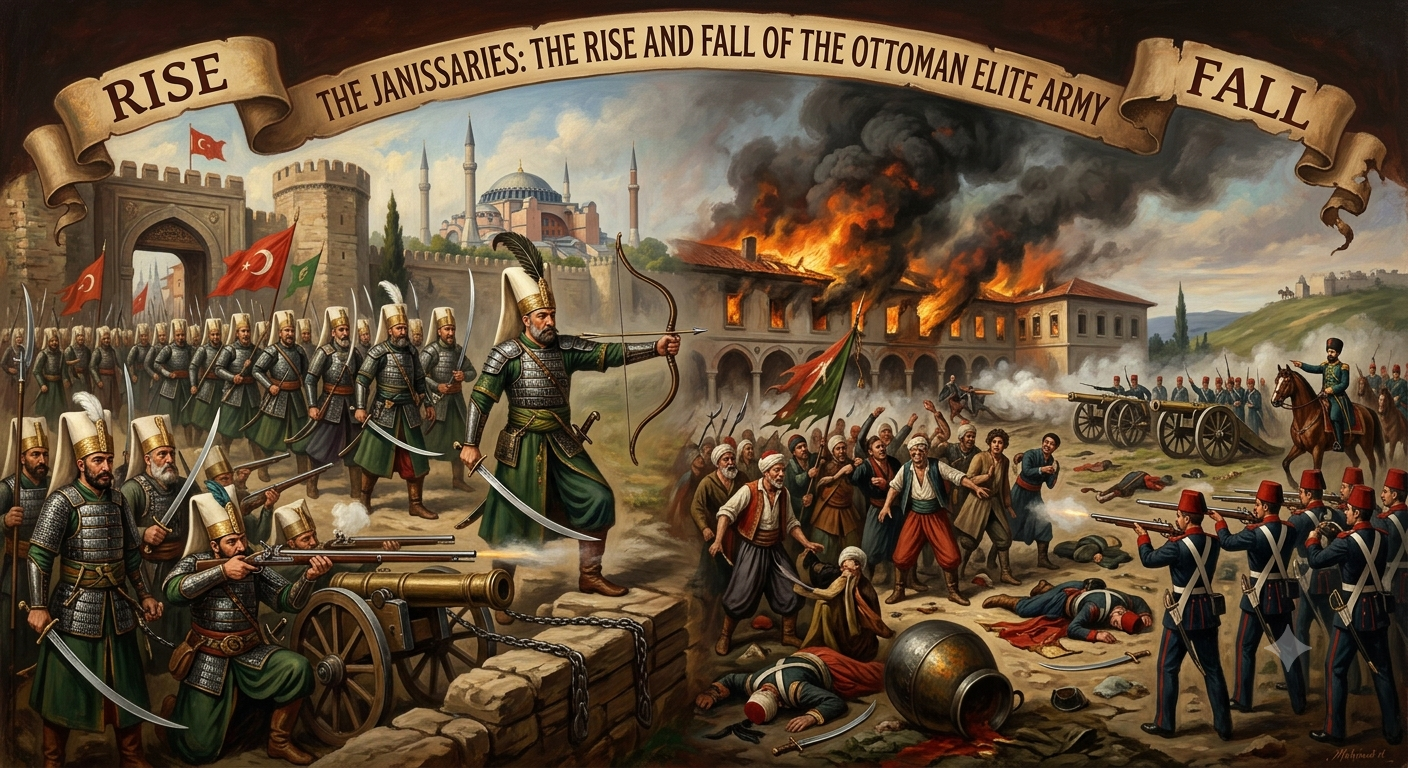
The Ottoman Empire’s six and a half centuries of history are known for conquests and vast area, but a big credit goes to its unmatched military system. The backbone of the Ottoman army, and the world’s first organized standing army, was called the Janissaries.
This corps was its time’s most organized, disciplined, and dreadful military corps, before which Europe’s great kings trembled. But history’s strange tragedy is this: the army that took the Ottoman Empire to the heights of glory, at a point in time, became the biggest threat to the empire itself.
The perfect weapon
The Janissaries, in Turkish Yeniçeri, meaning new army, were founded in the mid-14th century, in the era of Sultan Orhan Ghazi or Sultan Murad I. For the formation of this army, a special system was adopted, called the Devshirme System.
From the Ottoman Empire’s European possessions, especially the Balkans region, intelligent and healthy children of Christian families were selected. These children were brought to Istanbul and Anatolia, made Muslim, taught the Turkish language, Islamic sciences, and the strictest military etiquette.
These children had no family or past of their own, so all their loyalty was reserved only for the state and the Ottoman sultan of the time.
That was the design, and it was brilliant. An army with no tribe, no hometown, no inheritance, and no interest except the sultan’s interest could not be bought, could not be divided, and could not rebel for a rival prince, because it had no rival to belong to.
Built to have only one loyalty
The Janissaries were no ordinary army, but a kind of military dervishes or knights. In the early centuries, the laws made for them were extremely strict.
First, a ban on marriage: an active Janissary soldier was not allowed to marry before retirement, so that his attention would not be diverted to family.
Second, a ban on business: they could not do trade or any other business. Their sole purpose was only preparation for war and the defense of the sultan.
Third, residence in barracks: they lived separate from the general population in their barracks and did daily tough military drills.
Every rule had the same purpose: keep the weapon clean of every loyalty except one.
The decisive corps
When in 1453 Sultan Mehmed the Conqueror attacked Constantinople, or when Sultan Suleiman defeated Hungary at the field of Mohacs, the Janissaries were the last and decisive corps used to turn the tide of war.
The Janissaries were among the world’s first armies which began the regular and organized use of matchlock guns and gunpowder. And during war, the Ottoman military band, the Mehter, played music on a special beat, whose purpose was to warm the blood of Ottoman soldiers and strike terror in the hearts of the enemy.
For two centuries, the design worked exactly as intended. The weapon served only the sultan, and the sultan’s empire grew on its back.
When the design broke
By the 17th century, the Ottoman Empire’s conditions began changing, and with it, the Janissaries’ discipline also deteriorated.
With time, the Janissaries got permission to marry and do business. Now their attention shifted from the battlefield to their properties and family interests. Moreover, the Devshirme system was ended, and ordinary Turkish citizens began being included in this elite force through recommendation and bribery.
The weapon now had exactly what it was designed never to have: families, property, and friends in the city. And an army with families and property does not fight for the sultan. It fights for itself.
The Janissaries became so powerful that they began controlling Ottoman court politics. If any sultan decided against their will or tried to bring reforms in the army, they would come out of the barracks and rebel. They removed reformist sultans like Sultan Osman II and Sultan Selim III from the throne and brutally killed them.
The protectors had become the threat. The loyalty machine, once its rules broke, could only be obeyed or removed. It could no longer be reformed.
1826, the Auspicious Incident
When Sultan Mahmud II sat on the throne, he understood that until this rebellious army was ended, the Ottoman Empire could not compete with the modern era. He secretly prepared a new, modern-style army named Asakir-i Mansure-i Muhammediye.
In June 1826, when the Janissaries as usual rebelled again in Istanbul, Sultan Mahmud II, as a final argument, raised the Prophet’s blessed banner, the Sancak-i Serif, and won the people to his side.
The decisive action followed: Ottoman artillery surrounded the Janissary barracks from all sides and bombarded them. In this action, thousands of rebels were killed, and the survivors were given the death sentence. In Ottoman history, this day is called the Auspicious Incident, after which the Janissaries’ four and a half centuries chapter closed forever.
Built to have no family, no past, and no loyalty but the sultan, the Janissaries ended by the sultan’s own artillery. The design was perfect. It was the breaking of the design that destroyed them.
Read also: Auspicious Incident 1826
Read also: The Devshirme System
1 thought on “The Janissaries The Rise and Fall of the Ottoman Elite Army”