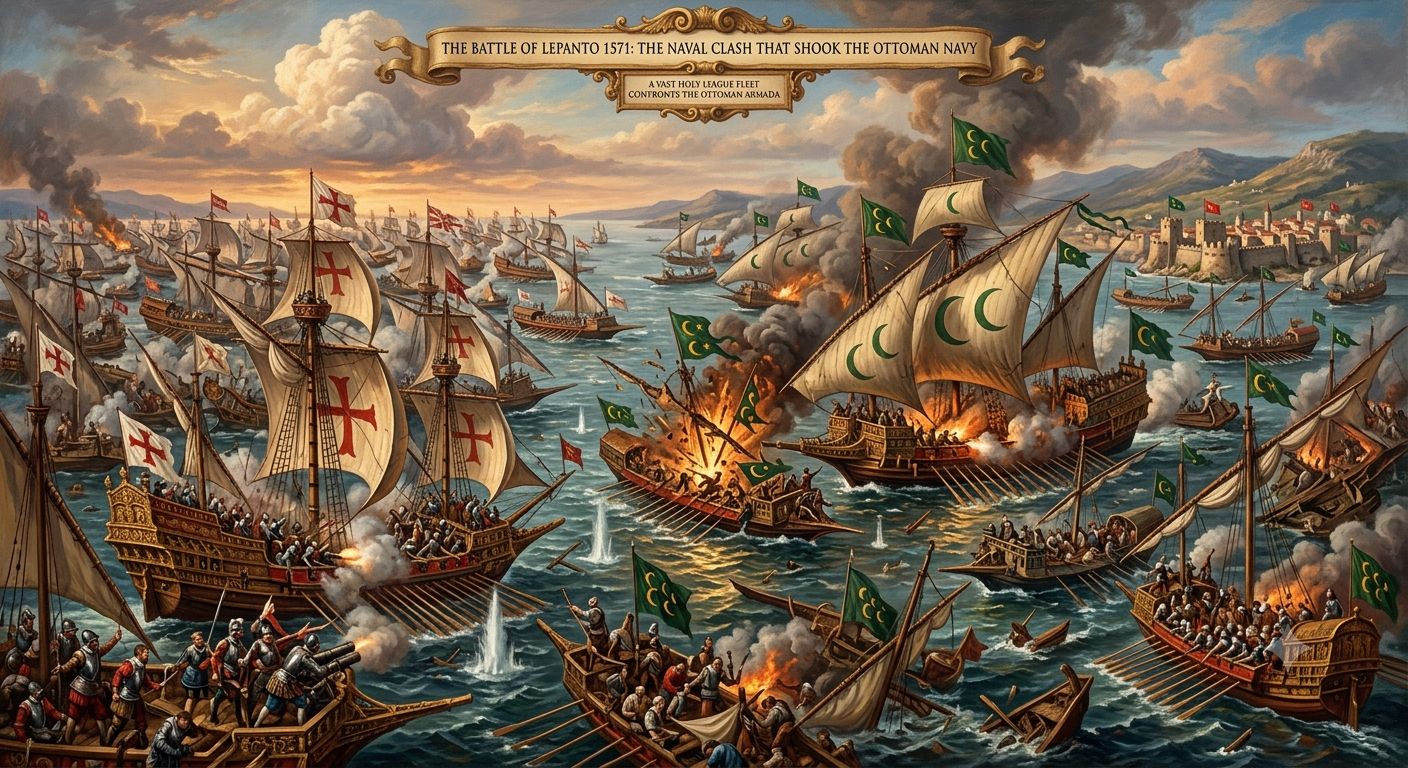
Ottoman history is full of land conquests and great sieges, but on the Mediterranean Sea’s blue waters, the Ottoman navy also ruled for a long time. But in Ottoman history, 7 October 1571 was such a terrible turning point which severely dented the impression of the Ottomans’ sea invincibility. This is the story of the Battle of Lepanto, counted among history’s biggest and bloodiest naval wars.
In this battle, on one side was the Ottoman Empire’s grand naval fleet, and on the other side, a joint alliance of all Europe’s Christian countries, called the Holy League. This bloody clash, within a single day, changed Mediterranean politics forever.
The lake that was not a lake
By the mid-16th century, due to the Ottoman navy’s famous admiral Hayreddin Barbarossa, the whole Mediterranean had become an Ottoman lake. The Ottomans ruled the sea the way they ruled land: completely, and for a long time.
Then came the shock. On 7 October 1571, in a single day, the lake was shown to be a sea again, and a sea can be lost.
Why Europe finally united
In 1570, in the era of Sultan Suleiman the Magnificent’s son, Sultan Selim II, the Ottomans attacked and conquered the island of Cyprus, which was under Venice’s influence.
The conquest of Cyprus rang alarm bells throughout Europe. The Christian world felt that if the Ottomans were not stopped now, they would reach the shores of Italy and Rome. In view of this fear, through the efforts of Pope Pius V, a great Christian naval alliance, the Holy League, was established, in which the fleets of Spain, Venice, Genoa, and the Vatican were included. The command of this united front was given to the Spanish king’s half-brother, Don John of Austria.
For the first time, Europe’s sea powers stopped fighting each other long enough to fight the Ottomans together. That alone tells you how frightening Cyprus had been.
Galleys, guns, and a wind
Near the coast of Greece, in the Gulf of Patras, at the place of Lepanto, both powers faced each other. This was medieval history’s last major battle fought completely on galleys, those ships run by both oars and sails.
The Ottoman fleet: about more than 250 ships, whose command was in the hands of the Ottoman admiral Muezzinzade Ali Pasha. The Ottomans’ real strength was their experienced sailors and archers.
The Holy League fleet: about 212 ships, but they had the superiority of technology. Their ships had far more and heavier cannons than the Ottomans, and they used a new type of heavy ship, Galleasses, which were like a moving naval fortress.
In the morning, the war began. The Ottoman admiral Ali Pasha rammed his ship straight into Don John’s central ship, and in the middle of the sea, a terrible hand-to-hand fight began.
During the war, the Ottomans faced a few tough challenges. First, the superiority of modern artillery: the modern cannons on the European ships began blowing the Ottoman ships like wood shavings. The Ottoman archers could not compete with the Christians’ guns and gunpowder like that. Second, the wind direction changed: at the start of the war, the wind was in the Ottomans’ favor, but at noon, suddenly the wind direction changed, which limited the Ottoman ships’ movement and helped the European ships take position. After hours of intense fighting, the Ottoman admiral Ali Pasha was killed on the battlefield, and the Christians captured his ship and lowered the Ottoman flag. With this, despair spread in the Ottoman ranks. The Ottomans’ experienced admiral Uluj Ali bravely fought with his detachment, destroyed some European ships, and succeeded in safely extracting a few of his detachments.
The beard that grew back
In the Battle of Lepanto, the Ottomans faced defeat in a major naval war for the first time. About 200 Ottoman ships were destroyed or captured, and thousands of experienced sailors were martyred. In Europe, celebrations were held on this victory and church bells rang, because they had broken the Ottomans’ spell of being invincible.
But was this the decline of the Ottoman Empire? According to historians, the Ottomans’ power was so great that they amazingly compensated for this loss.
The Ottoman grand vizier Sinan Pasha said a historic sentence to the Venetian ambassador on this occasion, which shows the Ottomans’ resolve:
“You, by burning our naval fleet, have only shaved our beard, and a shaved beard grows back thicker than before. But we, by conquering Cyprus, have cut off your arm, and a cut arm never grows back.”
The Ottomans, within only six months, prepared a new, even bigger and more modern naval fleet and put it back to sea, which surprised the European alliance. The Battle of Lepanto stopped the Ottomans’ European conquests dream to the extent of the sea, but it could not weaken the Ottoman Empire’s land power. Europe celebrated for a day. The Ottomans rebuilt their fleet in six months. Lepanto broke a myth, not an empire. Read also: Hayreddin Barbarossa Read also: The Ottoman Empire: From the Fall of Constantinople (1453) to the Golden Age of Suleiman the Magnificent