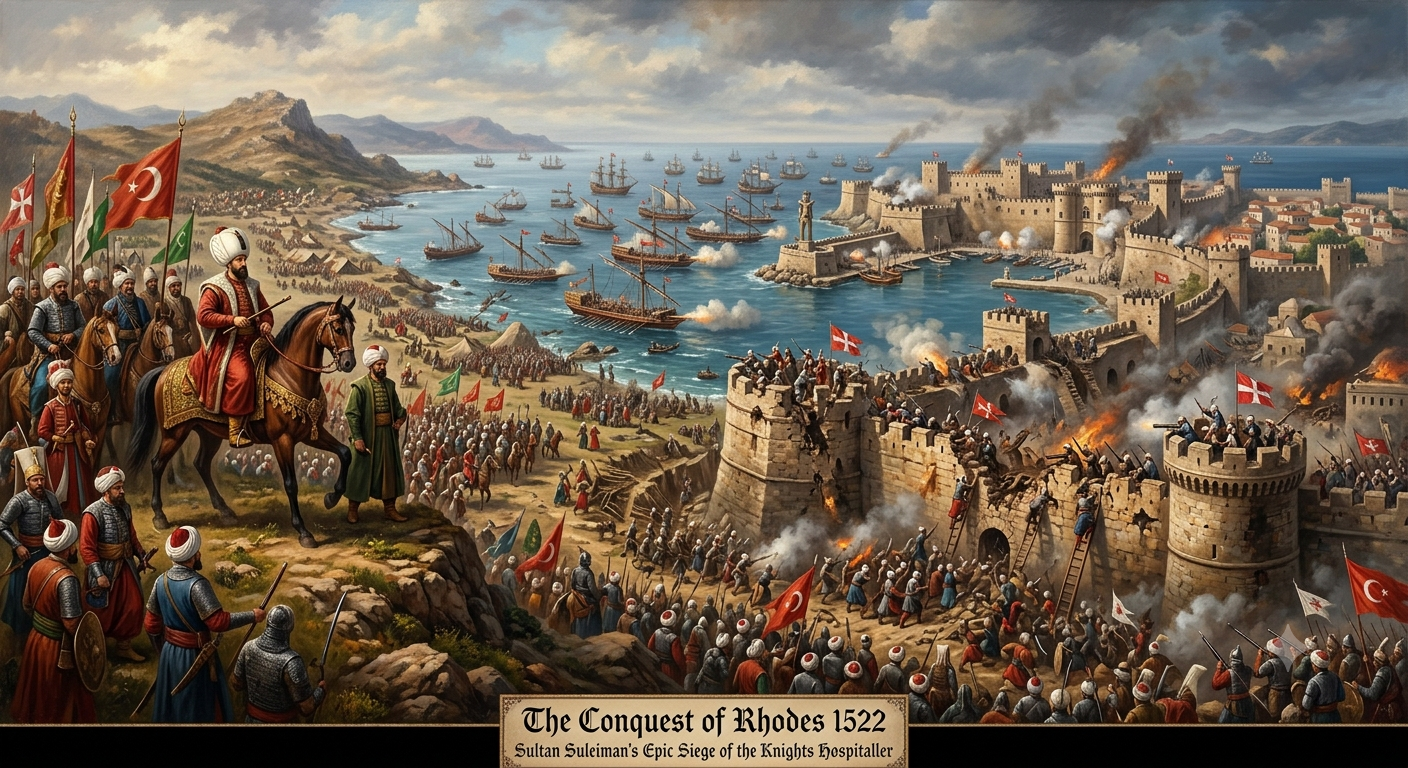
Discover the historic Conquest of Rhodes in 1522. Learn how Sultan Suleiman the Magnificent defeated the Knights Hospitaller to secure the Mediterranean.
In the summer of 1522, a massive Ottoman fleet carrying over 100,000 soldiers sailed across the Aegean Sea toward a small, rocky island that had long been a thorn in the side of the Islamic world: Rhodes.
Ruled by the Knights Hospitaller (the Knights of St. John), the island of Rhodes was one of the most heavily fortified strongholds in human history. For over two centuries, these Christian warrior-monks had raided Ottoman merchant ships, disrupted pilgrim routes to Mecca, and launched pirate attacks across the Eastern Mediterranean.
The Siege of Rhodes in 1522 was young Sultan Suleiman the Magnificent’s first major naval campaign—a grueling six-month military masterpiece that secured total Ottoman control over the Mediterranean trade routes.
The Island Fortress: Why Rhodes Was Unconquerable
Rhodes was not an ordinary island; it was a medieval engineering marvel. Over generations, the Knights Hospitaller had transformed the city into an impenetrable fortress designed specifically to withstand gunpowder artillery:
- Massive Double Walls: The city was defended by thick outer and inner stone walls, surrounded by a deep, dry moat cut directly into solid rock.
- Bastions and Towers: The defensive perimeter was divided into “Tongues” or sectors, each defended by knights from different European nations (e.g., France, England, Spain, Germany, Italy).
- Crossfire Defense: The walls were designed with angled bastions that allowed defenders to unleash deadly crossfire on any army attempting to enter the moat.
In 1480, Sultan Mehmed the Conqueror (the victor of Constantinople) had sent an army to take Rhodes, but the Ottomans were repulsed with heavy losses. The Knights believed their fortress was permanently unconquerable.
June 1522: Sultan Suleiman Launches the Campaign
When 26-year-old Sultan Suleiman I came to power, he recognized that as long as Rhodes remained in enemy hands, the sea routes connecting Istanbul to newly conquered Egypt and Syria would never be safe.
In June 1522, Suleiman dispatched an armada of over 400 ships carrying vast siege artillery, engineers, and janissaries. In July, the Sultan himself marched with his land army through Anatolia to join the siege personally, demonstrating his absolute resolve to capture the island.
Facing the massive Ottoman host was Grand Master Philippe Villiers de L’Isle-Adam and roughly 7,000 defenders, including 500 elite knights, mercenaries, and local Greek inhabitants.
The Six-Month Siege: Tunnels, Explosions, and Bloodshed
The siege developed into a brutal war of attrition, lasting from July to December 1522. Suleiman employed advanced subterranean and artillery tactics to break the defenders’ spirit:
1. Heavy Bombardment and Sapping
Ottoman cannons fired tens of thousands of iron balls and explosive mortars into the city day and night. Meanwhile, Ottoman sappers dug dozens of underground tunnels beneath the dry moat to plant gunpowder mines directly beneath the European bastions.
2. The Fall of the English Bastion
In September, Ottoman miners successfully detonated a massive mine beneath the Wall of the English Sector, blowing away a 12-yard section of stone. Janissary troops launched fierce assaults into the breach, but the Knights repeatedly drove them back in desperate hand-to-hand combat using liquid fire (Greek Fire) and muskets.
3. Winter Conditions and Disease
As autumn turned to winter, rain, mud, and disease began taking a heavy toll on the Ottoman camp. However, Sultan Suleiman refused to retreat, famously declaring that he would rather die beneath the walls of Rhodes than return to Istanbul in defeat. He constructed permanent wooden quarters for his troops to show the Knights he was prepared to stay indefinitely.
December 1522: Capitulation and Chivalrous Surrender
By December, the defenders of Rhodes were exhausted, low on ammunition, and running out of food. Large sections of their outer walls had been reduced to rubble, and no relief fleet from European monarchies was coming to save them.
Recognizing their hopeless situation, Grand Master L’Isle-Adam opened negotiations for surrender on December 20, 1522.
The Generous Terms of Suleiman
In a display of chivalry and diplomatic wisdom that astonished Western Europe, Sultan Suleiman offered honorable terms of capitulation:
- The Knights were given 12 days to pack their weapons, treasures, and religious relics and leave the island peacefully on their own ships.
- Local Christian inhabitants were guaranteed freedom of religion, exemption from taxes for five years, and protection against looting or enslavement.
- No churches were to be desecrated or immediately converted into mosques.
Impressed by the bravery of the aging Grand Master, Suleiman met with L’Isle-Adam personally, remarking to his Grand Vizier: “It brings me sorrow to force this noble old man to leave his home in his old age.”
Historical Impact and Legacy
On January 1, 1523, the Knights Hospitaller sailed away from Rhodes, eventually resettling on the island of Malta (where they would later face the Ottomans again at the Great Siege of Malta in 1565).
The Conquest of Rhodes was a major strategic and political triumph for the Ottoman Empire:
- Uncontested Naval Dominance: The elimination of the Rhodes pirate base secured the Eastern Mediterranean, allowing safe passage for merchant ships, pilgrims, and imperial communications between Istanbul, Cairo, and the Levant.
- Suleiman’s Prestige: The victory established Sultan Suleiman’s reputation across Europe as a formidable military leader who accomplished what even his grandfather Mehmed the Conqueror could not.
- Consolidation of Empire: With Rhodes captured and Belgrade fallen the year before (1521), the stage was set for Suleiman to launch his famous campaigns into Central Europe, culminating in the Battle of Mohács in 1526.
1 thought on “The Conquest of Rhodes 1522 Sultan Suleiman’s Epic Siege of the Knights Hospitaller”