Here is your next long-form, unique, and SEO-optimized English article. It covers another landmark chapter in Islamic and Ottoman history, formatted with proper headings ($H_2$, $H_3$), bullet points, and a meta description.
Title: The Battle of Ridaniya 1517: How Sultan Selim I Conquered Egypt and Claimed the Caliphate
Meta Description: Discover the epic history of the Battle of Ridaniya in 1517. Learn how Ottoman Sultan Selim I defeated the Mamluk Sultanate, conquered Cairo, and unified the Islamic world.
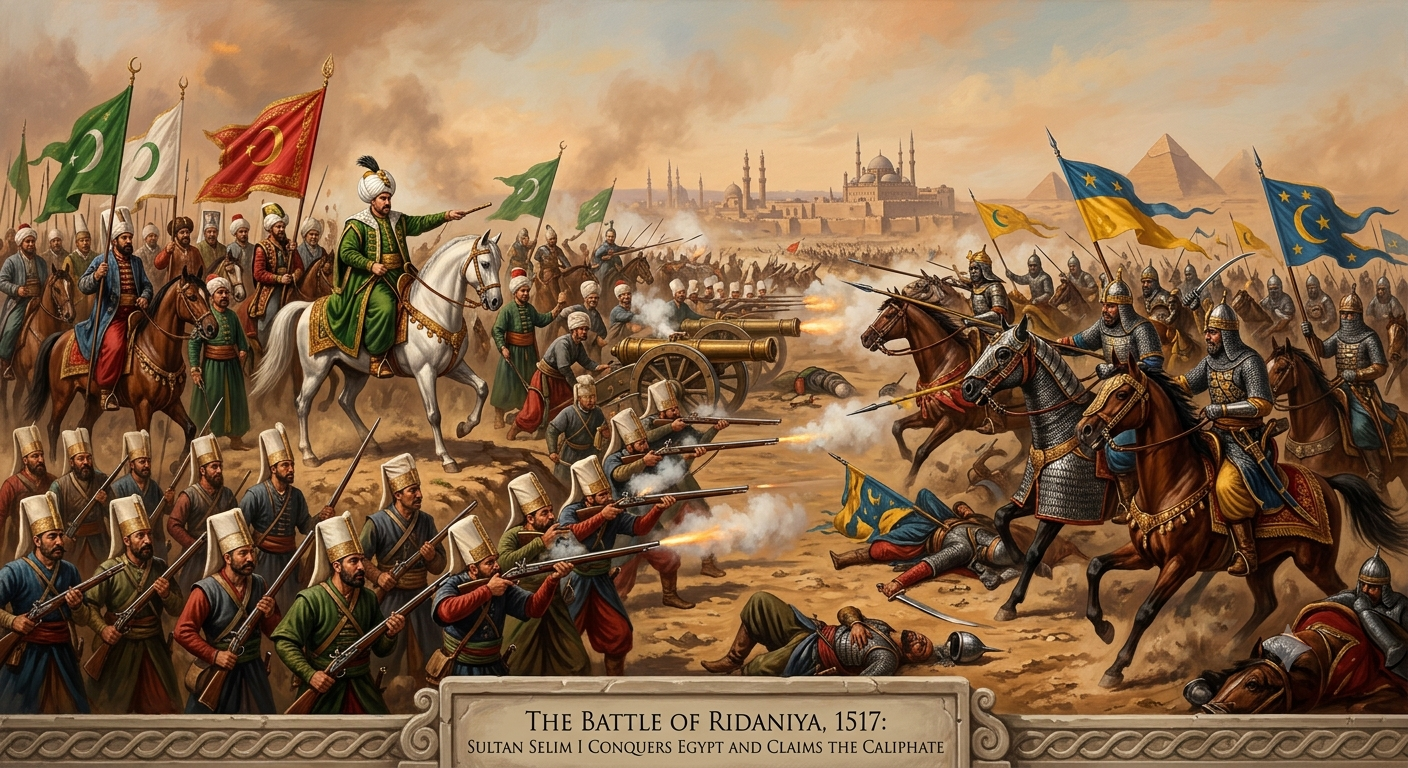
In early 1517, the sands outside Cairo became the stage for one of the most consequential military clashes in Islamic history: The Battle of Ridaniya. This decisive encounter pitted the rising gunpowder empire of the Ottomans against the legendary knightly empire of the Mamluks, who had ruled Egypt, Syria, and the Levant for over two centuries.
The victory of Ottoman Sultan Selim I (known as Selim the Grim or Yavuz) not only destroyed the Mamluk Sultanate but also transferred the historic title of Caliph of Islam to the Ottoman dynasty, uniting the heartlands of the Muslim world under a single ruler.
The Geopolitical Context: Two Sunni Superpowers
By the early 16th century, the Middle East was dominated by three major empires: the Safavids in Persia, the Mamluks in Egypt and Syria, and the Ottomans in Anatolia and the Balkans.
While the Mamluks were renowned for their elite cavalry, chivalric code, and their historic victory over the Mongols at Ain Jalut (1260), their military system had stagnated:
- Resistance to Firepower: The Mamluks viewed handguns and cannons as unchivalrous and unmanly, relying heavily on traditional heavy cavalry charging with lances and swords.
- The Ottoman Technological Revolution: Under Selim I, the Ottoman military had embraced modern field artillery and massed infantry firearms (Janissaries equipped with matchlock muskets).
After defeating the Safavids at the Battle of Chaldiran in 1514, Sultan Selim turned his attention south toward the Mamluk Empire to eliminate the threat on his southern flank and secure control over trade routes and holy sites.
The Path to Cairo: Marj Dabiq and the Ottoman Advance
The campaign began in 1516 at the Battle of Marj Dabiq near Aleppo, Syria. Sultan Selim I inflicted a crushing defeat on the Mamluk Sultan Al-Ashraf Qansuh al-Ghuri, largely due to Ottoman artillery superiority and internal Mamluk betrayals.
With Syria falling quickly into Ottoman hands, Selim made an unprecedented decision: he led his army across the treacherous, waterless Sinai Desert—a feat many thought impossible—and marched directly into the heart of Egypt to finish the Mamluk state once and for all.
January 22, 1517: The Clash at Ridaniya
The new Mamluk Sultan, Tuman Bay II, prepared a desperate defense at Ridaniya, just outside the northern walls of Cairo.
Recognizing the danger of Ottoman cannons, Tuman Bay constructed a fortified trench line and imported heavy static artillery pieces from European traders, concealing them behind earthen ramparts. His plan was to lure the Ottoman army into a frontal trap where their cavalry would be obliterated by Mamluk gun batteries.
Selim’s Flanking Maneuver
Sultan Selim, informed of the Mamluk trap by scouts and defectors, executed a brilliant tactical response:
- Outflanking the Guns: Instead of launching a direct frontal attack against the fortified Mamluk positions, Selim ordered his main force to circle around the Mokattam Mountain, attacking Tuman Bay’s forces from the flank and rear.
- Neutralizing the Artillery: Because the Mamluk cannons were mounted on fixed, immobile carriages, they could not be rotated to face the new direction of the Ottoman assault, rendering their defensive line useless.
The Charge of Tuman Bay
Realizing his artillery was ineffective, Sultan Tuman Bay launched a heroic, high-risk cavalry charge aimed directly at the Ottoman headquarters to kill Sultan Selim I.
Though Mamluk knights fought with fierce bravery—killing Selim’s Grand Vizier, Sinan Pasha, whom they mistook for the Sultan—the charge was ultimately repelled by concentrated volleys from the Janissaries’ muskets and field artillery. The Mamluk lines broke, and Cairo fell to the Ottomans.
Historical Impact: Transfer of the Caliphate and Imperial Dominance
The Battle of Ridaniya brought an end to the Mamluk Sultanate and forever altered the political and religious landscape of the Islamic world:
- The Ottoman Caliphate: The last Abbasid puppet Caliph residing in Cairo, Al-Mutawakkil III, formally surrendered the sacred relics of the Prophet Muhammad ﷺ—including his cloak (Hırka-i Şerif) and sword—to Sultan Selim I. Selim became the first Ottoman Sultan to assume the title of Caliph of all Muslims.
- Control of the Holy Cities: With the conquest of Egypt and the Levant, the Sharif of Mecca submitted to Ottoman authority. Selim took on the honored title of Khadim al-Haramayn al-Sharifayn (Servant of the Two Holy Mosques of Mecca and Medina).
- Economic Superpower: The acquisition of Egypt gave the Ottomans control over lucrative Red Sea trade routes, Venetian grain supplies, and the customs revenues of Cairo, transforming the empire into a global economic titan.