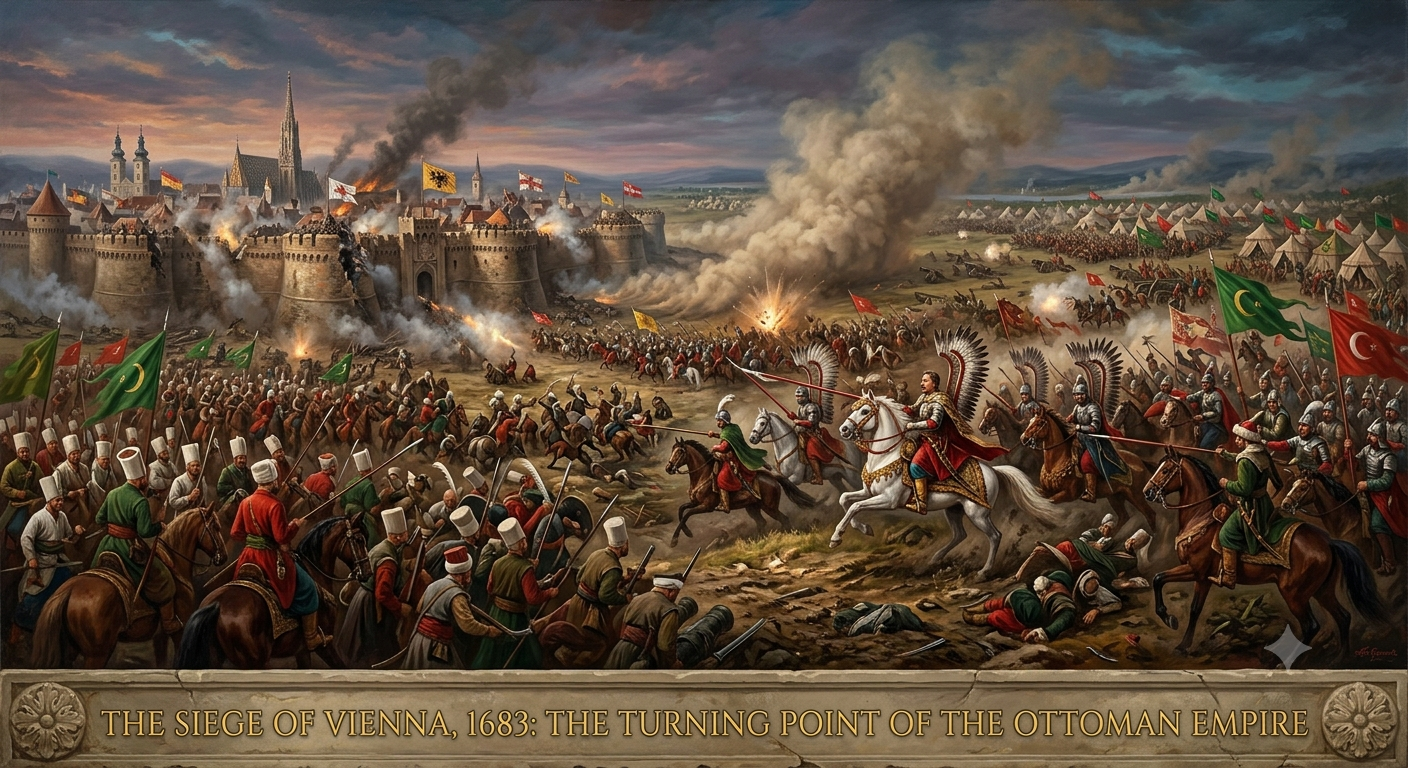
Explore the epic history of the Siege of Vienna in 1683. Learn how the Ottoman forces under Kara Mustafa Pasha clashed with the European alliance in a battle that changed history.
For over three centuries, the Ottoman Empire was the undisputed superpower of the Mediterranean, North Africa, the Middle East, and Southeastern Europe. Its westward expansion seemed unstoppable as its armies pushed deeper into the heart of the European continent. However, in the late summer of 1683, the fate of Europe hung in the balance beneath the stone walls of Vienna.
The Siege of Vienna in 1683 was not merely a military confrontation between two rival empires; it was a watershed moment in world history. It marked the maximum territorial extent of Ottoman expansion in Europe and initiated a gradual shift in the global balance of power.
Background: The Ambition of Kara Mustafa Pasha
By the late 17th century, the Ottoman Empire was ruled by Sultan Mehmed IV, but administrative power largely rested with his Grand Vizier, Merzifonlu Kara Mustafa Pasha. Driven by a desire to match the historic achievements of past leaders like Sultan Suleiman the Magnificent, Kara Mustafa sought a decisive victory that would solidify Ottoman supremacy over Central Europe.
The target was Vienna—the proud capital of the Habsburg Empire, ruled by Holy Roman Emperor Leopold I. Known to the Ottomans as the “Golden Apple” (Kızıl Elma), Vienna was strategically vital. Capturing the city would grant the Ottomans complete control over the Danube River trade routes and open a direct gateway to Germany and Western Europe.
The Advance and the Surroundment of Vienna
In the spring of 1683, an enormous Ottoman army—estimated between 100,000 and 150,000 soldiers, including elite Janissaries, cavalry units, and vassal forces—marched toward Austria.
As news of the overwhelming Ottoman advance reached Vienna, Emperor Leopold I and much of the civilian population fled the city, leaving behind a garrison of roughly 15,000 defenders under the command of Count Ernst Rüdiger von Starhemberg.
The Siege Begins (July 1683)
On July 14, 1683, the Ottoman forces reached the outskirts of Vienna and completely encircled the city. Recognizing that Vienna’s massive stone walls were too formidable for direct infantry assaults, Kara Mustafa Pasha chose a strategic siege tactic:
- Sapping and Mining: Ottoman engineers, famous for their subterranean warfare skills, began digging extensive networks of trenches toward the city walls. They planted massive gunpowder mines beneath the bastions to blow breaches in the defenses.
- Blockade: The city was cut off from all supply lines, leading to severe food shortages, disease, and starvation inside the city walls over two long months.
By early September, Ottoman mines had successfully breached several outer fortifications. The defenders were exhausted, low on ammunition, and on the brink of collapse.
The Holy League and the Relief Force
As Vienna teetered on the edge of surrender, Pope Innocent XI worked tirelessly to forge an alliance among Christian European states, known as the Holy League.
The crucial breakthrough came when King John III Sobieski of Poland joined the coalition with his formidable army, uniting Polish, Austrian, and German forces into a relief army of approximately 70,000 to 80,000 men.
The Charge of the Winged Hussars (September 12, 1683)
On September 12, 1683, the combined relief force positioned itself on the heights of Kahlenberg, overlooking the Ottoman siege lines.
Kara Mustafa Pasha made a critical tactical mistake: he focused almost all his troops on forcing an entry into the city rather than securing his flanks against the incoming relief army.
late in the afternoon, King John III Sobieski personally led one of the largest cavalry charges in human history:
- Over 18,000 cavalrymen, led by the legendary Polish Winged Hussars, thundered down the hills directly into the flank of the exhausted Ottoman camp.
- The sudden, massive cavalry assault shattered the Ottoman lines, causing widespread panic and confusion among the troops.
Realizing the battle was lost, Kara Mustafa Pasha ordered a general retreat, leaving behind the grand Ottoman camp, cannons, treasure, and military supplies.
Historical Impact and Legacy
The relief of Vienna sent shockwaves across Europe and the Islamic world. While the Ottoman army remained a formidable military force for decades to come, the defeat at Vienna marked a definitive end to Ottoman territorial expansion in Western Europe.
- The Treaty of Karlowitz (1699): In the aftermath of the siege, the Holy League launched a counter-offensive, reclaiming Hungary, Transylvania, and parts of the Balkans. This culminated in the Treaty of Karlowitz, marking the first time the Ottomans officially ceded major European territories.
- Shift in European Diplomacy: The victory established the Habsburg Empire as a dominant European superpower and solidified King John III Sobieski’s reputation as a heroic military commander.
- Cultural Legacy: The siege left a lasting cultural imprint. Legend attributes the creation of the croissant (shaped like the Islamic crescent) and the popularization of coffee houses in Vienna to the supplies left behind in the Ottoman camp.