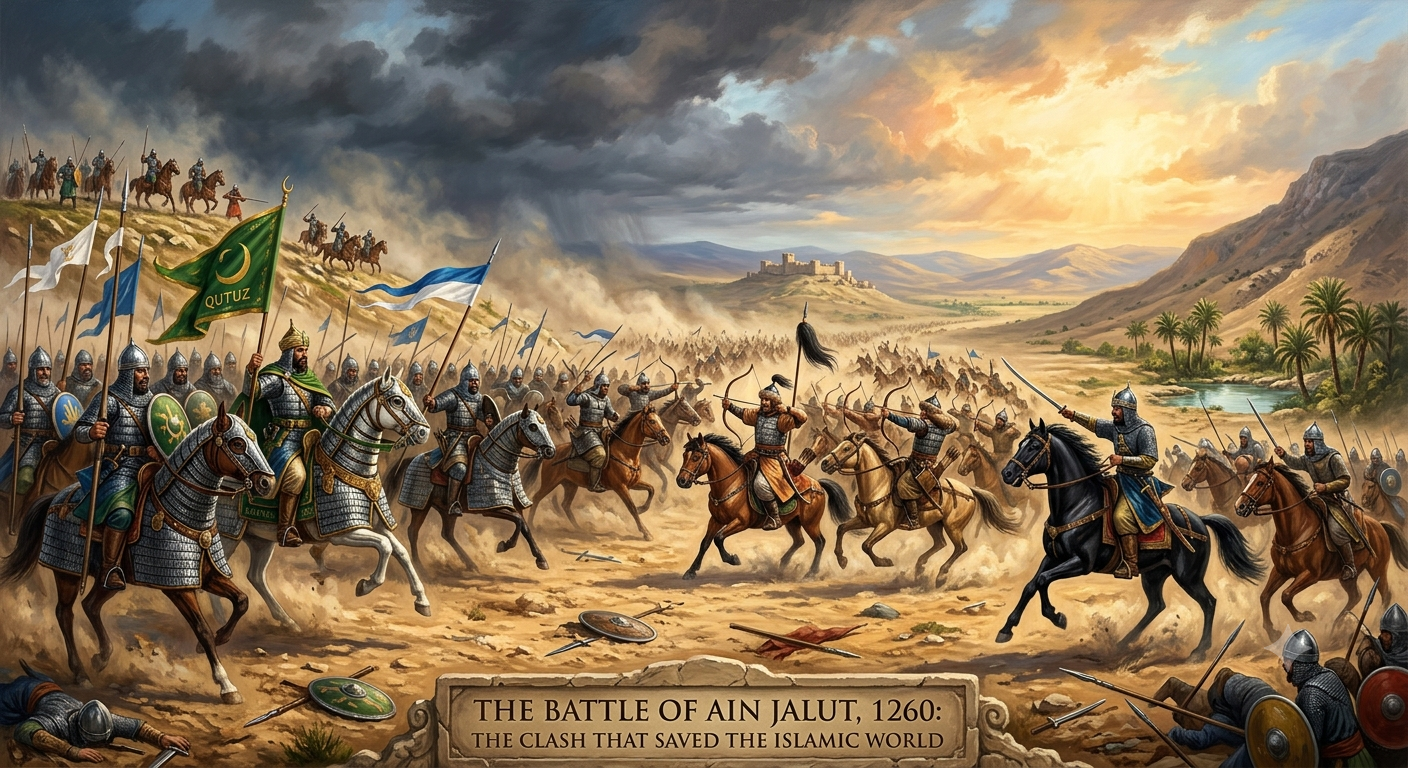
Discover the historic Battle of Ain Jalut in 1260. Learn how the Mamluk Sultanate handed the Mongol Empire its first major defeat and saved the Islamic heartland.
On September 3, 1260, in the Jezreel Valley of Palestine, two formidable armies clashed in a battle that altered the fate of civilization: The Battle of Ain Jalut (the “Spring of Goliath”).
For half a century, the Mongol Empire had seemed an unstoppable force of nature, sweeping across Eurasia, shattering empires, and laying waste to ancient cities—including the tragic destruction of Baghdad in 1258. As the Mongol horde marched toward North Africa, only one power stood between them and the complete subjugation of the Islamic world: the Mamluk Sultanate of Egypt.
The decisive victory led by Mamluk Sultan Qutuz and his legendary general Baibars shattered the myth of Mongol invincibility and permanently preserved Islamic culture, religion, and governance in the Middle East.
The Mongol Onslaught: The Fall of the East
In the early 1250s, Hulagu Khan, grandson of Genghis Khan, launched a massive campaign to conquer the Middle East. The results were swift and catastrophic:
- The Fall of Baghdad (1258): The seat of the Abbasid Caliphate was sacked, ending a 500-year golden age of Islamic scholarship and architecture.
- The Conquest of Syria (1260): The historic cities of Aleppo and Damascus fell in rapid succession, bringing the Mongol frontier directly to the borders of Mamluk Egypt.
Hulagu sent an emissary to Cairo bearing a terrifying ultimatum to the Mamluk Sultan Saif ad-Din Qutuz:
“You have heard how we have conquered a vast empire… You cannot escape us. Where can you flee? Submit to our authority and accept our terms.”
Qutuz’s Courageous Decision and the Mamluk Mobilization
Sultan Qutuz knew that surrendering meant total destruction. Instead of submitting, Qutuz executed the Mongol envoys—a declaration of absolute war—and rallied the Mamluk amirs, declaring: “If no one else will fight, I will go alone to face the Mongols.”
The Mamluks were uniquely suited to face the Mongols:
- Warrior Class: Originally brought to Egypt as enslaved Turkic and Circassian military youths, the Mamluks underwent rigorous, lifelong martial training in horse archery, swordplay, and tactical formations.
- Tactical Parity: Unlike European knights or heavy infantry, Mamluk cavalry possessed the speed, horse archery skills, and mobility necessary to counter nomadic Mongol tactics.
A Twist of Fate
Just as Hulagu Khan prepared to lead the invasion of Egypt, his brother Möngke Khan (the Great Khan) died in East Asia. Hulagu withdrew the vast majority of his army back to Karakoram to participate in the succession council, leaving behind his trusted Christian general, Kitbuqa, with a reduced force of roughly 10,000 to 20,000 troops.
Recognizing the opportunity, Sultan Qutuz marched his army out of Egypt into Palestine, choosing to confront the Mongols on neutral ground rather than waiting for Cairo to be besieged.
September 3, 1260: The Battle at the Spring of Goliath
Sultan Qutuz and General Baibars chose the terrain of Ain Jalut—a valley surrounded by forested hills—to set a brilliant tactical trap.
1. Baibars’ Vanguard and Feigned Retreat
General Baibars took the vanguard and engaged Kitbuqa’s Mongol army in the open valley. After a brief exchange of arrows and heavy fighting, Baibars ordered a feigned retreat—a classic nomad tactic that the Mamluks turned against the Mongols themselves.
Kitbuqa, believing the Mamluks were breaking, ordered a full-scale charge deep into the valley, abandoning his high ground.
2. The Springing of the Trap
Once the entire Mongol force entered the valley, Qutuz unleashed the hidden Mamluk main body from the surrounding hills. The Mongols found themselves completely encircled and caught in a deadly vice.
3. Qutuz Rallies the Lines
Despite being surrounded, the Mongols fought with desperate ferocity, nearly breaking the Mamluk left flank. Realizing the danger, Sultan Qutuz threw off his helmet so his men could recognize his face, mounted a hill, and shouted his famous war cry:
“O Islam! O Allah, grant victory to Your servant Qutuz!”
Inspired by their Sultan’s courage, the Mamluk lines held firm, launching a massive counter-charge that shattered the Mongol army. General Kitbuqa was slain on the battlefield, and the remaining Mongol forces fled.
Historical Impact and Lasting Legacy
The Battle of Ain Jalut was a pivotal turning point in world history:
- First Permanent Stop to Mongol Expansion: It marked the very first time in history that a Mongol advance was definitively halted and its army defeated in open field battle, permanently protecting Cairo, Mecca, and Medina from destruction.
- Rise of the Mamluk Empire: The victory cemented the Mamluk Sultanate as the premier superpower of the Islamic world for the next two centuries, securing their control over Egypt, Syria, and the Holy Land.
- Preservation of Islamic Scholarship: With Baghdad destroyed, Egypt and Syria became the new safe havens for Islamic scholars, scientists, and artists, preserving centuries of knowledge.
- Fragmentation of the Mongol Empire: The defeat coincided with internal rivalries between Hulagu’s Ilkhanate and Berke Khan’s Golden Horde (who had converted to Islam), ending the unified expansion of the Mongol Empire toward the West.
1 thought on “The Battle of Ain Jalut 1260 The Clash That Saved the Islamic World”