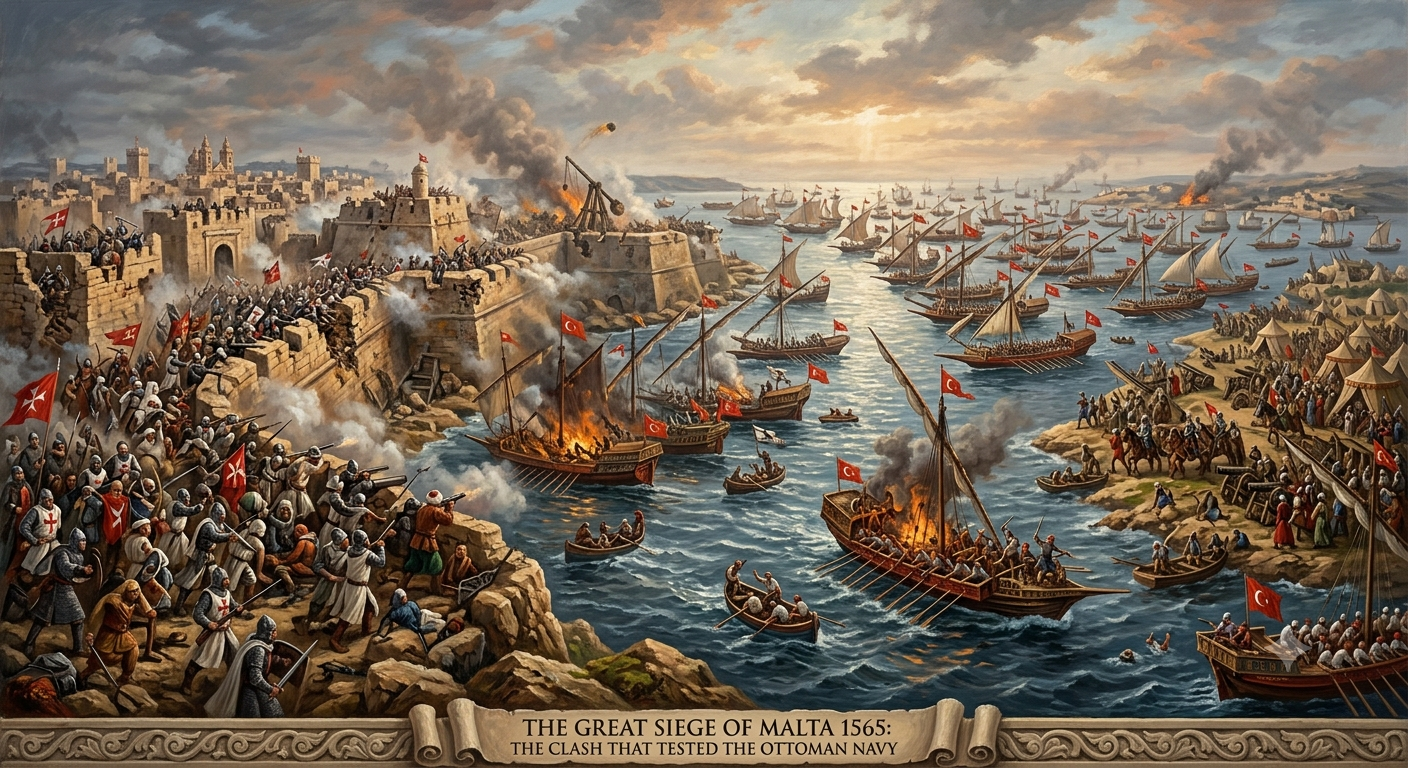
Discover the epic history of the Great Siege of Malta in 1565. Learn how the Knights Hospitaller resisted Sultan Suleiman’s powerful Ottoman armada.
In May 1565, the Mediterranean Sea witnessed one of the most intense, bloody, and dramatic military encounters of the 16th century: The Great Siege of Malta.
Following the conquest of Rhodes in 1522, Sultan Suleiman the Magnificent sought to eliminate the last major Christian naval stronghold in the Central Mediterranean. On the small, rocky island of Malta stood the Knights Hospitaller (Knights of St. John), led by their resolute Grand Master, Jean Parisot de Valette.
The siege became an epic battle of endurance, military engineering, and sheer willpower that captured the attention of all Europe and marked one of the rarest setbacks for the Ottoman military during the height of its expansion.
Strategic Importance: Why Malta Mattered
After being granted the Maltese islands by Holy Roman Emperor Charles V in 1530, the Knights Hospitaller turned Malta into a heavily fortified naval fortress. From this strategic hub in the center of the Mediterranean, the Knights:
- Disrupted Trade Routes: Intercepted Ottoman merchant vessels sailing between Istanbul, Alexandria, and Tunis.
- Raided Coastal Settlements: Launched privateering raids against Ottoman-controlled North African ports.
- Controlled Sea Lanes: Threatening the sea routes linking the eastern and western halves of the Mediterranean.
Sultan Suleiman recognized that capturing Malta was essential to securing total Ottoman naval supremacy and opening a clear path toward Sicily and Southern Italy.
May 1565: The Arrival of the Ottoman Armada
In late May 1565, an immense Ottoman fleet carrying over 30,000 to 40,000 troops—including elite Janissaries, sipahis, and North African corsair units—arrived off the coast of Malta.
The Ottoman command was split between two veteran leaders:
- Mustafa Pasha: Commander of the land forces.
- Piyale Pasha: Grand Admiral of the fleet.
- Turgut Reis (Dragut): The legendary corsair admiral who joined the siege in June.
Defending the island were roughly 6,100 men under Grand Master Jean de Valette, including 500 Knights Hospitaller, Spanish mercenaries, and local Maltese militia.
The Battle for Fort St. Elmo: A Costly Struggle
The Ottoman commanders decided to first capture Fort St. Elmo, a small star-shaped fort guarding the entrance to Marsamxett Harbour, so Piyale Pasha’s fleet could anchor safely.
What the Ottomans expected to be a three-day siege turned into a brutal four-week nightmare:
- Heroic Resistance: The small garrison of knights and Maltese militia held out far beyond expectations under relentless artillery bombardment.
- Heavy Ottoman Casualties: Although Fort St. Elmo eventually fell on June 23, it cost the Ottomans thousands of experienced soldiers and the fatal wounding of their esteemed admiral, Turgut Reis.
The prolonged defense of St. Elmo bought precious time for the main fortresses across the harbor—Birgu (Fort St. Angelo) and Senglea (Fort St. Michael)—to reinforce their defenses.
Summer 1565: The Assaults on Birgu and Senglea
Throughout July and August, Mustafa Pasha launched fierce, repeated land and sea assaults against the fortifications of Birgu and Senglea:
- Subterranean Warfare: Ottoman sappers dug extensive trenches and mines beneath the bastions, while defenders built counter-mines to detonate them underground.
- The Battle of the Breach: In mid-August, Ottoman forces breached the walls of Birgu and came dangerously close to capturing the city. The 70-year-old Grand Master De Valette personally led a counter-attack into the breach, inspiring his men to drive the Ottomans back.
- Scorching Heat and Disease: As summer progressed, both sides suffered terribly from dysentery, lack of fresh water, and intense heat. However, the Ottoman supply lines stretched back across the sea, making logistical support increasingly difficult.
September 1565: The Relief Force and Ottoman Retreat
By early September, the Ottoman army was exhausted, short on ammunition, and facing approaching autumn storms that threatened their fleet.
On September 7, a long-awaited Spanish relief force—known as the Gran Soccorso (roughly 8,000 to 10,000 European troops commanded by the Viceroy of Sicily)—finally landed on the northern end of Malta.
Realizing his troops were demoralized and caught between the relief army and the entrenched fortresses, Mustafa Pasha ordered a general evacuation. On September 11, 1565, the remaining Ottoman forces boarded their ships and sailed away.
Historical Impact and Legacy
The relief of Malta was celebrated across Christian Europe as a monumental victory, while in Istanbul it was viewed as a disappointing setback that halted westward naval expansion in the Central Mediterranean:
- Symbolic Turning Point: The siege shattered the perception of Ottoman invincibility on land and sea, boosting European morale.
- Foundation of Valletta: In honor of the Grand Master who led the defense, the Knights built a new, state-of-the-art fortified capital city on the Sciberras peninsula: Valletta (the modern capital of Malta).
- Shift in Mediterranean Naval Dynamics: While the Ottomans quickly rebuilt their military strength—capturing Cyprus in 1570 and rebuilding their fleet after Lepanto—the failure at Malta permanently preserved Christian control over the Western Mediterranean.