Here is your next long-form, unique, and SEO-optimized English article. It covers another crucial chapter in Islamic and Ottoman history, formatted with proper headings ($H_2$, $H_3$), bullet points, meta description, and focus keyphrase.
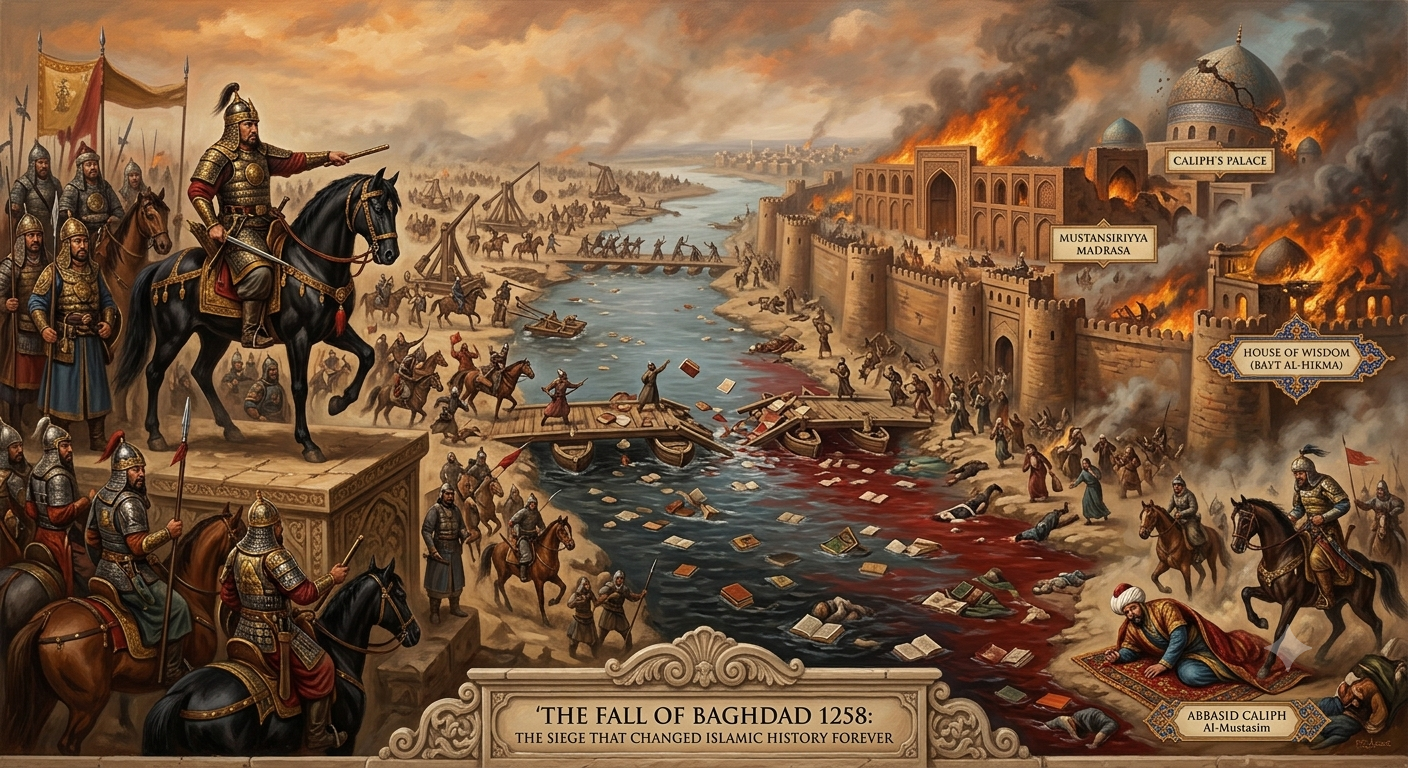
Title: The Fall of Baghdad 1258: The Siege That Changed Islamic History Forever
Meta Description: Discover the tragic history of the Fall of Baghdad in 1258. Learn how Hulagu Khan’s Mongol army destroyed the Abbasid Caliphate and transformed the Islamic world.
In February 1258, the cultural, intellectual, and economic capital of the Islamic world faced an apocalyptic disaster. Baghdad, the glittering seat of the Abbasid Caliphate for over five centuries, was completely besieged, sacked, and destroyed by the armies of the Mongol Empire under Hulagu Khan.
The Fall of Baghdad was not just a military defeat; it was a profound cultural catastrophe that brought an end to the Islamic Golden Age. The destruction of its grand libraries, architectural wonders, and massive population reshaped the political landscape of the Middle East, paving the way for the eventual rise of later gunpowder empires like the Ottomans and Mamluks.
Baghdad: The Center of the World
Founded in 762 AD by the Abbasid Caliph Al-Mansur, Baghdad (known as the City of Peace) grew to become the largest and most prosperous metropolis in the medieval world.
For 500 years, it was the focal point of global trade, philosophy, science, and literature:
- House of Wisdom (Bayt al-Hikmah): A world-renowned academy and library where scholars translated, preserved, and expanded upon Greek, Persian, Indian, and Syriac texts in mathematics, medicine, astronomy, and philosophy.
- Architectural & Economic Marvel: Located along the fertile banks of the Tigris River, Baghdad featured grand palaces, sophisticated canal irrigation systems, and bustling international markets connecting Asia to Europe.
However, by the mid-13th century, internal political decay, religious factions, and weak leadership had severely eroded the Caliphate’s actual military strength, leaving it vulnerable to external threats.
The Mongol Onslaught: Hulagu Khan’s Campaign
By 1255, the Supreme Mongol Emperor Möngke Khan tasked his brother, Hulagu Khan (grandson of Genghis Khan), with expanding the empire westward and subjugating the remaining Islamic states of the Middle East.
After crushing the Nizari Ismaili state (the Assassins) at Alamut, Hulagu turned his attention to Baghdad, sending a demand of submission to the last Abbasid Caliph, Al-Musta’sim Billah.
The Miscalculation of Caliph Al-Musta’sim
Caliph Al-Musta’sim misjudged the severity of the threat. Believing that the broader Muslim world would automatically rush to protect the seat of the Caliphate, he rejected Hulagu’s ultimatum with defiant rhetoric while failing to properly reinforce the city’s defenses or pay his troops.
January 1258: The Siege and Fall
In late January 1258, Hulagu’s army—an estimated force of 120,000 to 150,000 soldiers, augmented by Christian allies from Armenia and Georgia—encircled Baghdad.
- Subterranean Mining and Bombardment: Mongol engineers constructed siege engines and catapults, bombarding the city’s brick walls with heavy stones and incendiary weapons while undermining the fortifications.
- Breaching the Defenses: By February 5, the Mongols breached a key section of the eastern wall.
- Surrender and Massacre: Realizing all hope was lost, Caliph Al-Musta’sim surrendered on February 10, 1258. The Mongols entered the city and initiated a week of systematic destruction, pillaging, and mass execution.
The Loss of Knowledge and Life
Historians record that the famous House of Wisdom was dismantled, and hundreds of thousands of irreplaceable manuscripts and scientific works were thrown into the Tigris River. It was famously noted that the river ran black with the ink of books and red with the blood of scholars. Caliph Al-Musta’sim was executed, ending the historic line of Baghdad’s Abbasid Caliphs.
Geopolitical Aftermath and the Rise of New Powers
The collapse of Baghdad shocked the entire Eurasian continent, but it also triggered key shifts in Islamic political organization:
- The Mamluk Stand at Ain Jalut (1260): The destruction of Baghdad left the Mamluk Sultanate of Egypt as the primary defender of Islam. Just two years later, in 1260, the Mamluk Sultan Qutuz and General Baibars handed the Mongols their first major defeat at the Battle of Ain Jalut, halting Mongol expansion into Egypt and North Africa.
- Transfer of the Caliphate: A surviving member of the Abbasid family was established in Cairo under Mamluk protection, maintaining a symbolic religious continuity until Sultan Selim I brought the title to the Ottoman Empire in 1517.
- Islamization of the Mongols: In a historic twist, the conquerors themselves were eventually conquered by the faith of the vanquished. Hulagu’s cousin, Berke Khan (ruler of the Golden Horde), converted to Islam and turned against Hulagu, while later Ilkhanate rulers (such as Ghazan) officially embraced Islam as the state religion.