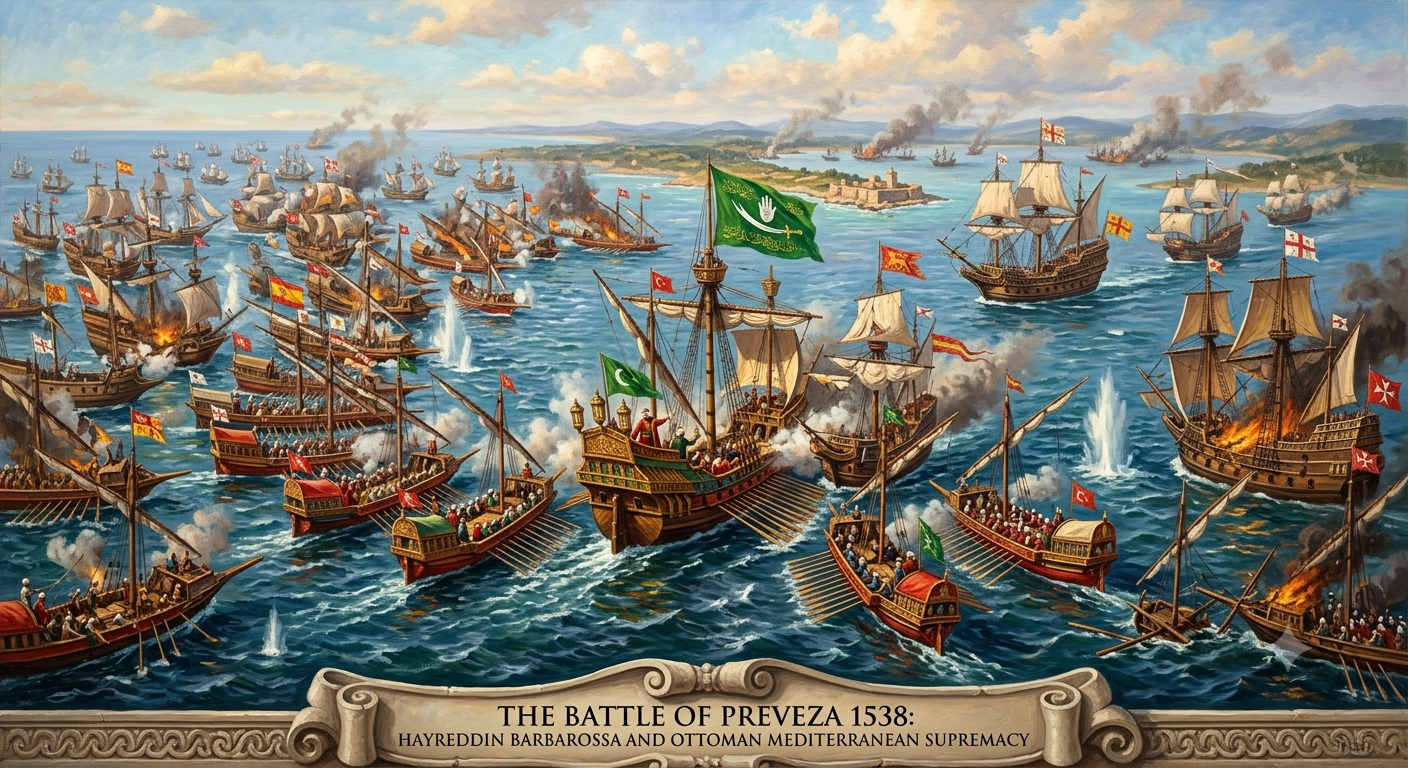
Explore the historic Battle of Preveza in 1538. Learn how Grand Admiral Hayreddin Barbarossa defeated the Holy League fleet to establish total Ottoman naval dominance.
On September 28, 1538, the turquoise waters of the Ambracian Gulf near Preveza, Greece, witnessed the greatest naval clash of the 16th century. The battle pitted the expanding Ottoman Navy against the massive, combined fleet of the Holy League—an alliance of Christian European powers assembled by Pope Paul III.
At the center of this legendary encounter was the grand admiral of the Ottoman fleet, Hayreddin Barbarossa. Facing an enemy fleet that vastly outnumbered his own in both ships and firepower, Barbarossa executed brilliant naval maneuvers that shattered the European armada without losing a single ship, securing absolute Ottoman supremacy over the Mediterranean Sea for decades to come.
The Rise of Barbarossa and the Battle for the Mediterranean
By the 1530s, the Mediterranean had become a fierce battleground between two massive superpowers:
- The Ottoman Empire: Led by Sultan Suleiman the Magnificent, the empire sought total maritime security for its trade routes and coastal territories across North Africa, Greece, and the Levant.
- The Spanish Empire: Led by Emperor Charles V (Habsburg), Spain controlled key ports in Italy, Sicily, and North Africa, aiming to curb Muslim sea power.
To command his naval forces, Sultan Suleiman summoned Hayreddin Pasha (known to Europe as Barbarossa or “Redbeard”), the former ruler of Algiers and a master of naval warfare. Appointed as the Kaptan-ı Derya (Grand Admiral) of the Ottoman Navy, Barbarossa modernized the fleet, built new shipyards, and launched aggressive raids against Habsburg strongholds in Italy and Greece.
The Asymmetric Clash: Assembling the Fleets
Alarmed by Barbarossa’s relentless campaigns, Pope Paul III forged a powerful Holy League coalition comprising Spain, the Republic of Venice, the Republic of Genoa, the Papal States, and the Knights of Malta.
Command of the Holy League was given to Andrea Doria, an elite Genoese admiral considered Europe’s finest sea commander.
Comparing the Naval Forces
When the two fleets met off the coast of Preveza, the disparity in numbers was striking:
- The Holy League Armada: Roughly 300 to 300+ ships (including over 160 massive galleys and heavy galleons), carrying nearly 60,000 soldiers and over 2,500 cannons.
- The Ottoman Fleet: Only 122 galleys and galliots, carrying roughly 20,000 troops and 800 cannons.
Andrea Doria possessed heavier firepower, larger warships, and numerical dominance. However, Barbarossa held two crucial advantages: superior mobility and an intimate knowledge of local wind patterns and coastline geography.
September 28, 1538: The Tactical Triumph at Preveza
Recognizing that his smaller galleys would be crushed in a direct, static artillery duel against Doria’s giant heavy galleons, Barbarossa devised a crescent-shaped tactical formation and waited inside the Gulf of Preveza.
1. The Wind Trap
On the morning of September 28, the wind suddenly died down, leaving the Holy League’s massive, heavy sailing ships (galleons) stranded and immobile in calm waters. Barbarossa’s lighter, rowed galleys were unaffected by the lack of wind and could maneuver freely using oars.
2. Dividing and Conquering the European Lines
Barbarossa ordered his fleet forward in a Crescent Formation (Hilal Taktik), dividing his force into three wings with a strong reserve under the command of Turgut Reis (Dragut).
Instead of attacking Doria’s heavy center, Barbarossa used his high-speed galleys to circle around the stranded Christian vessels:
- Ottoman ships fired rapid, low-trajectory cannon volleys into the wooden hulls of the immobilized European galleons.
- Turgut Reis led daring flanking attacks, isolating and capturing enemy ships one by one before they could receive support from Doria’s main line.
3. Andrea Doria’s Retreat
Seeing his formation fractured, several heavy ships sinking, and panic spreading among his captains, Andrea Doria refused to order a full counter-attack. As dusk fell, Doria ordered the remaining Holy League fleet to extinguish their lights and retreat under cover of darkness toward Corfu.
The Aftermath and Historical Impact
The Battle of Preveza was a crushing victory for the Ottoman Empire and one of the most one-sided naval engagements in history:
- Zero Ships Lost: Barbarossa defeated a fleet twice his size without losing a single Ottoman warship, while destroying or capturing dozens of enemy vessels and taking over 3,000 prisoners.
- Uncontested Naval Supremacy: For the next 33 years (until the Battle of Lepanto in 1571), the Ottoman Empire enjoyed undisputed control over the Mediterranean Sea.
- Strategic Expansion: The victory allowed the Ottomans to secure control over North Africa (Tunisia, Tripoli, Algiers) and launch successful campaigns across the Aegean and Adriatic seas.
Sultan Suleiman commemorated the triumph by ordering illuminated celebrations across Istanbul, while Barbarossa’s tactical genius at Preveza cemented his reputation as one of the greatest naval commanders in world history.