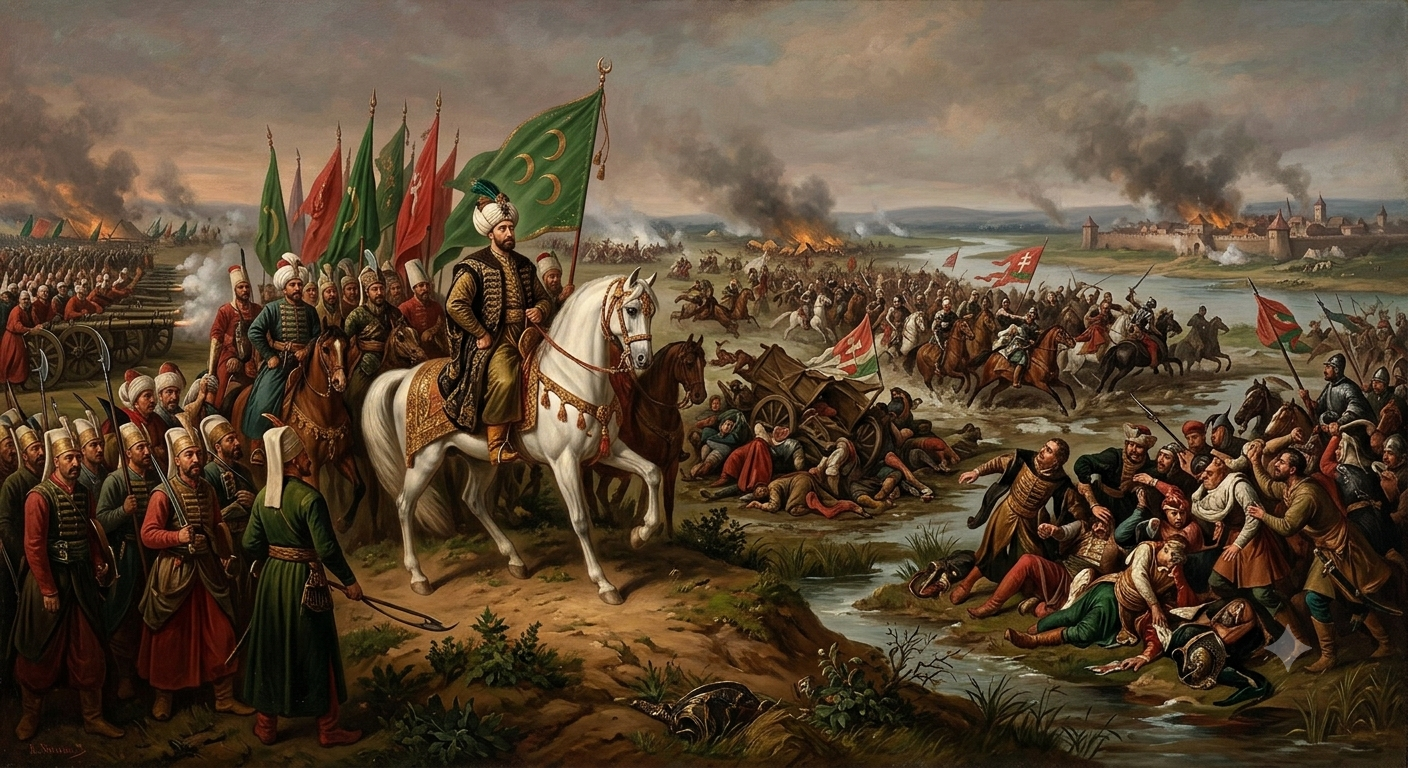
In Ottoman history, where there is a long list of conquests, there are some battles which overnight changed the whole world’s political map. The Battle of Mohacs, fought on 29 August 1526, was such a decisive and sensational battle, which destroyed Central Europe’s biggest Christian power, the Kingdom of Hungary, within just two hours.
This war is living proof of the military skill of the Ottoman Empire’s most famous ruler, Sultan Suleiman the Magnificent, the use of modern artillery, and unparalleled discipline. This victory opened the doors to the heart of Europe, Vienna and Germany, for the Ottomans.
A kingdom that expected minutes
In 1520, when Sultan Suleiman sat on the Ottoman throne, Europe thought a young and inexperienced boy would not handle the empire. But the sultan immediately conquered Belgrade and the island of Rhodes and showed his ambitions.
Hungary’s king, Louis II, was refusing to pay the annual tribute to the Ottomans, and Ottoman ambassadors were mistreated. To secure the Ottoman borders and raise the flag of Islam in Central Europe, Sultan Suleiman decided to attack Hungary. In April 1526, the sultan departed Istanbul with a great army.
The field of Mohacs, located in present Hungary near the Danube river, was chosen for this bloody battle. On 29 August, both armies faced each other.
- The Ottoman army: about 60,000 to 80,000 regular troops, including the world’s best and most loyal infantry, the Janissaries, and more than 300 of the most modern cannons.
- The Hungarian allied army: about 35,000 to 40,000 fighters, whose real strength was their heavy cavalry, knights in iron dress, famous throughout Europe for their powerful and fast charge.
The Hungarian generals were fully confident that their knights would pierce the Ottoman ranks, reach the sultan, and win the war in minutes.
The trap in three layers
Sultan Suleiman and his grand vizier Ibrahim Pasha, gauging the strength of the Hungarian knights, laid a trap rarely matched in military history. They divided their army into three parts.
First layer: light cavalry, the deception trap. The sultan placed light cavalry in the frontmost detachment. Their job was only to provoke the Hungarian knights and force them to attack.
Second layer: Janissaries and hidden artillery. Right behind the next rows, 300 cannons chained together stood in a line, and behind them the Janissary musketeer detachments were hidden.
Third layer: the sultan’s personal guard detachment. At the very back, Sultan Suleiman himself was present with his royal detachment, so that the final blow could be struck if needed.
The retreat that was not a retreat
As soon as the war began, the Hungarian iron-clad knights launched a powerful and terrible attack. The Ottomans’ first row resisted as per strategy and then feigned a retreat.
The Hungarian king and generals thought the Ottoman army was fleeing in fear. In enthusiasm, they blindly chased the Ottomans and came to the middle of the field. This was the place where the Ottomans’ real trap was laid.
Two hours
As soon as the whole Hungarian army approached the Ottoman center, the retreating detachments turned right and left, and before the Hungarians appeared a wall of Ottoman artillery.
- A rain of fire: at once, 300 cannons and thousands of Janissary guns opened fire. The Hungarian knights, who because of their heavy iron dress could not turn quickly, came under the gunpowder.
- The swamp trap: Ottoman cavalry, wheeling around from the flanks, surrounded the Hungarian army from three sides and pushed them toward the marshy area near the Danube river.
Within just two hours, the whole Hungarian army was destroyed. King Louis II, fleeing the battlefield, died drowning in the river because of the weight of his heavy iron dress.
What two hours changed
This victory changed Europe’s politics forever.
- First, the end of the Hungarian kingdom: Hungary ended as an independent state, and most of it became a province of the Ottoman Empire.
- Second, Ottoman control over Central Europe: the Ottoman borders now directly met Austria’s Habsburg Empire, and Istanbul emerged as Europe’s biggest power.
- Third, the promotion of Protestantism: because of this war, the Catholic Church weakened, which gave Martin Luther’s Protestant movement a chance to flourish in Europe, because the Ottomans adopted a policy of religious freedom.
A kingdom that expected to win in minutes was gone in two hours, not because its knights were weak, but because they charged exactly where Suleiman wanted them to charge.
Read also: Sehzade Mustafa The Prince Who Could Have Saved the Ottoman Empire