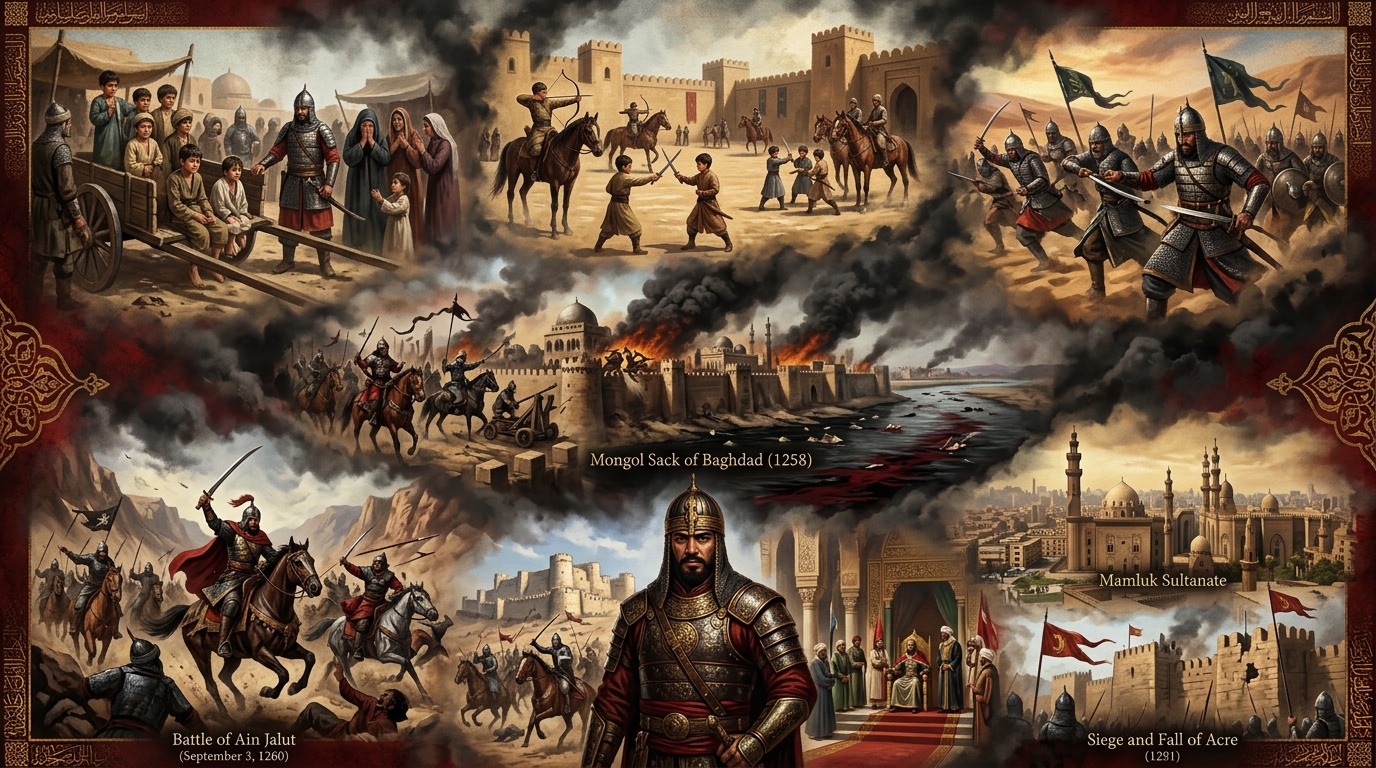
They were bought as children, torn from their families, sold in markets like cattle, and yet these same people became the most feared soldiers of the medieval world. They defeated an enemy that had never been defeated, an enemy that had turned Baghdad to ash, murdered the caliph with bare hands, and convinced the entire Islamic world that God himself had abandoned it. And between that enemy and the complete destruction of Islamic civilization stood only one thing: an army of slaves. Not kings, not nobles, not generals born into power. Slaves.
This is the story of the Mamluks. And once you understand what they really were and what they really did, you will never look at military history the same way again.
The strangest army in history
To understand the Mamluks, you must understand the world they were born into. The Abbasid Caliphate in Baghdad, the empire that had presided over the Islamic Golden Age, the empire of scholars and astronomers and philosophers, had a problem that powerful empires eventually always have: its rulers had gone soft.
The caliphs of the ninth century were unimaginably wealthy, surrounded by luxury, courtiers and poets and musicians. They were not soldiers. And an empire that stops producing soldiers eventually learns that the hard way.
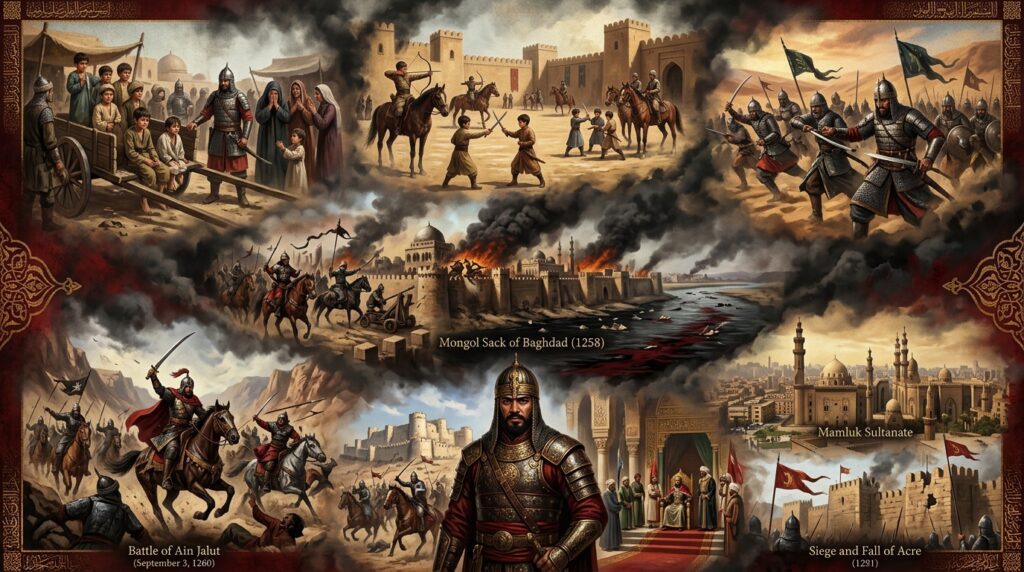
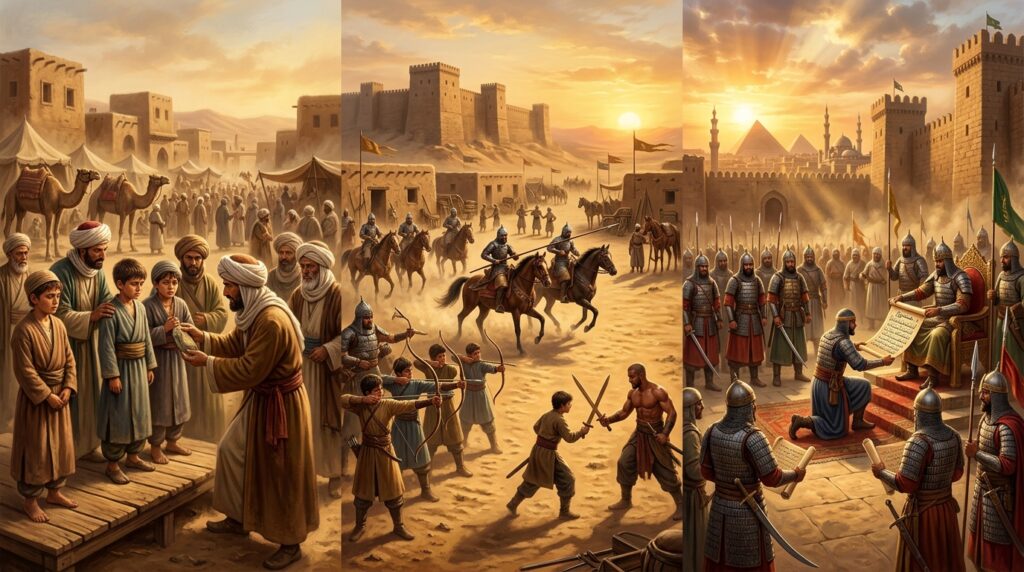
So the Abbasid caliphs began buying them. They bought young boys, mostly Turkic children from the steppes of Central Asia, brought them to Baghdad, raised them in specific military households, and trained them from about age 9 or 10 in horse riding, archery, sword fighting, and battlefield tactics.
These boys were called Mamluks, an Arabic word meaning taken into ownership, slave.
But here is what makes this system so extraordinary and so counterintuitive: these were not the broken, brutalized slaves of the Atlantic slave trade or the Roman mines. The Mamluk system was built on a specific logic: you invest completely in these boys. You feed them well, you educate them, you train them until they become the deadliest soldiers you have ever produced. And then, when their training is complete, you free them. They earn their freedom as the reward for completing the process.
And what you get in return is a soldier who is personally loyal to the household that raised him, professionally trained to a standard no conscript army can match, and psychologically shaped from childhood around a single identity: warrior. He had nothing else. No family to go back to, no land to farm, no trade to fall back on. War was not just his job. It was his entire world.
That is the paradox at the heart of this story. History’s only slave system designed to produce free men. And those free men would go on to own the system itself.
From barracks to throne
By the time the Ayyubid dynasty, the empire founded by Saladin, ruled Egypt in the 13th century, the Mamluks had become the backbone of the entire military structure. The Ayyubid sultans trusted them more than anyone else. They were so good that not trusting them was impossible, and that trust would ultimately prove fatal for the Ayyubids.
In 1250, the Mamluk commanders in Egypt looked at their weak, quarreling Ayyubid masters, and made a decision. They seized power. That was all. Slaves became sultans, and no one could stop them, because no one else even had the military capacity to try.
Think about what that means. In every other slave system in history, the slaves stayed slaves, or died trying to escape. The Mamluks did something no slave population had ever done: they did not overthrow the system from outside. They climbed to the top of it from inside, because the system itself had trained them to be the only people capable of holding power.
The day the unstoppable stopped
But none of that is the most important part of this story. The most important part comes in 1258.
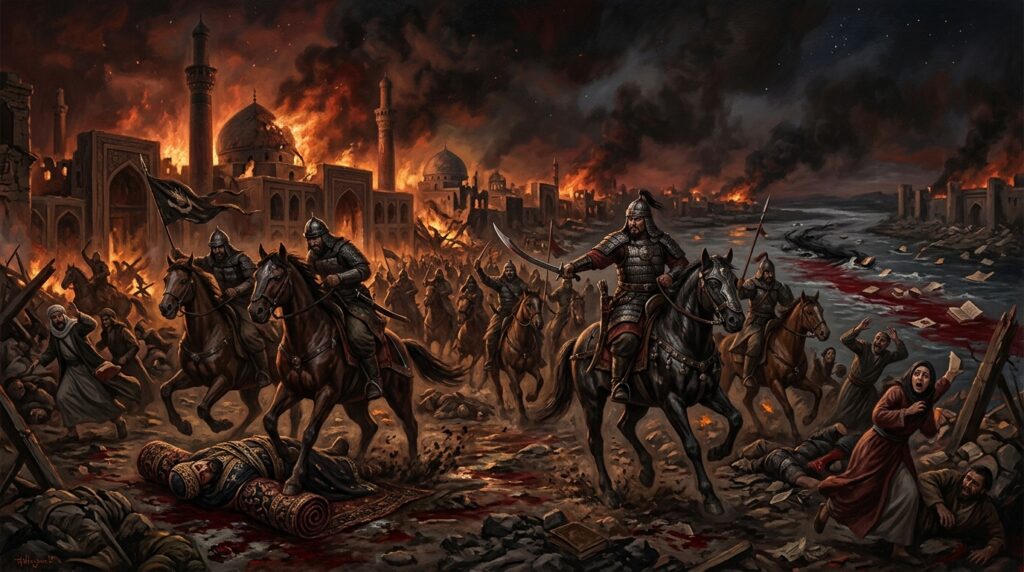
That is the year the Mongols sacked Baghdad. The Mongol army led by Hulagu Khan, the grandson of Genghis Khan, did not just conquer Baghdad, it erased it. They murdered the Caliph al-Mustasim by rolling him in a carpet and trampling him with horses, a Mongol tradition based on the belief that royal blood must not touch the ground. They burned the great libraries of the Abbasid court. Scholars say the river Tigris turned black from the books thrown into it, and red from the blood of the dead.
Somewhere between 200,000 and a million people were killed in the sack of Baghdad. Historians argue about the numbers, but even the lowest estimates are staggering. The center of the Islamic world was gone. The caliphate that had existed for more than five centuries was over. And the Mongols were not stopping.
They moved west. Damascus fell. Aleppo fell. The entire Levant was opening before them like a wound.
The Islamic world was in a state of collective trauma, real existential terror, because the Mongols had never lost. Not once. To anyone.
And then they ran into the Mamluks.
On 3 September 1260, at a place called Ain Jalut, the Spring of Goliath, located in modern day Palestine, the Mamluk army met a Mongol force in open battle.
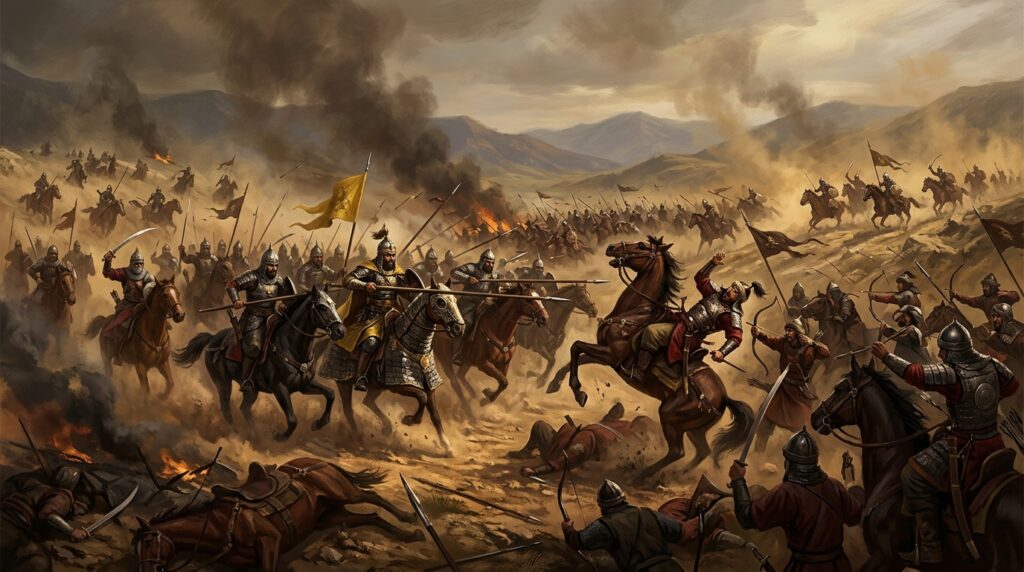
The Mamluk sultan at the time was Qutuz, but the man who actually commanded the battle, the man whose tactical genius shaped the entire fight, was a former slave who had been bought as a boy, trained in Egypt, and had already lived a life so brutal and so extraordinary that it barely seems real. His name was Baybars.
Baybars used the feigned retreat, a tactic the Mongols themselves had used to devastating effect in decades of conquests, against the Mongols themselves. He drew their cavalry forward, dragged the Mongol forces into rough terrain, and then hit them from multiple directions simultaneously with the full force of Mamluk heavy cavalry.
The Mongol commander Kitbuqa was killed in the fighting. The Mongol force was destroyed, and for the first time in the history of Mongol conquests, a Mongol army was defeated in open field battle by another army.
The myth of Mongol invincibility, the myth that had forced entire cities to surrender without a fight, that had paralyzed the strategic thinking of every ruler from China to Eastern Europe, was broken by people who had been bought as children.
Pause here for a moment and sit with that thought: if the Mamluks had lost at Ain Jalut, the Mongols would have poured into Egypt. Egypt would have fallen, and then there would have been no coherent military power left in the Arabic speaking Islamic world to stop them. The holy cities of Mecca and Medina would have stood exposed. The entire cultural continuity of Islam in the Arab world was in real danger of being cut off in the same way it was cut off in Persia and Central Asia, where Mongol conquests set progress back for generations.
Ain Jalut is not just a military victory. It is the moment when a door that was opening was slammed shut, and the Mamluks are the ones who slammed it.
The slave who built an empire
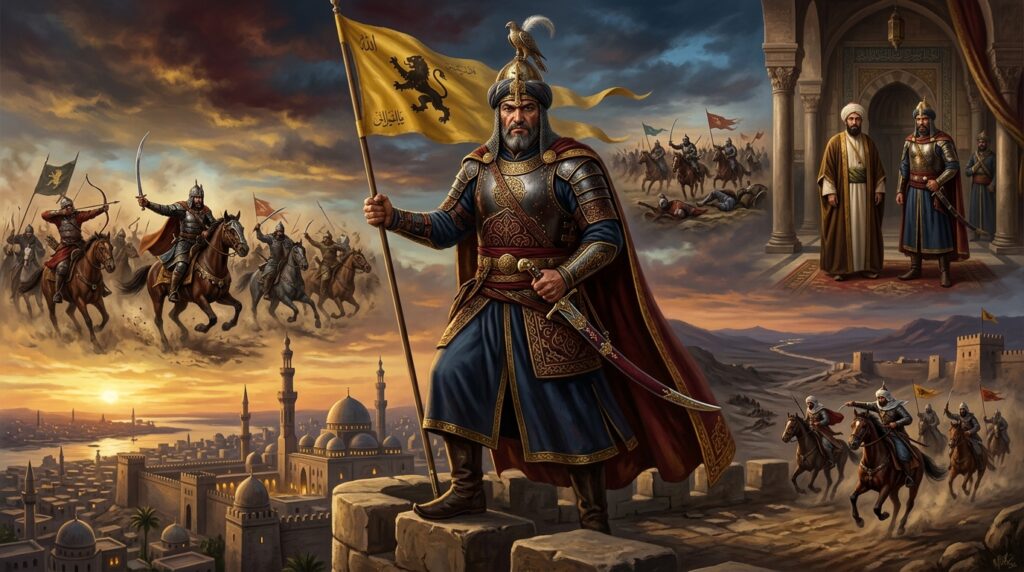
Baybars became sultan shortly afterward. He had Qutuz assassinated, which tells you everything about Mamluk court politics. And what followed was one of the most remarkable military campaigns in Islamic history.
He spent the next 17 years systematically ending the Crusader presence in the Levant, defeating Mongol invasions twice more, re-establishing a symbolic Abbasid caliphate in Cairo to restore Islamic legitimacy, and building a military postal system called the Barid that could carry messages from Cairo to Damascus in 12 hours, a speed of communication that gave him a strategic intelligence advantage most medieval rulers could not even imagine. He was not just a warrior. He was a strategist, an administrator, and a political operator of the highest order.
The Mamluk sultanate he and his successors built went on to expel the last Crusaders from the Holy Land with the fall of Acre in 1291, ending almost 200 years of Crusader presence in the Levant. They held Egypt and Syria against repeated Mongol attempts to return.
They remained a military and political power until the Ottomans defeated them at Marj Dabiq in 1516 and Ridaniya in 1517, when Sultan Selim I broke their army with gunpowder and artillery, weapons the horse archer elite had never adapted to. And even after that, the Ottomans kept Mamluk administrators in their posts in Egypt for centuries, because the institutional knowledge and local government infrastructure the Mamluks had built was too valuable to throw away.
Men bought as children who became a civilization’s shield in its most desperate hour. A military system so effective it defeated the most feared conquering force of the medieval world. A battle fought on 3 September 1260 that most people alive today have never even heard of, which almost certainly changed the course of Islamic civilization permanently.
They were bought as children, and they saved a civilization. And they did it because the system that enslaved them was also, by accident of its own logic, the system that set them free.
Read also: The Complete History of the Middle East: From Ancient Mesopotamia to the Modern Era
Read also: The Crusader States From the First Crusade to the Fall of Jerusalem