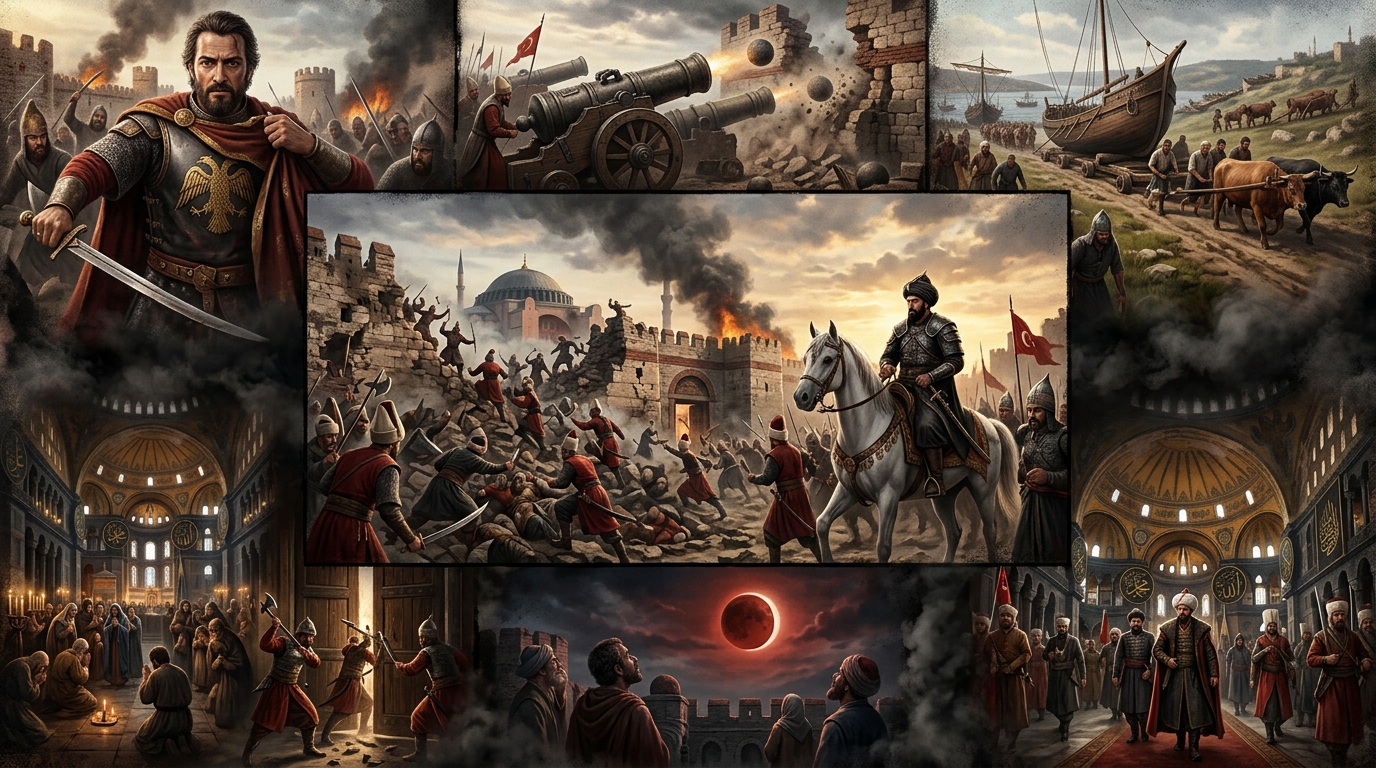
29 May 1453. Before dawn, the city is still breathing. Constantinople, once the heart of the Roman world, lies wrapped in darkness, its streets silent, its churches full, its walls trembling. For 53 days, the ground has shaken under Ottoman cannon fire. For 53 days, the defenders have repaired the walls by torchlight, filling the breaches with rubble, timber, and the bodies of men. Tonight, there will be no repairs.
This is the story of the last night of Rome, told through the two men who decided it: an emperor who refused to leave his city, and a 21 year old sultan who believed he was not destroying Rome, but inheriting it.
The city that would not die
To understand why the fall of Constantinople in 1453 shook the world, first understand what that city was, and what it had already lost. By the middle of the fifteenth century, the empire that still called itself Roman was little more than a shadow stretched across memory. Its people did not call their state Byzantine. That was a label invented centuries later. To them, they were Romeoi, Romans, citizens of an empire that had existed in unbroken continuity since the time of Augustus Caesar.
When Rome fell in the west in the fifth century, Constantinople endured. It became the vessel that carried Roman law, philosophy, Christian theology, and imperial administration through the entire Middle Ages. For more than a thousand years, emperors ruled from its palaces, armies marched under its banners, and scholars copied the texts that would otherwise have crumbled to dust.
But by 1453, that continuity had grown fragile. The empire’s territory had shrunk to little more than the city itself, a strip of land in the Peloponnese, and a few scattered islands. Constantinople’s once crowded population had fallen from hundreds of thousands to perhaps 50,000. Whole neighborhoods lay abandoned. Fields were cultivated inside the walls where markets and fora had once stood.
The greatest wound had come not from Muslims but from Christians. In 1204, the armies of the Fourth Crusade, diverted by politics, debt, and ambition, broke upon Constantinople. Western knights looted the greatest Christian city on earth with a brutality that shocked even their contemporaries. Churches were robbed, relics stolen, artworks melted down. The empire never fully recovered. What remained after the Byzantines retook the city decades later was poor, weak, and permanently divided from the Latin West.
Then came plague. The Black Death swept through the city in the fourteenth century, killing thousands and accelerating the demographic collapse. Trade slipped from imperial hands into the hands of Venetian and Genoese merchants, who grew rich while the empire starved. The treasury emptied, the army shrank. When Constantine XI came to the throne in 1449, the Roman Empire could barely field 7,000 soldiers to defend walls stretching more than 14 miles.
The emperor who refused to leave
Constantine never expected to rule. Born in 1405, he was the fourth son of Emperor Manuel II, destined for obscurity, a provincial governor, perhaps a military commander. But fate removed his brothers one by one until the crown fell upon his head.
Those who knew him described him as a man of quiet determination, deeply religious, physically unremarkable, but with a stubborn courage that bordered on fatalism. He was no fool. Constantine understood that Constantinople could not stand alone. Venice and Genoa offered help, but always at a price: control of harbors, autonomy for districts, influence that would turn the empire into a client state. Hungary promised help but gave nothing. The Pope offered armies in exchange for union between the Orthodox and Catholic churches, a theological compromise the emperor accepted in theory, but which his people overwhelmingly rejected. “Better the turban of the Turk than the cardinal’s hat of the Latin,” many Byzantines said.
Constantine had to walk a narrow line between survival and betrayal. Every option required sacrificing something essential: faith, freedom, dignity. In the end, he chose to sacrifice himself.
On 26 May, Constantine called his last council. The situation was hopeless. The walls were broken. The soldiers were wounded beyond endurance. No relief army had come. Some advised the emperor to flee and continue resistance elsewhere. Constantine refused. He would not abandon his city.
Before taking his position on the wall, he went to Hagia Sophia. There, under the vast dome that had once symbolized the union of heaven and empire, Orthodox and Catholic worshippers prayed side by side. For centuries, the Christian world had been divided by doctrine, ritual, pride. Tonight, none of that mattered. Men and women wept openly. Priests gave communion to soldiers who would be dead before sunrise. The emperor himself knelt and asked forgiveness from nobles, soldiers, and servants for any wrong he had done them in his life. This was not the act of a ruler preparing to negotiate. It was the act of a man preparing to die.
The boy who would inherit Rome
Across the Bosphorus, a very different man was preparing to make history. Mehmed II, later known as the Conqueror, took the Ottoman throne for the second time in 1451. He was 21 years old, brilliant, unstable, and obsessed with Constantinople.
The city was more than a strategic prize. It was an idea, a symbol that had defied Muslim armies for 8 centuries. Mehmed was unusually educated for a medieval ruler. He spoke several languages, read classical history, and admired Alexander the Great. He surrounded himself with scholars, artists, and engineers. But he was also ruthless. To secure his throne, he had his infant half brother executed without hesitation. For Mehmed, mercy was a tool, not a principle.
He did not see himself as a barbarian destroying Rome. He believed he was inheriting it. Once Constantinople fell, he would take the title Kayser, Caesar of Rome. In his mind, empire passed not through bloodlines, but through conquest.
Preparation began immediately. In 1452, Mehmed ordered the construction of a massive fortress, Rumeli Hisari, on the European shore of the Bosphorus, directly opposite an older Ottoman stronghold. Together, they strangled Constantinople’s access to the Black Sea. Any ship passing without permission was sunk. The city was being starved before the siege had even begun.
Then came the weapon that would change everything. A Hungarian engineer named Urban arrived in Constantinople, offering a cannon like the world had never seen. It could break the walls that had resisted every army since antiquity. Constantine wanted it desperately, but the imperial treasury was empty. Mehmed had no such problem. Urban entered Ottoman service and set to work.
What he built was a monster: enormous bronze cannons capable of firing stone balls weighing more than half a ton. They needed teams of oxen, hundreds of men, and specially built roads to move them. When one fired, the earth shook. When a ball struck, stone shattered like dry clay. For the first time in history, Constantinople’s walls faced a weapon designed specifically to destroy them.
By April 1453, Mehmed was ready. His army, tens of thousands strong, gathered before the city. His fleet had closed it off from the sea. The siege of Constantinople, long imagined and often attempted, had begun in earnest.
Inside the walls, Constantine prepared for the inevitable. He strengthened the defenses, organized mixed Greek and Latin units, and placed his greatest trust in Giovanni Giustiniani, the Genoese commander whose experience of siege warfare gave the defenders their best chance. Citizens were put to work. Monks carried stones. Children brought water. Every able bodied person was needed.
As the first Ottoman cannons fired on 12 April 1453, a sound echoed through the city that no Roman citizen had ever heard: the sound of the medieval world breaking apart.
The siege of Constantinople was not a single battle, but a relentless grinding: day after day of thunder, smoke, and exhaustion that tested the limits of human endurance.
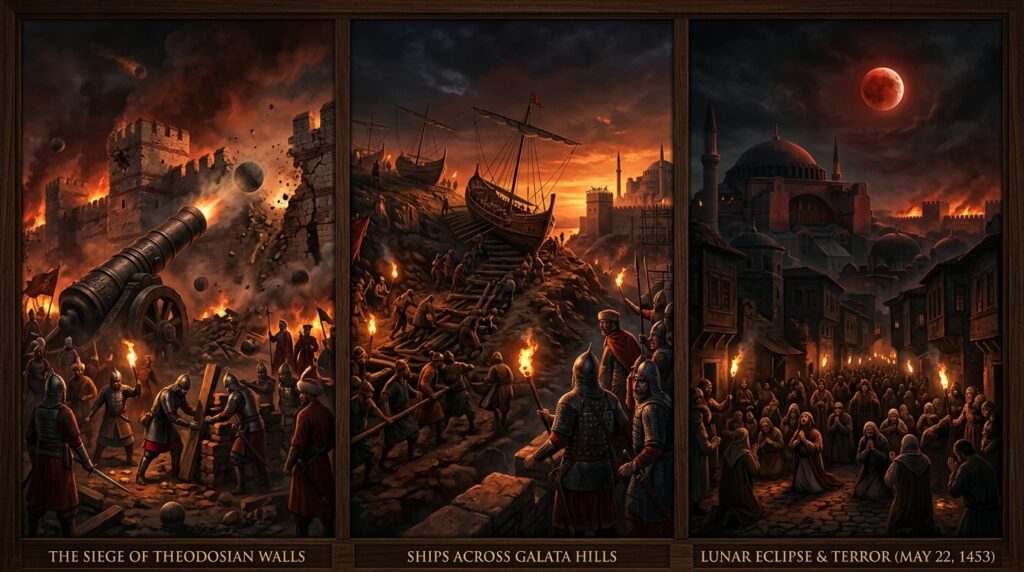
On 12 April 1453, the Ottoman cannons began their work in earnest. When the great cannon fired, the sound carried for miles. Windows shattered inside the city. Birds flew from rooftops in panic. The great stone ball struck the Theodosian walls with a violence never seen in any previous siege. Sections that had stood for a thousand years cracked, crumbled, and fell in clouds of dust.
Yet the walls did not fall, at least not at first. The cannons were powerful, but imperfect. They overheated, they burst, and they needed long pauses between shots. Every night, under cover of darkness, the defenders rushed to the breaches. They filled the gaps with earth, timber, and rubble, building temporary fortifications behind the broken stone. By morning, the walls still stood, ugly, weakened, but defiant.
The psychological damage was immense. For the first time in their lives, many Byzantines experienced artillery warfare. The constant thunder shook nerves and faith alike. Some claimed to hear demonic voices in the cannon’s roar. Others believed the noise was God’s punishment. Sleep became impossible. Men collapsed from exhaustion, then rose again when the drums sounded.
Mehmed watched patiently. He understood that the city could not be taken by force alone. It had to be broken mentally and spiritually as well as physically.
One of Constantinople’s greatest advantages was water. The city was surrounded by sea on three sides. The Golden Horn, a deep natural harbor, was protected by a huge iron chain stretched across its entrance. As long as that chain held, the Ottoman fleet could not enter, and the city could receive limited supplies and reinforcements.
Mehmed needed the Golden Horn. When naval attacks failed and the chain held, he devised a solution so bold it bordered on madness. On the night of 21 April, Ottoman engineers built a wooden road over the hills of Galata, greased with animal fat. Using oxen, ropes, and sheer human strength, they hauled dozens of ships overland from the Bosphorus, across the hills, and down into the Golden Horn.
By morning, the people of Constantinople woke to an impossible sight: Ottoman ships floating quietly in their most secure harbor. The shock was devastating. The Golden Horn was considered impregnable, protected by both nature and iron. To see enemy ships there felt like a violation of reality itself. Morale broke. Rumors spread that God had abandoned the city. From that moment, Constantinople was completely surrounded.
The defenders did not surrender. Giovanni Giustiniani reorganized the walls with ruthless efficiency. Greeks and Latins, united by necessity, fought side by side. Every breach was counterattacked. Greek fire flowed in burning arcs, sticking to flesh and armor. Ottoman dead piled before the walls.
Mehmed launched his first major assault on 18 April. Wave after wave of irregular troops advanced with battle cries. They were sent to die, to exhaust the defenders and expose weak points. The Byzantines killed them from above with grim resolve. As night fell, the sultan threw in his better trained troops. Still the wall stood. The first assault failed.
Then came a war beneath the earth. Ottoman engineers began digging tunnels under the walls, intending to fill them with gunpowder and bring the foundations down from below. But the Byzantines had their own expert engineers, a foreigner known by the name John Grant. By placing bowls of water on the ground and watching the vibrations, Grant located the tunnels. Counter tunnels were dug. Underground battles were fought, men fighting with daggers, fire, and bare hands in suffocating darkness. On several occasions, Byzantine counter miners filled Ottoman tunnels with fire and smoke, killing everyone inside. It was brutal, claustrophobic, and terrifying. For a time, the defenders prevailed.
As weeks passed, frustration grew in the Ottoman camp. Losses mounted, disease spread, supplies dwindled. Some of Mehmed’s advisors begged him to lift the siege. Constantinople, they warned, had broken armies more powerful than his. But Mehmed refused. He believed destiny was on his side.
Then, in late May, strange events occurred, events both sides interpreted as heavenly signs. One evening a thick fog settled over the city, unnatural for the season. That night, eyewitnesses reported strange lights flickering around the dome of Hagia Sophia. To the Byzantines, it felt as if the holy presence protecting the city was departing. To the Ottomans, it was proof that victory had been granted by God. The next day, an icon of the Virgin of the Blessed fell during a procession and could not easily be lifted. A violent storm came, flooding the streets with water and damaging buildings. For a population already living on the edge of despair, these signs felt final.
On 28 May, Mehmed ordered a day of rest and prayer. His army had been promised three days of plunder if the city fell. The first man up the walls would be rewarded with wealth and rank. That night, the sultan addressed his commanders, declaring that by morning, Constantinople would be his, or he would die.
Inside the city, a strange calm settled. People gathered in churches. Final confessions were made. Families embraced, unsure whether they would see each other again. The last Roman emperor walked the walls thanking soldiers by name, speaking words of courage to men who knew the odds. As midnight passed, the city waited. The drums began again. The final day had arrived.
The night itself, hour by hour
The night of 28 May flowed into 29 May without ceremony. Morning had not yet come, the sun had not risen, only darkness and sound.
At about 1:30 at night, the final assault began. From Ottoman ranks stretching from the Golden Horn to the Sea of Marmara, drums thundered through the night. Trumpets answered. Thousands of torches flared at once, turning the field before the walls into a sea of fire. The sound reached the city like thunder: metal on metal, men crying out prayers, commanders shouting orders in Turkish, Arabic, Greek, and Slavic languages. To those waiting behind the walls, it felt as if Judgment Day were approaching on foot.
Inside Constantinople, the bells of Hagia Sophia rang, not to summon worshippers, but to warn the living that the final hour had come. For more than a thousand years, this city had endured. It had survived plague, earthquakes, civil wars, Crusaders, and sieges by far larger armies. Its walls, built in an age when emperors still spoke Latin, had never fallen to a foreign enemy. But tonight, stone standing since the fifth century was crumbling under gunpowder.
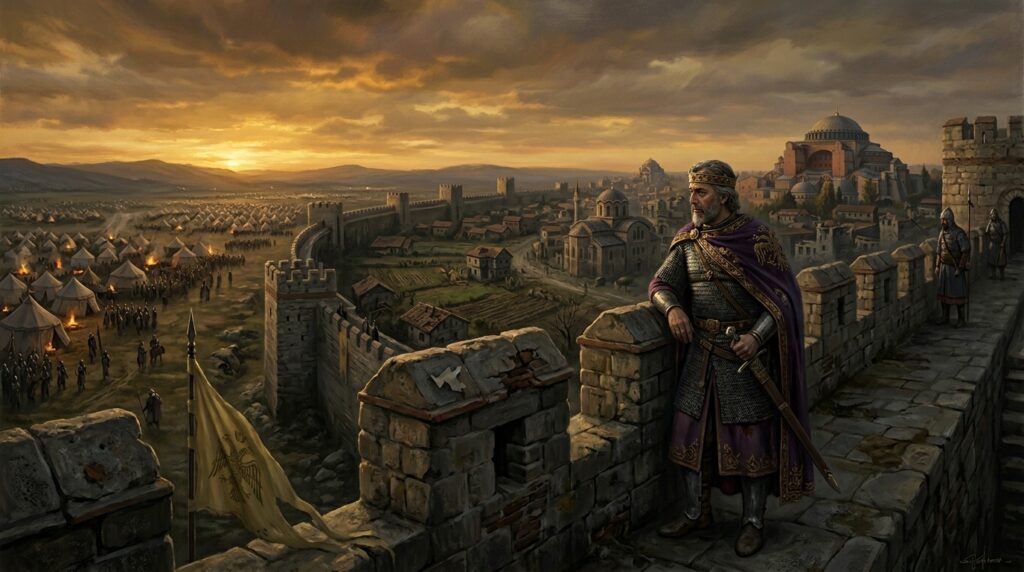
Near the St Romanus Gate, beside a worn section of wall, Emperor Constantine XI Palaiologos waited. He wore no silk. He wore no crown. The purple boots that marked his rank, the symbol of imperial authority stretching back to Augustus, were hidden beneath his armor, which was scratched, dented, and blackened with soot. At 49 years old, Constantine knew what price this night would demand of him. He had known for months.
Now, as the first wave of attackers advanced, Constantine gripped his sword and watched the ladders rise.
The Ottomans first sent their irregular troops: thousands of poorly armed men, driven forward by fear, ambition, and promises of plunder. They ran screaming, filling the darkness with noise meant to break the defenders’ nerves. Arrows rained down. Stones fell from above. Greek fire flowed over the walls, burning bodies in liquid flame. The moat filled with the dead. For hours the attack continued.
Then came the Anatolian regulars: better armed, better trained, advancing in disciplined waves. They pushed toward the weakest section of wall, where cannon fire had shattered the masonry. The defenders fought with an exhaustion close to collapse. Many had not slept for days. Some were wounded, held upright by comrades. Yet they held.
As the sky began to lighten, the sultan played his final card. Mehmed II, 21 years old, ordered the Janissaries forward. They were the elite of his army, soldiers raised for war from childhood, forbidden family, forbidden retreat, loyal only to the sultan. They advanced in formation, beating drums as they came, their banners cutting through the smoke. This was the hammer meant to break what remained of Roman resistance.
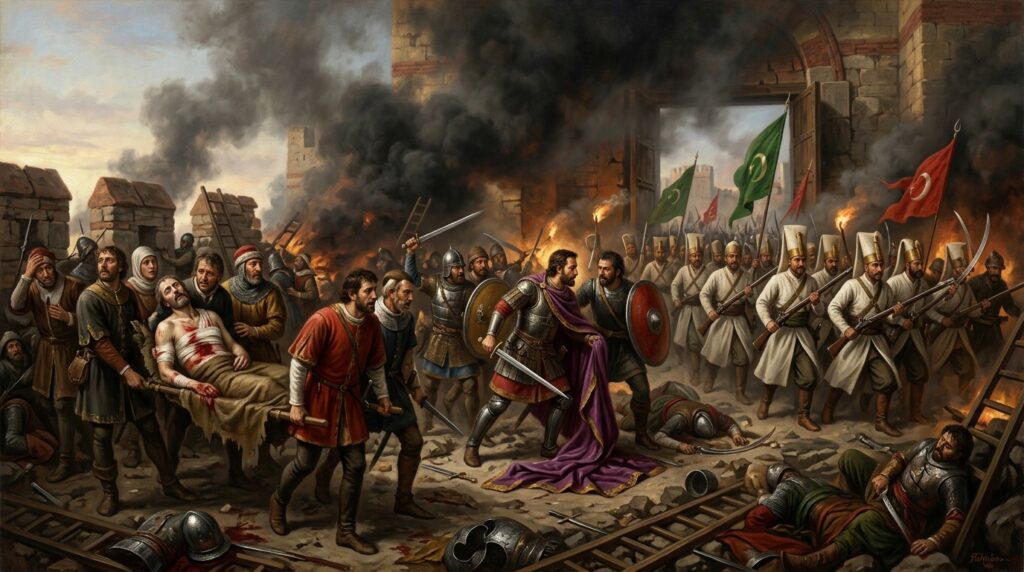
At that moment, disaster struck inside the walls. A small gate, forgotten, unguarded, left open during the chaos, was found by Ottoman soldiers. A handful slipped inside. Though they were soon killed, the damage was done. Rumor spread: Ottoman banners had been seen inside the city. Panic spread across the walls like fire.
Then the defenders lost their anchor. Giovanni Giustiniani, the Genoese commander who had held the walls together by sheer force of will, was wounded. Whether by bullet or arrow, no one agrees. The wound was severe, bleeding heavily, barely conscious, he was carried from the wall. When his men saw him go, many fell back. The line broke.
Constantine saw it happen. He understood at once that this was the end. No reinforcements were coming. No miracle would appear on the horizon. The city had fallen, not tomorrow, not by negotiation, but now.
According to eyewitnesses, the emperor turned to those still standing near him and spoke words that would echo through history: “The city is fallen and I am still alive.”
He tore off the last visible symbols of imperial rank and moved forward. A handful of companions went with him: relatives, friends, soldiers who refused to abandon him. Together they plunged into the chaos at the St Romanus Gate, fighting not as emperors and nobles, but as men among men.
Constantine was seen knocking down attackers, shouting orders, then disappearing into the crush of bodies, and then he was gone. His body was never conclusively identified. No tomb was built. The last Roman emperor vanished into legend, swallowed by the fall of the city he had refused to abandon.
By midday, Ottoman banners flew from the minarets. Constantinople, queen of cities, New Rome, the last living link of the ancient world, had fallen.
The morning after, and what was born
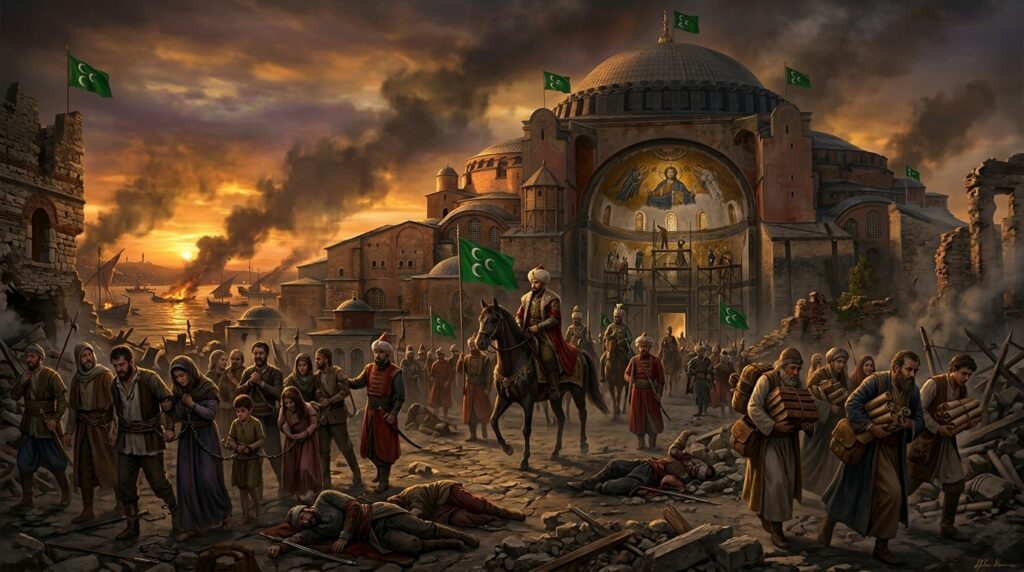
What followed left a mark on history. As promised, Mehmed allowed his army to plunder the city. Soldiers spread through neighborhoods, breaking down doors, dragging people from hiding places, seizing treasures collected over centuries. Families were broken apart. Churches were desecrated. Blood ran in the streets. Thousands fled to Hagia Sophia, believing the great church would be spared. They filled the vast interior, men, women, children, praying for a deliverance that did not come. Ottoman soldiers broke down the doors. The strong were enslaved, the weak were killed.
By afternoon, Sultan Mehmed II entered the city. He rode straight to Hagia Sophia. There, standing under the vast dome, he ordered the plundering to stop. He declared the building his property and ordered it converted into a mosque. According to tradition, he picked up a handful of earth and sprinkled it on his turban, a symbol of humility before God.
The Roman Empire, older than any empire in Europe, was over.
But history was not over. From the ashes of Constantinople, new worlds would rise.
When the violence subsided, Constantinople was broken but not erased. Sultan Mehmed II understood what few conquerors understand: to rule a city, it must be preserved. Within hours, he ordered the uncontrolled plunder to end. Churches, palaces, and streets lay wounded. Yet the city itself stood, spared the fate of total destruction that erased so many ancient capitals.
Mehmed did not consider himself the destroyer of Rome. He considered himself its heir. He took the title Kayser, Caesar of Rome, and kept much of the Byzantine administrative system. Greek officials were retained. The Orthodox Church was restored under a new patriarch. Genoese and Venetian communities were given trading privileges. Constantinople’s name became Istanbul, but its soul was not erased. It was transformed.
The consequences of this transformation reshaped the world. Across Europe, the fall of Constantinople echoed like an earthquake. Bells rang in distant cities, courts and monasteries mourned the loss of the civilization that had anchored Christian history for a thousand years. The last direct link to ancient Rome was gone. The medieval world, defined by inherited authority and fortified certainty, had fallen.
From the ruins came inspiration. Greek scholars fled west, carrying manuscripts long preserved in Constantinople, the works of Plato, Aristotle, Euclid, and countless others. Their arrival fueled the Renaissance, accelerating Europe’s revival of classical learning. What had been saved in the East now reignited the West.
The Ottomans, enriched by Byzantine knowledge and strategic power, rose as a global empire. Istanbul became a crossroads of cultures, languages, and faiths, bridging Europe and Asia for centuries to come.
For the Greeks, the loss became myth. They whispered that Constantine XI had not really died: that an angel had turned him to marble and hidden him beneath the city, waiting for the day Constantinople would return to Greek hands. It was a myth born of grief, but also of hope, sustaining identity through centuries of foreign rule.
And so Rome’s last day became more than an ending. It became a warning. No wall is eternal, no empire safe, no age permanent. Constantinople had stood for more than a thousand years, outliving empires and cultures that considered themselves invincible. Yet in a single night, history moved on.
As the sun set over the Bosphorus on that evening of 1453, the bells of the churches were silent. The call to prayer rose where hymns had once echoed. A medieval world had closed its final chapter, and the modern age began, born not in triumph, but in fire, blood, and irreversible change.
Read also: The Fall of Constantinople and the Rise of Istanbul How 1453 Changed the World
2 thoughts on “The End of the Roman Empire and the Birth of the Ottoman Era”