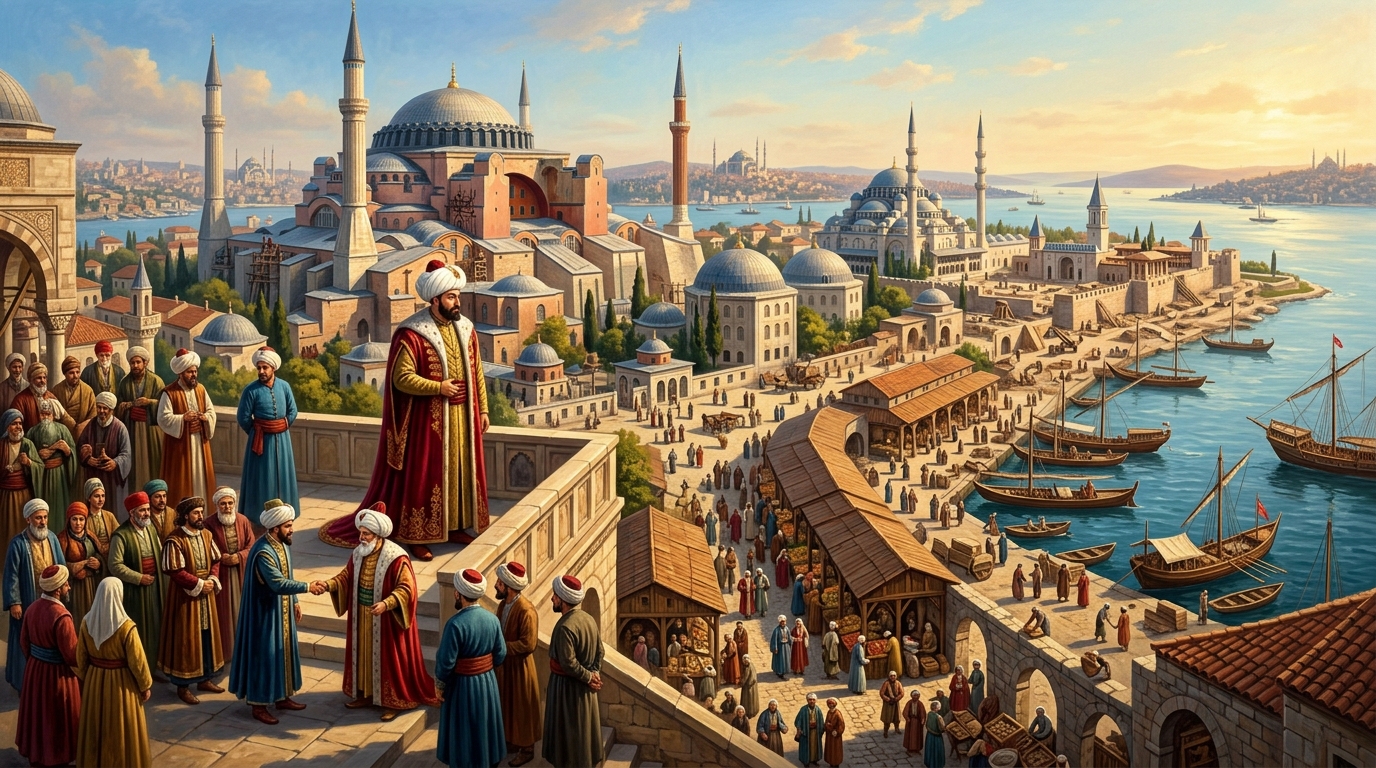
On 29 May 1453, a 21 year old sultan walked into a city that had been the capital of an empire for 1,100 years, and the world changed. Not just the city. The fall of Constantinople is usually told as a siege story, cannons, walls, and a last emperor dying in the breach. But the siege was only the prologue. What made 1453 a hinge of history was what it set in motion: Greek scholars carrying ancient knowledge to Italy, European merchants driven to the sea in search of a new route to Asia, and a new superpower capital rising on the Bosphorus. One date, three shockwaves, and a city reborn. This is how 1453 changed the world.
The 53 days that ended an empire
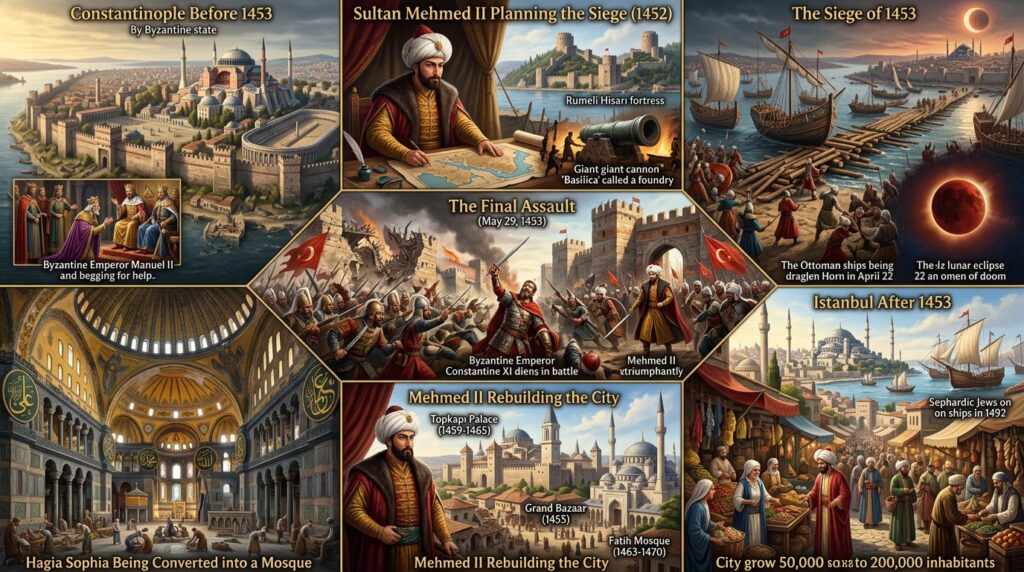
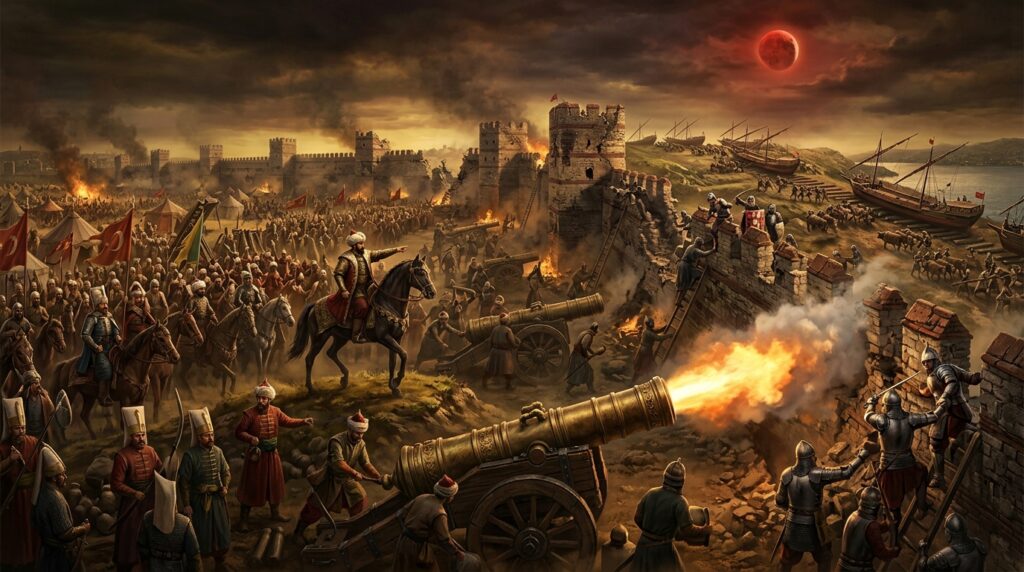
By the spring of 1453, the Byzantine Empire was little more than Constantinople itself, an island of Christian rule in a Muslim Ottoman sea. The young and determined Ottoman Sultan Mehmed II began the siege that ended it. On 6 April, Mehmed’s large army, estimated at more than 100,000 men, began bombarding the land walls with large cannons. The Byzantines, led by Emperor Constantine XI Palaiologos, were vastly outnumbered, perhaps only 7,000 defenders. Yet they defended the city bravely.
Mehmed had prepared the ground well. He built the fortress of Rumeli Hisari on the European shore of the Bosphorus to choke the city’s supplies from the Black Sea, and when his ships could not pass the great chain across the Golden Horn, he had them hauled overland on greased planks and launched into the harbor behind the chain. The city was now besieged by land and by water.
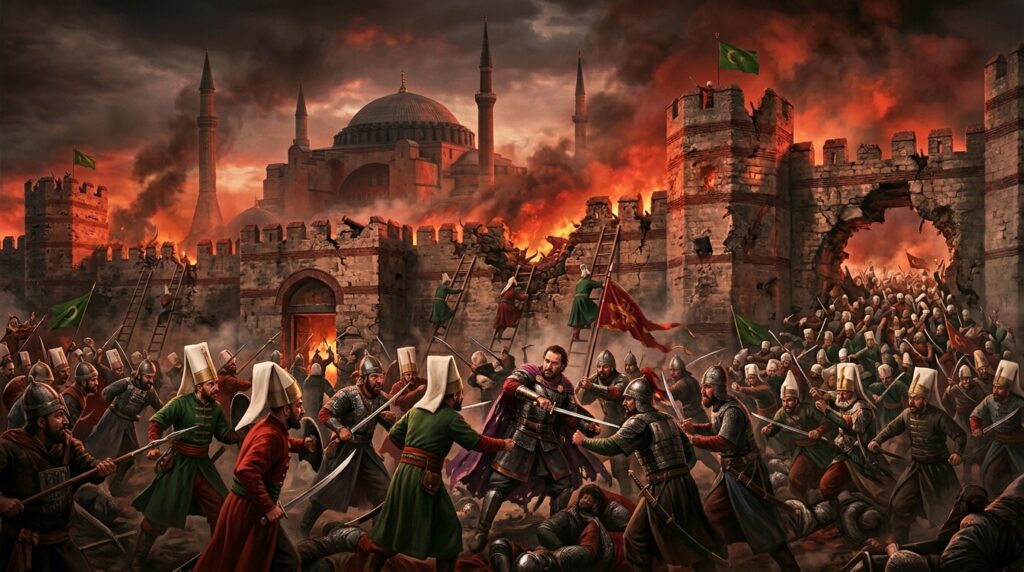
After a seven week siege, the final assault came on 29 May, when Mehmed’s forces broke through the walls and entered the city. In the bitter fighting that followed, it is said that Emperor Constantine XI took off his imperial purple cloak and threw himself into the thick of the fight before dying in the struggle. With his death, the city of Constantinople, the capital of the Byzantine Empire, after almost 1,100 years of continuous existence, came to an end.
Mehmed stopped the customary three days of plunder after the first day and immediately declared Constantinople the new capital of his growing Ottoman Empire. Standing amazed under the dome of Hagia Sophia, Mehmed ordered the cathedral converted into a mosque, symbolically changing the city’s religious identity. The city would officially remain Konstantiniyye, the Ottoman form of Constantinople, for many years. But gradually, “eis tin polin,” a phrase long used by the Greek population meaning “to the city,” became the more common name Istanbul.
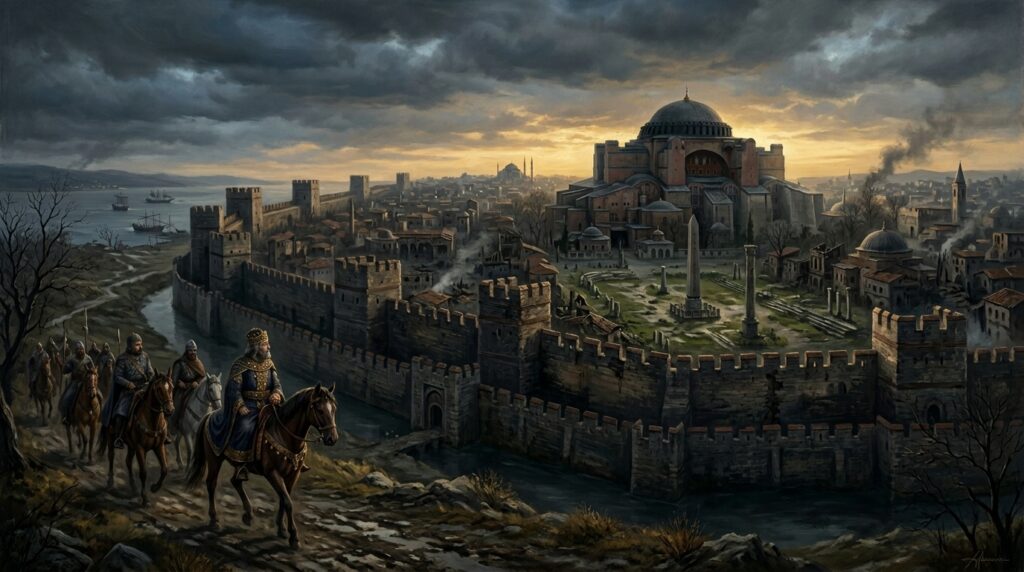
The empire was dead. The shockwaves were just beginning.
Ripple one, the scholars who carried Greece to Italy
First, the intellectual effect. When Constantinople fell, thousands of Greek scholars fled, mainly to Florence, Venice, and Rome, and they carried with them ancient Greek manuscripts that were barely known in Western Europe: Plato, Aristotle, Archimedes, works of medicine, mathematics, and philosophy.
This gave a huge boost to the Italian Renaissance, which was already underway. Renaissance humanism drew directly from the refugee scholars of Constantinople. The Greek classics that would shape European literature, science, and philosophy for centuries arrived in the West not through slow trade, but in the luggage of people fleeing a fallen city. The fall of Constantinople did not just end the Eastern Roman Empire. It handed the West its own past, and the West used it to invent its future.
Ripple two, the trade choke that sent Europe to sea
Second, the commercial effect. With the Ottomans controlling Constantinople and the entire land route between Europe and Asia, trade with the East became very expensive. The silk and spice routes that passed through this region came under Ottoman control. This put European trading powers in a desperate position, and they began searching for alternative sea routes.
Portugal was already exploring the African coast in search of a sea route to India. Spain funded Columbus in 1492. The fall of Constantinople in 1453 was one of the factors that accelerated the Age of Discovery. Without 1453, America might not have been discovered when it was. The search for a way around the Ottoman choke point redrew the map of the world, opened the Atlantic age, and eventually shifted the center of world trade from the Mediterranean to the oceans.
Ripple three, a new capital for a new superpower
Third, the geopolitical effect. Istanbul, as Mehmed II renamed it, became the capital of the world’s most powerful empire. In the second half of the 15th century and throughout the 16th century, the Ottoman Empire was the dominant superpower, and the heart of all that power was the city we today call Istanbul.
Mehmed II immediately set to work repopulating and rebuilding the city. He invited, and in some cases forcibly moved, people from all over his empire, settling Muslims, Christians, and Jews alike in different neighborhoods to bring life back to the city’s empty streets. From a low of perhaps 50,000 inhabitants at the time of the conquest, Istanbul’s population multiplied within a few decades as the city opened as the capital of a new dynamic empire that soon spanned three continents.
Between 1459 and 1465, Topkapi Palace was built, which would be the heart of the Ottoman Sultanate for nearly 400 years. Located at the tip of the peninsula where the Bosphorus, the Sea of Marmara, and the Golden Horn meet, Topkapi was not a palace in the European sense, but a city within a city, with courtyards, pavilions, gardens, libraries, royal kitchens, the royal harem, and treasury rooms. From here, until the 19th century, Ottoman sultans ruled the empire.
Mehmed also built the Fatih Mosque, the Conqueror’s Mosque, between 1463 and 1470, on the site where the Church of the Holy Apostles once stood, which after Hagia Sophia was the second most important church of Byzantium and which was demolished for the construction of the new mosque. Along with it, he built a complex that included eight madrasas, a library, a hospital, and a market. It was the first great Ottoman religious complex in the city.
Mehmed II died in 1481 at only 49 years of age. His successor was his son Bayezid II, and the 15th century ended with a city that had transformed from the remains of a dying Christian capital into the world’s most dynamic metropolis.
In 1492, the same year Columbus reached America, the Catholic monarchs expelled the Jews from Spain. Sultan Bayezid II offered them refuge in the Ottoman Empire. Thousands of Sephardic Jews settled in Istanbul and other Ottoman cities, enriching the city with their culture, their medical knowledge, their experience in trade, and their traditions. Thus Istanbul became a city of coexistence for Greeks, Turks, Armenians, Jews, Genoese, and people of many other backgrounds.
By the end of the 15th century, this city had grown from 50,000 inhabitants to more than 200,000. It was the most populous city in Europe. It was the fastest growing city in the world. In just 100 years, this city had transformed from the remains of a 1,000 year old empire into the capital of the world.
That is the real meaning of 1453. It did not just end Rome. It rearranged the map of knowledge, the map of trade, and the map of power. Greek books reached Italy, European ships reached America and India, and the center of the world moved to a city on the Bosphorus that still carries all three of its lives in its stones: Byzantion, Constantinople, Istanbul.
Read also: The Ottoman Empire: From Founding (1299) to the Fall of Constantinople (1453)
1 thought on “The Fall of Constantinople and the Rise of Istanbul How 1453 Changed the World”