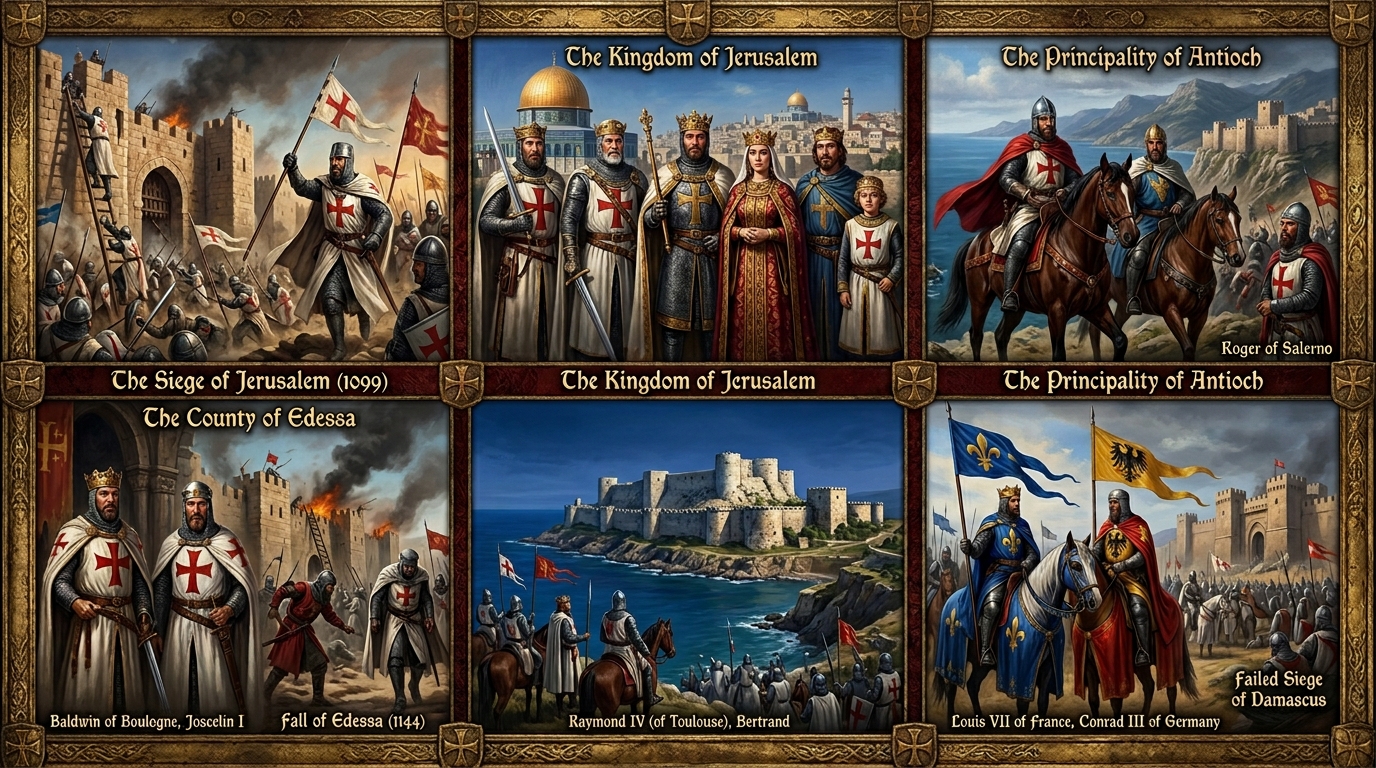
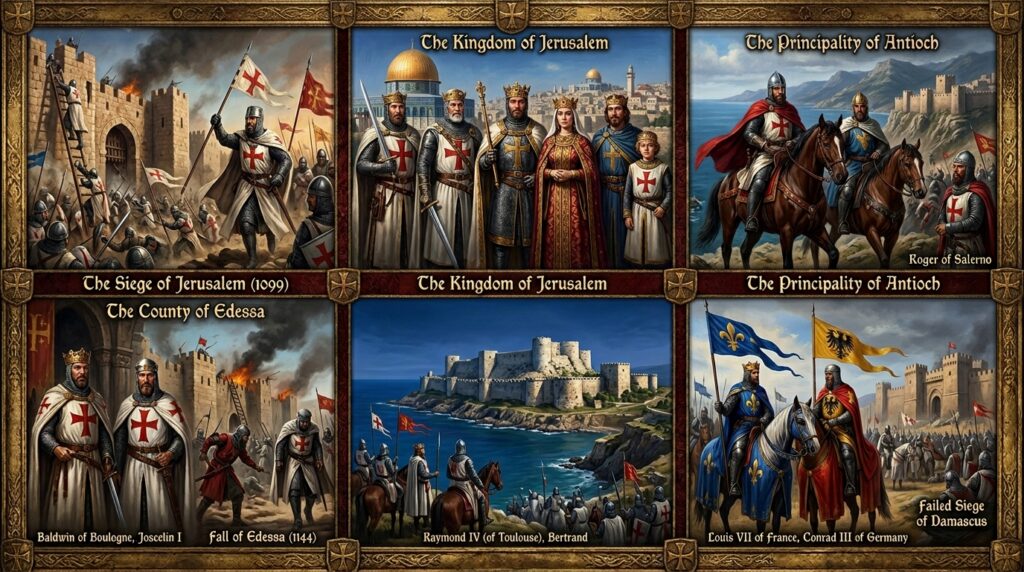
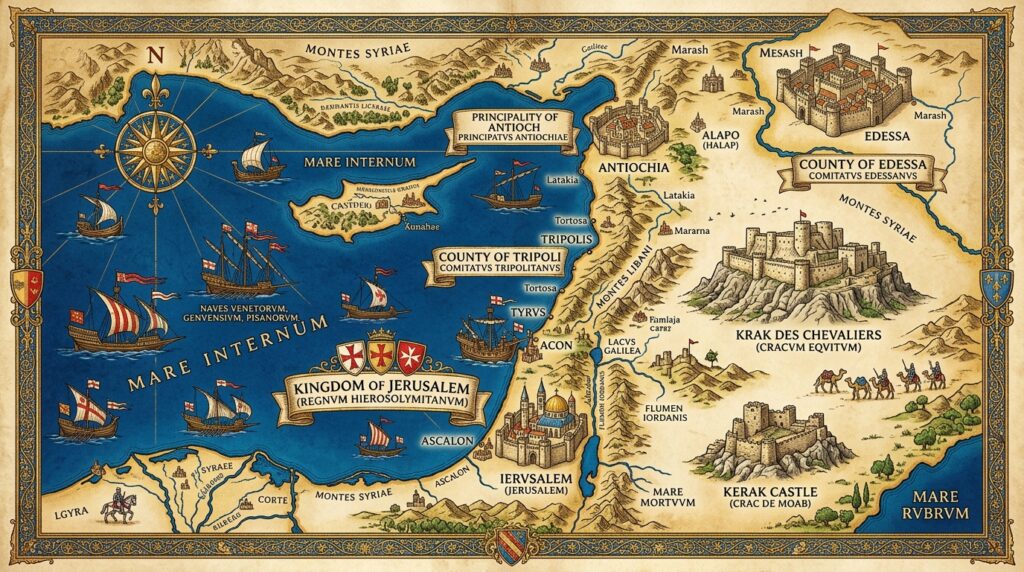
After the First Crusade, four Crusader states emerged in the Middle East. Jerusalem came under Christian control and remained the Crusaders’ capital for almost a century, until the Muslims took their revenge. The usual story is a war of religions, Christians against Muslims, ending at Hattin in 1187. The real story is stranger: the Crusader states were Europe’s first overseas colonies, and they were never one country. They were four rival lordships that fought each other almost as often as they fought Muslims, a kingdom that at its best could field only 20,000 soldiers, and a colony that survived longest whenever it stopped acting European. It did not fall to Saladin alone. It fell apart first.
Four states, not one kingdom
The first ruler of the Kingdom of Jerusalem was Godfrey of Bouillon, who took the title Defender of the Holy Sepulchre. In his new lands, he introduced Europe’s distinctive feudal system. He distributed lands to knights in his army, who in return gave him feudal homage.
Yet after the First Crusade, most Crusaders returned to Europe, because they had fulfilled their vow to retake Jerusalem from the Muslims. Those who remained began to establish their own lordships. Thus in 1099, Tancred of Taranto conquered Galilee, creating his own state, but he gave feudal homage to Godfrey, which made Tancred’s holdings part of the Kingdom of Jerusalem.
Godfrey did not rule for long. He died the next year while trying to capture cities on the Mediterranean coast. His brother Baldwin I, who was then Count of Edessa, became the new king of Jerusalem. Unlike Godfrey, Baldwin was not known for his humility, and he took the title King of Jerusalem.
Baldwin I proved a skilled statesman. He cleverly removed Dagobert of Pisa, the Patriarch of Jerusalem, who wanted to establish a theocratic rule in the city like the Papal States of Rome.
Baldwin I spent almost his entire reign expanding the kingdom’s territories. In 1101, he conquered the cities his brother had planned to take. In 1104, he captured Acre, an extremely important city for the Kingdom of Jerusalem, because its port would generate the most revenue for the treasury.
In the coming years, Baldwin secured his conquests in the three Battles of Ramla. Despite a Crusader defeat in the second battle, two victories were enough for the Fatimid Caliphate to abandon its claims to the lost territories.
Baldwin I then turned to resolving conflicts among the Crusaders. In 1109, the King of Jerusalem succeeded in uniting them to capture the lands of Lebanon, which had blocked the land route from Byzantium. During this campaign, Baldwin I added Beirut to his kingdom, while the rest of Lebanon became part of the County of Tripoli.
Baldwin I also captured Sidon with the help of Norwegians, who had started a short crusade but soon left. In 1115, Baldwin I conquered lands on the eastern bank of the Jordan River and reached the Red Sea, cutting Muslim Egypt and Syria off from each other.
The first king of Jerusalem died in 1118 during a campaign in Egypt, having reached the Nile Valley.
His successor was the Count of Edessa, his companion Baldwin II of Bourcq. With the help of Venice, he succeeded in completing the conquest of the coastal cities. He tried to capture Aleppo and Damascus, but failed and was imprisoned for two years. Even after his release, Baldwin II continued his campaigns in Syria, although they were now limited to raids on Muslim cities.
Baldwin II bequeathed his crown to his grandson Baldwin III. However, since Baldwin III was still a child, power passed to his daughter Melisende and her husband Fulk, who were crowned together with the young King Baldwin III.
Melisende was known for her generosity and political intelligence, which won her the love of her subjects. Her husband Fulk, by contrast, often interfered in the affairs of his barons. During his reign, Fulk faced a series of defeats at the hands of Muslims, which further reduced his popularity. Only his untimely death in 1143 saved the kingdom from civil war.
In 1098, Bohemond became Prince of Antioch. He too tried to expand his principality, but with less success. In 1100, he lost the Battle of Melitene and was held captive by the Turks for 3 years. Upon his release, he returned to Europe, recruited volunteers, and set out to fight again, although this time not against Muslims, but against the Byzantines. In 1108, he was defeated at Devol and made peace with the emperor, agreeing to hand Antioch over to Byzantium.
Yet in Antioch itself, where his nephew Tancred ruled in his absence, this agreement was refused recognition.
Tancred himself was more successful in expanding the principality’s territories. In 1104, he captured Edessa while its count was in Turkish captivity. A year later, at the Battle of Artah, he defeated the emir of Aleppo and pushed the principality’s borders far to the east. In 1108, Tancred took Latakia from the Byzantines, and at the Battle of Tell Danith he defeated Baldwin of Bourcq, Count of Edessa and future King of Jerusalem, when he tried to retake his county. It was only in 1111, under threat of excommunication, that Tancred returned Edessa to Baldwin.
Tancred also attempted to capture the County of Tripoli and the lands of the Cilician Armenians, but his premature death from typhus in 1112 prevented these plans from being completed.
His successor Roger of Salerno lost to the Turks at the Battle of the Field of Blood in 1119. The Crusaders suffered heavy losses, and the power of the Principality of Antioch was severely weakened. After that, the rulers of Antioch depended on either Jerusalem or Byzantium.
Raymond IV of Toulouse found no land in Palestine and went to serve Byzantium. There he met new Crusaders, mostly those who had not hurried to join the First Crusade, or who had fled from it. In Europe, they were considered cowards, and they decided to start a campaign that would be known in history as the Crusade of the Faint-Hearted.
They traveled with three separate armies. Raymond joined this campaign as a guide, but no one listened to his advice. And all three armies were defeated by the Turks in Anatolia. With the remnants of these Crusaders, Raymond fought his way to Antioch, after which he decided to establish his own county.
He captured Tortosa, then unsuccessfully besieged Tripoli, during which he received a mortal wound. Shortly after his death, his forces succeeded in capturing Arqa, which effectively cut Tripoli off from the rest of the Muslim world. Yet the city had sea links with Egypt and had no intention of surrendering.
Raymond’s son Bertrand captured it only in 1109, with the help of King Baldwin I of Jerusalem.
The County of Tripoli was the smallest of the Crusader states. However, it was protected by the mountains of Lebanon. To secure the mountain passes, the famous Krak des Chevaliers castle was built, which still stands today.
But the Crusaders were not the only ones occupying mountain fortresses. In the castle of Masyaf lived the sect of the Assassins, known for murdering neighboring rulers. The rulers of Tripoli faced many problems from such neighbors, and Count Raymond II was eventually killed by them. After that, Tripoli came under the influence of Jerusalem.
The County of Edessa, the first Crusader state, was farthest from Jerusalem, which made it the most vulnerable.
During his time as count, Baldwin of Boulogne of Edessa actively expanded the borders of his land. Some lands were conquered, while others, like the emirate of Samosata, were bought with money. In 1100, he even helped the emir of Aleppo suppress a revolt, for which he received a monetary reward.
When his brother Godfrey died in 1101 and Baldwin became King of Jerusalem, he transferred Edessa to his companion Baldwin of Bourcq.
The new Count of Edessa expanded its borders to the east, although his attempt to capture the city of Harran in 1104 failed, and Baldwin of Bourcq was captured by the atabeg of Mosul. At the same time, Tancred, ruler of Antioch, seized his county, and did not return it even when Baldwin was released from captivity in 1108. Baldwin then gathered troops, including Muslim mercenaries, but was defeated at the Battle of Tell Danith. Only in 1111 did Baldwin of Bourcq regain Edessa.
In 1118 he became King of Jerusalem, Baldwin II. Meanwhile, Edessa passed to the Courtenay family.
Joscelin I de Courtenay gave feudal homage to the new King of Jerusalem and took part in all his wars. His son Joscelin II, although he also gave homage, adopted a more independent policy. Ultimately, this caused his downfall.
In 1144, he formed an alliance with the Turkish Kara Arslan, who was then fighting the atabeg of Mosul, Zengi, and went to his aid. Meanwhile, Zengi besieged Edessa.
The kingdom that ran on 20,000 men
While the city was under siege, its count waited for reinforcements from the Crusaders. However, they did not arrive, because the Prince of Antioch, with whom Joscelin II had recently quarreled, forcibly turned back the Crusaders going to help.
The capture of Edessa raised the prestige of the atabeg Zengi, and Muslim emirs began to unite around him, believing he could defeat the Crusaders. This process did not stop even with Zengi’s death, because his son Nur al-Din continued his father’s work.
News of the fall of Edessa shook the Crusader spirit in Europe. Preachers demanded a new crusade, prominent among them Bernard of Clairvaux. In this crusade, King Louis VII of France and Emperor Conrad III volunteered to go.
In 1147, they set out for the Middle East. Conrad III first reached Byzantium, from where he entered Anatolia, where he suffered a devastating defeat at the hands of the Turks at Dorylaeum. After returning to Constantinople, he went by ship to Palestine. The French king also tried to travel by land, suffering losses in small skirmishes with the Turks, then hired a Byzantine fleet and sailed to Antioch.
In the spring of 1148, the Crusaders arrived at Acre, where they met Queen Melisende, the regent. A military council at Acre exposed the biggest problem of the campaign: the Crusaders could not agree among themselves. Some wanted to regain Edessa, others wanted to go to Aleppo, while the Queen of Jerusalem proposed capturing Ascalon.
Eventually, they reached a compromise to march on Damascus.
The problem was that at that time Damascus was an ally of the Kingdom of Jerusalem, because it too was fighting the atabeg of Mosul, Nur al-Din.
Despite the leadership of the young King Baldwin III, most of his vassals refused to participate. The Crusader army failed to capture Damascus. Four days of continuous attacks on the city’s fortifications resulted in significant losses. Accusing each other of treachery, the participants of the Second Crusade began to abandon the siege of Damascus, and by the spring of 1149 they had completely left the Kingdom of Jerusalem.
This failed campaign not only forced the Crusaders to suffer significant losses, but also allowed Damascus to fall under the control of the atabeg Nur al-Din, who continued to unite Muslims for war against the Crusaders.
Queen Melisende refused for a long time to hand over power to her son Baldwin III. He finally had to stage a revolt to gain control of his kingdom. He sent his mother to a monastery, and then focused on military affairs.
Baldwin captured Ascalon, and a few years later he defeated Nur al-Din and forced him to make peace with the Crusaders. Thus the Kingdom of Jerusalem reached the peak of its power.
A permanent problem for the Kingdom of Jerusalem was a shortage of soldiers. At its best, the King of Jerusalem could field no more than 20,000 soldiers in battle, and of these about 5,000 were heavy armored cavalry, knights, the most capable army of the time.
Yet this was never enough. The shortage was so severe that the Patriarch of Jerusalem and Christian monasteries also had to recruit soldiers at their own expense to serve the kingdom.
Another way to increase the army was the urban military orders. The first such order appeared in 1113, based on the Hospital of St John in Jerusalem, the Hospitallers. A more famous order was the Knights Templar, founded in 1119 by veterans of the First Crusade.
Both orders were essentially autonomous states within the Kingdom of Jerusalem. They had their own treasuries, filled with pilgrim donations as well as land holdings, which sometimes made them more powerful than ordinary vassals. The Krak des Chevaliers castle mentioned earlier belonged to the Hospitallers.
The political structure of the Kingdom of Jerusalem was typical for a feudal state. Western European settlers, knights and vassals, took all the lands and political power. In return, they were required to provide military service.
The local population, including Greeks, Armenians, Assyrians, and Arabs, who were the majority of the population in these lands, became dependent peasants, villeins. They worked on the lords’ lands in exchange for leases of land for their own use.
The knights were not completely separated from local Christians. They actively cooperated with them. European vassals often appointed local Armenians and Greeks to important government positions. Marriages between European and local Christian nobility were also common. Children born from such marriages were called Poulains. By the middle of the twelfth century, these Poulains would become the basis of the local urban nobility.
The Muslim community in the Kingdom of Jerusalem underwent very few changes. The only notable difference was that they had to pay an additional tax, similar to how Christians paid in Muslim states. For Muslims, this tax was not particularly high. The Arab traveler Ibn Jubayr even wrote that Arab peasants often migrated from war torn Muslim emirates to the Crusader states, because life there was often easier for them.
Trade flourished in the Kingdom of Jerusalem. The first kings gave privileges to Italian merchants, and Baldwin III even exempted them from taxes, securing trade for them. This significantly increased trade with European states. Meanwhile, the royal treasury was filled with customs duties collected from Arab merchant caravans, because the trade route between Africa and Asia passed through the lands of the Kingdom of Jerusalem.
Baldwin III’s plans to strengthen his position included establishing an alliance with the Byzantine Empire. He met Emperor Manuel I at Antioch, and both parties agreed on an alliance to fight Muslims. But Baldwin III’s premature death prevented these plans from being implemented.
The crown passed to his younger brother Amalric I.
The help that hurt
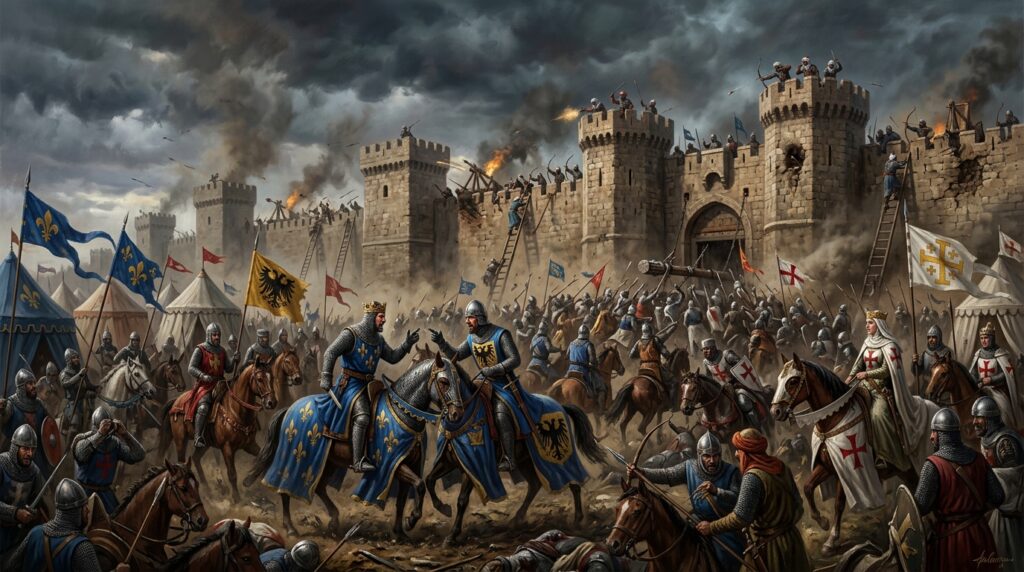
Amalric I launched four campaigns in Egypt. During the first, in 1163, he defeated the Fatimid forces at the Battle of al-Babein and forced Egypt to pay tribute to Jerusalem.
His second campaign took place the following year, where Amalric joined forces with the Egyptian vizier Shirkuh against Nur al-Din. Together with the Fatimid forces, the Crusaders besieged Shirkuh’s forces at Bilbeis and forced them to surrender. However, this success was short lived, because Amalric I received news that Nur al-Din had attacked Antioch and captured the Prince of Antioch at the Battle of Harim. The King of Jerusalem had to quickly return home to defend his kingdom.
Amalric I’s third campaign in Egypt was caused by Shirkuh’s renewed attack. This time, the Muslims inflicted a heavy defeat on the Crusaders at the Battle of al-Babein. Yet Shirkuh failed to capitalize on his victory. He captured Alexandria, but there, he and his forces were surrounded by joint Fatimid and Crusader forces. Eventually, Shirkuh was again forced to surrender. Before returning to Jerusalem, Amalric I left a garrison in Alexandria to maintain his influence in the region.
In 1168, Amalric invaded Egypt for the fourth time, this time intending to conquer it forever. He easily captured Bilbeis, after which he moved north and besieged Damietta. The Byzantine fleet helped him from the sea, but they failed to capture the city, which forced the King of Jerusalem to retreat.
In 1173, after Nur al-Din’s death, Amalric launched an unsuccessful campaign against Damascus. On his return, he contracted dysentery and died the following year, in 1174.
During Amalric I’s fourth campaign in Egypt, Nur al-Din’s general Shirkuh arrived to conquer the region. While the Crusaders were besieging Damietta, Shirkuh defeated the Fatimid forces, executed the vizier Shawar, and began ruling Egypt himself.
His power passed to his nephew Yusuf, Saladin, who declared himself Sultan of Egypt. He came into conflict with Nur al-Din, who considered Saladin his vassal. Yet Nur al-Din died only 2 years later, and Saladin took over his state.
From this point on, Saladin’s lands almost surrounded the Kingdom of Jerusalem. Moreover, he managed to unite most Muslim emirs under his rule, creating a powerful army that contemporary chronicles estimated at about 100,000 soldiers. The Muslims were now ready to launch an offensive against the Crusader states.
The pattern was now clear. Every great rescue from Europe had made things worse. The Second Crusade had handed Damascus to Nur al-Din. Amalric’s Egypt campaigns had handed Egypt to Saladin. The colony’s worst enemies were often created by its own allies.
The leper king’s last stand, and the day the kingdom died
Saladin faced opposition from the young King Baldwin IV. From childhood, Baldwin suffered from leprosy, which worsened over the years. He commanded far fewer troops than Saladin, and with no reinforcements coming from Europe, his subjects doubted that the king could defend Jerusalem against Saladin. The Patriarch of Jerusalem, Heraclius, even traveled to Europe in search of a more suitable candidate for the throne.
Just as Saladin was gathering his forces at Aleppo for a campaign against Jerusalem, Baldwin IV of Jerusalem launched an unexpected raid on Damascus, looting the city.
This surprising move caught Saladin off guard, so he decided to negotiate peace with the Crusaders.
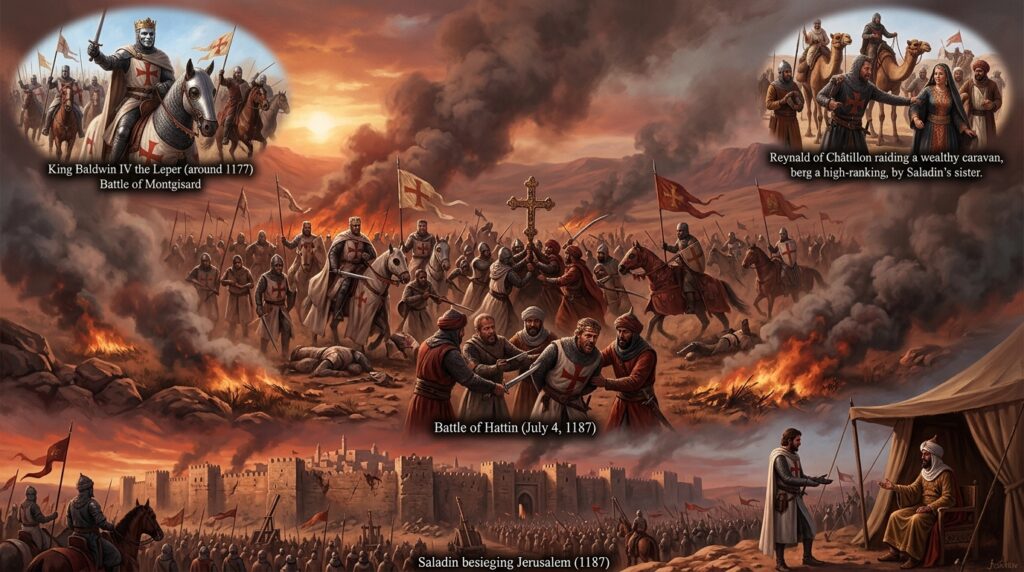
A year later, war resumed. This time, King Baldwin IV personally confronted Saladin at the Battle of Montgisard. The Crusaders attacked the Muslim army from behind. Saladin barely escaped death in battle, and his army scattered.
This defeat severely damaged Saladin’s authority, and his own emirs began to rebel against him. Despite a few small victories over the Crusaders, he was forced to make a truce with Baldwin IV.
Two years later, the truce broke again, yet Baldwin IV managed to defeat Saladin at the Battle of Belvoir.
This victory cost the king dearly. As a result, he tried to avoid breaking peace with Saladin in the future, understanding that without reinforcements from Europe, he could not continue war against Muslims for long.
Yet not all vassals understood the plans of the King of Jerusalem. A notable figure among them was Reynald of Chatillon. He came to the Holy Land during the Second Crusade and became regent of Antioch through marriage to the widow of the Prince of Antioch.
Reynald’s life followed a single pattern: he broke the rules, was about to be punished, apologized, and then the cycle began again.
In 1154, Reynald kidnapped the Patriarch of Antioch and tortured him for money. After that, Reynald had to apologize to King Baldwin III of Jerusalem. In 1156, he raided the Byzantine island of Cyprus, and was forced to apologize to the Byzantine emperor.
Reynald suspended his activities for some time due to 16 years of Muslim captivity. During this time, Reynald lost his power in Antioch. Yet upon returning to Jerusalem, he married the widow of the baron of Kerak Castle.
On his new lands, Reynald of Chatillon began raiding Arab caravans in violation of truces in 1176 and 1182. King Baldwin IV had to defend the kingdom from Saladin in victorious wars. After that, Reynald apologized to Baldwin IV.
In 1183, Reynald of Chatillon built five ships and sailed in the Red Sea, planning to destroy Mecca. He did not reach Mecca. His fleet was defeated by Saladin’s navy, and Reynald himself escaped.
Saladin brought his forces to Kerak and besieged it. Only the timely arrival of King Baldwin IV with his own army saved Reynald from certain death.
When Baldwin IV died, his 7 year old nephew Baldwin V inherited the crown, although real power lay with the new king’s stepfather Guy of Lusignan. Baldwin V died a year later, and Guy became King of Jerusalem. Reynald of Chatillon became his close ally.
In late 1186, another Arab caravan passed near Kerak, and Reynald was quick to raid it. The historian William of Tyre wrote that this caravan included Saladin’s sister, whom Reynald captured. For this, Saladin swore to punish this knight personally.
In the spring of 1187, Saladin entered the Kingdom of Jerusalem with an army of 40,000 soldiers. He plundered the lands of Reynald of Chatillon, and then entered Galilee, where he defeated the Templars at the Battle of Cresson and besieged the city of Tiberias.
Guy gathered his forces and hurried to confront the Muslims. Most barons advised the king not to march in the summer, because the route passed through desert. Instead, they suggested preparing Jerusalem for defense.
Yet Guy ignored this advice and set out on the campaign.
He met Saladin’s army near the Horns of Hattin. The Muslims trapped the Crusaders in a trap, cutting them off from water sources, setting fire to the surrounding grass, and easily defeating the exhausted Crusader forces.
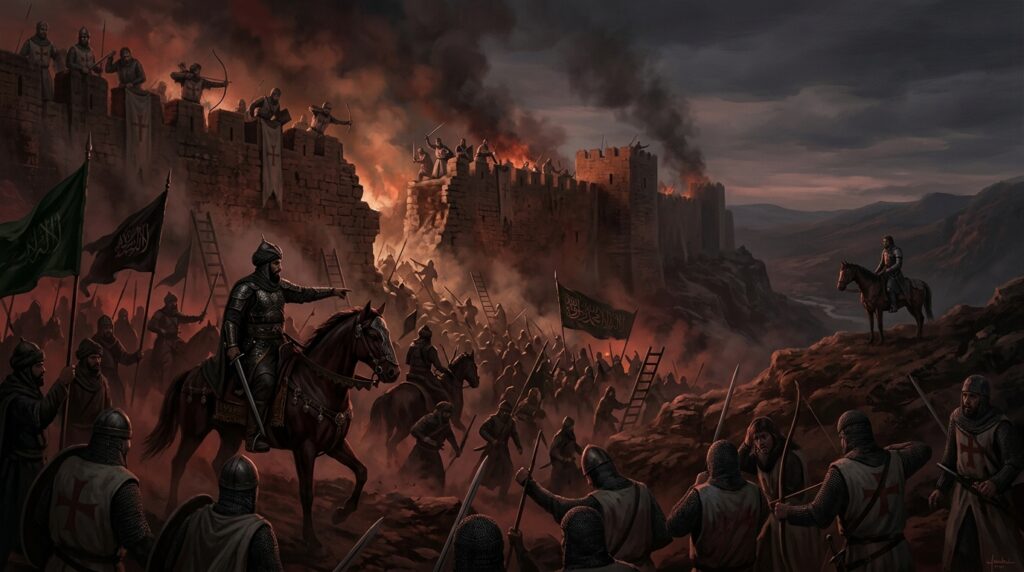
King Guy, along with his brother, was captured. Reynald of Chatillon was also taken prisoner, and immediately executed.
After that, Saladin moved north and captured the lands of the Principality of Antioch and the County of Tripoli. He postponed the conquest of their capitals and hurried to Jerusalem, capturing all the cities of the kingdom on the way except Tyre.
The defense of Jerusalem was led by the knight Balian of Ibelin. He successfully repelled attacks on the city, until on the 9th day of the siege the city wall finally fell. Even then Balian held firm, and the Muslims failed to enter the city.
At this point, Saladin proposed negotiations. The parties agreed that Christians would be allowed to leave the city in exchange for ransom, an average of 10 dinars per person, and then the city would be handed over to the Muslims.
In this story, the Patriarch Heraclius was again disgraced, because he had embezzled church funds that he had promised to use for the ransom of Christians. At the same time, Saladin, whether out of nobility or simply to rid the city of Christians, donated 100,000 dinars to help the Christians of Jerusalem pay their ransom.
A month later, when Balian himself led the last group of Christians out of the city, Saladin took control of Jerusalem. By that time, about 10,000 Christians remained in the city, unable to pay their ransom. They were enslaved.
The loss of Jerusalem by Christians was seen in Europe as a disaster. Some saw it as divine punishment, while others began preparing the Third Crusade.
Europe’s three most prominent rulers would lead this crusade: King Richard I of England, the Lionheart, King Philip II Augustus of France, and Emperor Frederick Barbarossa of the Holy Roman Empire.
This campaign would become one of the most famous in the history of the Crusades. It recovered Acre in 1191, and the kingdom lived on from Acre as a second, smaller kingdom. Jerusalem itself was regained by diplomacy under Frederick II in 1229, then lost again in 1244. The end came slowly: Baibars took Antioch in 1268, Tripoli fell in 1289, and Acre, the last major stronghold, fell to the Mamluks in 1291, ending 192 years of Crusader rule in the Holy Land.
The colony that forgot Europe ended the way it had lived: divided. The barons would not listen to each other at Hattin, the orders answered to no king, and the kings spent as much time fighting their own vassals as their enemies. Saladin won the battle. The Crusader states had already lost the war against themselves.
Read also: The Complete History of the Middle East: From Ancient Mesopotamia to the Modern Era
Read also: The Complete History of Constantinople/Istanbul: From Greek Byzantium to the Ottoman Capital