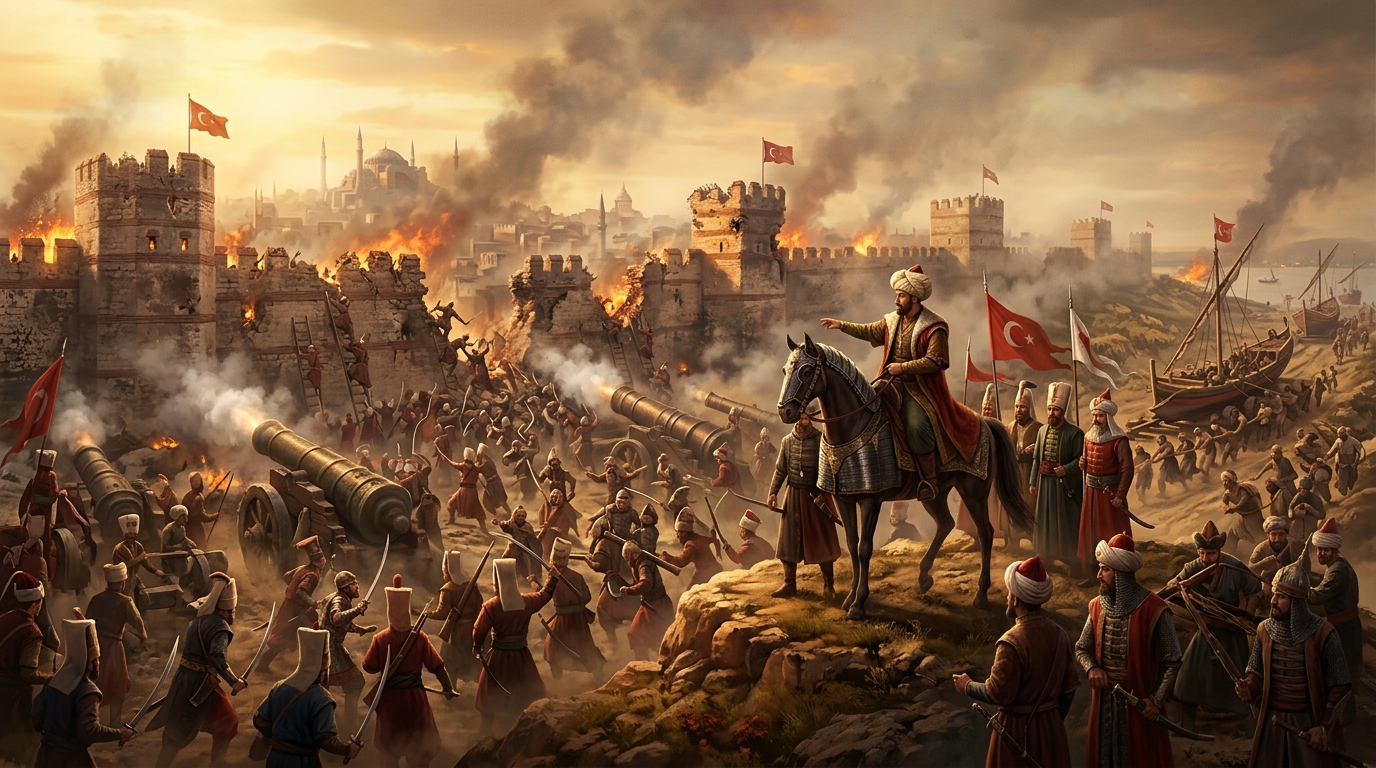
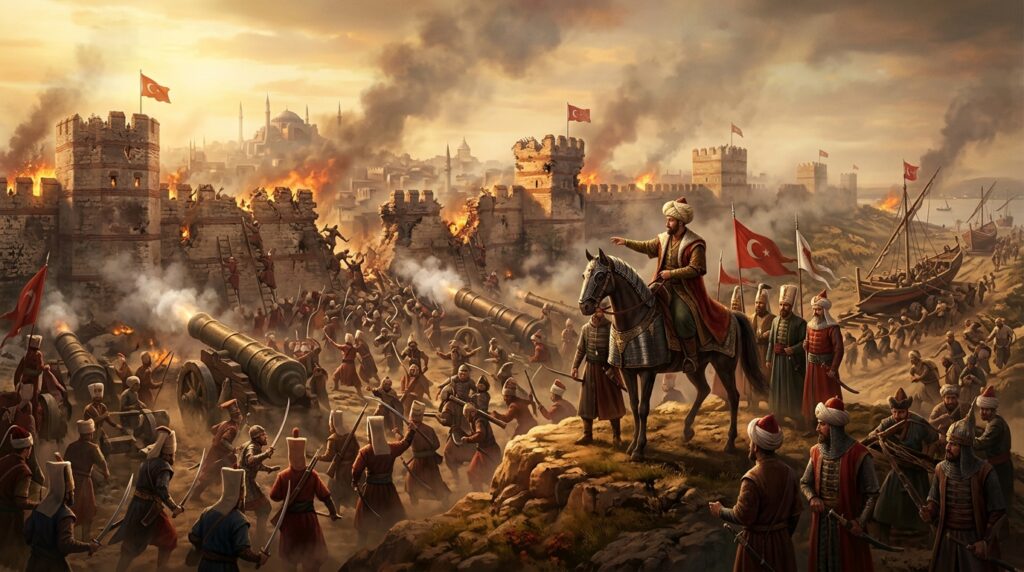
Constantinople did not fall because one sultan was brilliant. It fell because, over 150 years, a small frontier tribe built five things no other beylik had: a capital, a province in Europe, a standing army, a bureaucracy, and guns. This is how a tribe became a state, from the founding in 1299 to the fall of the city in 1453.
A capital instead of a camp, 1299 to 1326
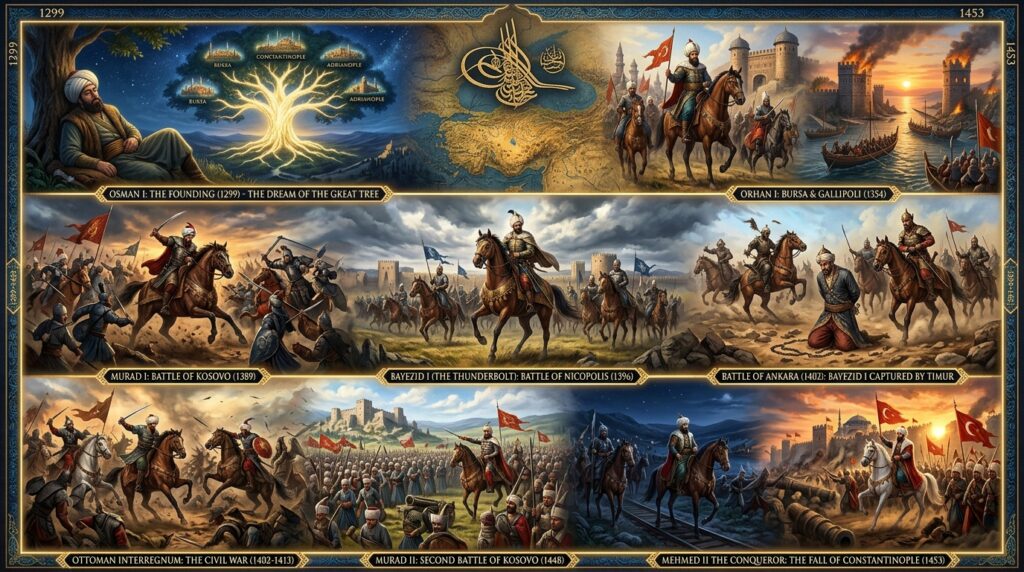
Osman founded his beylik in 1299, and his son Orhan gave it the first thing every state needs: a capital. Bursa fell to Orhan in 1326 and became the seat of government, the treasury, and the court. Around the same time, the ghazi warriors who had lived as nomads began settling into conquered towns. A tribe that holds towns, collects taxes, and runs a capital is no longer just raiding. It is governing. From Bursa, the Ottomans could plan campaigns across years instead of seasons, and every later institution grew from this change.
A province in Europe, 1354 to 1389
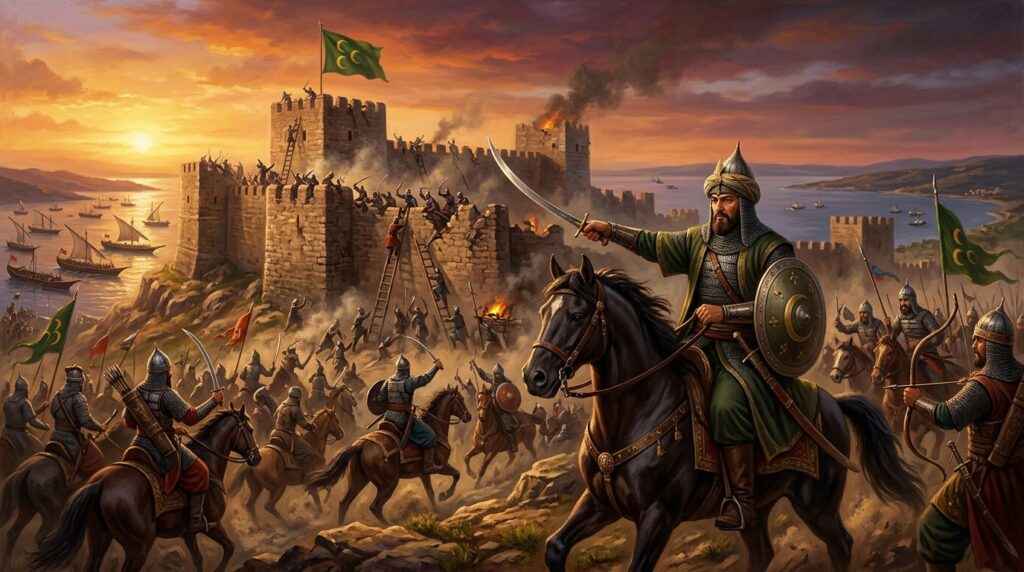
The second institution was a European province. In 1354 Orhan’s forces crossed into Gallipoli and took a permanent foothold in Europe. His successor Murad I moved the capital to Adrianople in Europe and pushed deep into the Balkans. At the Battle of Kosovo in 1389, Murad was killed, but his son Bayezid took command on the field and won. That is the moment that proves the state existed: a sultan could die in battle and the army, the treasury, and the government kept working. The Ottomans were now a Balkan power as much as an Anatolian one, and Constantinople sat between their two halves.
The army that belonged to the sultan
The third institution was the army that belonged to the sultan alone. Under Murad I and his successors, the Ottomans built the devshirme system: Christian boys taken from Balkan villages, converted to Islam, and trained in the capital to become administrators, soldiers in the elite Janissary corps, and sometimes palace officials. Positions were based on merit, not birth, which gave the sultan officials loyal to him rather than to tribes or families. The Janissaries fought on foot and were early adopters of firearms, and they became the most disciplined infantry of their age. The system had a double edge, and it showed in 1446: when the young Mehmed II first took the throne, the Janissaries revolted, and his father Murad II had to return to power to restore order. An army loyal only to the sultan could also make and break sultans. But without it, no sultan could have held an empire together.
The crisis that proved the state, 1402 to 1448
The fourth test came from disaster. In 1402 Timur crushed Bayezid at Ankara and threw the empire into an eleven year interregnum, a civil war between Bayezid’s sons. The state survived it. Mehmed I restored unity by 1413, and the institutions, the capital, the army, the tax system, held through a decade without a settled ruler. That survival is the difference between a tribe and a state.
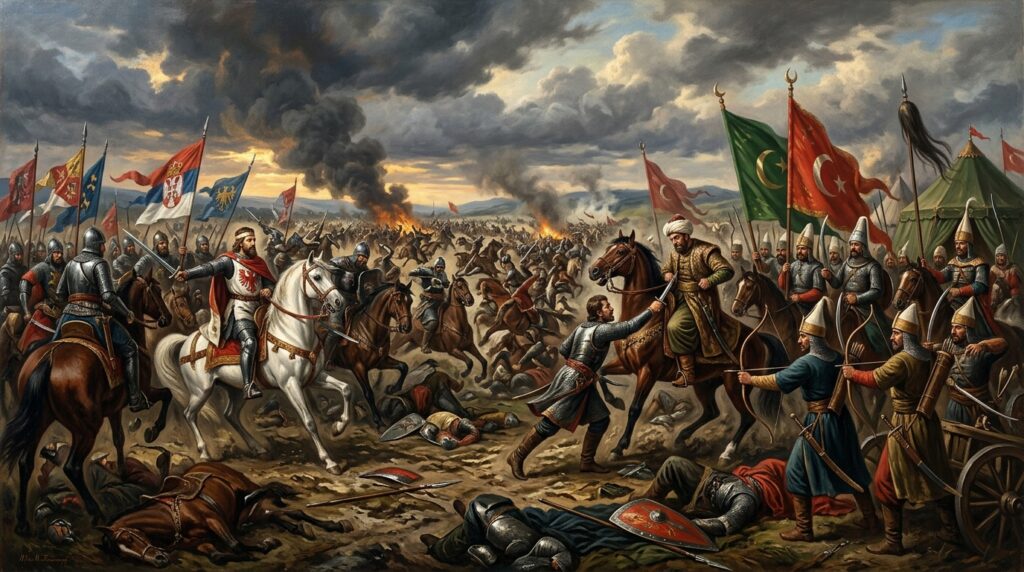
The fifth test came from Europe. In 1443 the Crusade of Varna began, organized by several European states to stop Ottoman expansion in the Balkans and Europe. Pope Eugene IV proclaimed the crusade, and King Wladyslaw III of Poland led it, with the Transylvanian commander John Hunyadi and Mircea II, the eldest son of the famous Vlad III Dracula, among his allies. A year later the crusade ended with the Battle of Varna. Murad II faced Wladyslaw and his allies there. The Ottomans crushed the crusaders, and Wladyslaw was killed during a cavalry charge against Murad II’s army. It was one of the last attempts to stop Ottoman expansion in the Balkans, and it failed.
In 1446 Murad II returned to power at his son’s request and had to put down the Janissary revolt, the elite infantry corps. The Janissaries were European Christians taken as children, enslaved, forced to convert to Islam, and turned into the Ottoman army’s elite. This corps was famous for its influence and special status, which is why it sometimes joined revolts against the sultan. In 1448 the Second Battle of Kosovo became Sultan Murad II’s last military victory. A united European army under the Hungarian commander John Hunyadi, who was then regent of the Hungarian kingdom, invaded the Balkans to avenge the defeat at Varna. Murad II used his numerical superiority and won. In doing so he paved the way for the final conquest of the Balkans and ended European attempts to save Byzantium. The Hungarian kingdom no longer had enough military and financial resources to attack the Ottoman Empire, and Constantinople remained cut off from the Christian world.
The guns and the city, 1451 to 1453
After Murad II’s death, his son and heir Mehmed II returned to power. Europeans hoped the young sultan would be no serious danger for some time because of his lack of experience. But Mehmed II intended to fulfill his great predecessor’s long held dream: to conquer Constantinople.
Byzantine-Ottoman wars had already lasted a century and a half. For decades the Ottoman Turks had been seizing Byzantine territory and making failed attempts to take New Rome. By the end, Byzantium consisted only of the Peloponnese in southern Greece, Constantinople, and its surrounding areas. Yet the empire survived and continued to trouble the Ottoman rulers.
Byzantine emperor Constantine XI Palaiologos sensed Mehmed II’s intentions and appealed to European states for help, but very few answered Byzantium’s call for help. England and France were still in the Hundred Years’ War. The Holy Roman Empire was dealing with internal disputes. The Spanish kingdoms were busy with the Reconquista, and Poland and Hungary had still not recovered from the defeats Murad II had given them. Only a few Italian states offered limited help: the Republic of Venice and Genoa, the Kingdom of Sicily, and the Papal States.
Finally, the 21 year old Mehmed II strengthened the Ottoman navy and gathered a large army. Western sources report an army of 100,000 to 300,000. Ottoman writers give a much smaller number, 40,000 to 50,000. Modern researchers estimate 60,000 to 80,000. Whatever the true number, the Ottomans vastly outnumbered the Byzantines, who had 7,000 to 11,000 soldiers. About 35,000 armed citizens also took part in the defense.
The Ottomans’ greatest advantage, besides numbers, was the use of various cannons, including bombards. Among them was the great basilica cannon, one of the largest cannons in history. Mehmed II’s army besieged the city by land and blockaded the Bosphorus. For weeks the Ottoman cannons bombarded Constantinople’s great walls. Despite this, because of the enemy’s faulty cannons and limited firing range, the Byzantines managed to partially repair the damaged sections.
The Ottoman navy could not enter the Golden Horn because of a large chain across its entrance. So Mehmed II ordered the construction of a road past the Byzantine settlement, and the Ottomans dragged their ships overland into the Golden Horn, ignoring the blockade. After that, the Byzantines lost sea access and could not get the supplies they needed for defense from the Republic of Genoa.
Ottoman forces made several attacks on Constantinople’s walls. All their attempts resulted only in heavy losses. So they began digging tunnels to enter the city, but the Byzantines destroyed them.
Mehmed II sent an envoy to Constantinople and offered to lift the siege in exchange for surrendering the city. He promised Constantine XI the governorship of the Peloponnese, a safe route, and safety for residents who wanted to stay in Constantinople. The Byzantine emperor agreed to pay tribute and surrender all previous Ottoman conquests. Negotiations failed, and Mehmed II began preparations for a full scale attack.
The decisive attack was the largest and came in several waves. Finally, Ottoman forces entered Constantinople, looted the city, but did not carry out a large scale massacre. They needed prisoners who could be enslaved. Mehmed II prevented the destruction of the Byzantine capital. He intended to make it his residence, understanding the city’s strategic and symbolic value.
The Byzantines lost about 4,000 to 12,000 people, including soldiers and civilians. A further 30,000 to 50,000 residents were taken prisoner. Ottoman losses were significantly higher, according to various sources between 15,000 and 50,000. A large army and new technology allowed the Ottoman Turks to break the great walls of a great city. But the walls were broken by a state built over 150 years: a capital, a province, an army, a bureaucracy, and guns. That is how a tribe took Constantinople.
Read also: The Entire History of the Ottoman Empire: From Osman’s Dream and the Fall of Constantinople
1 thought on “The Ottoman Empire: From Founding (1299) to the Fall of Constantinople (1453)”