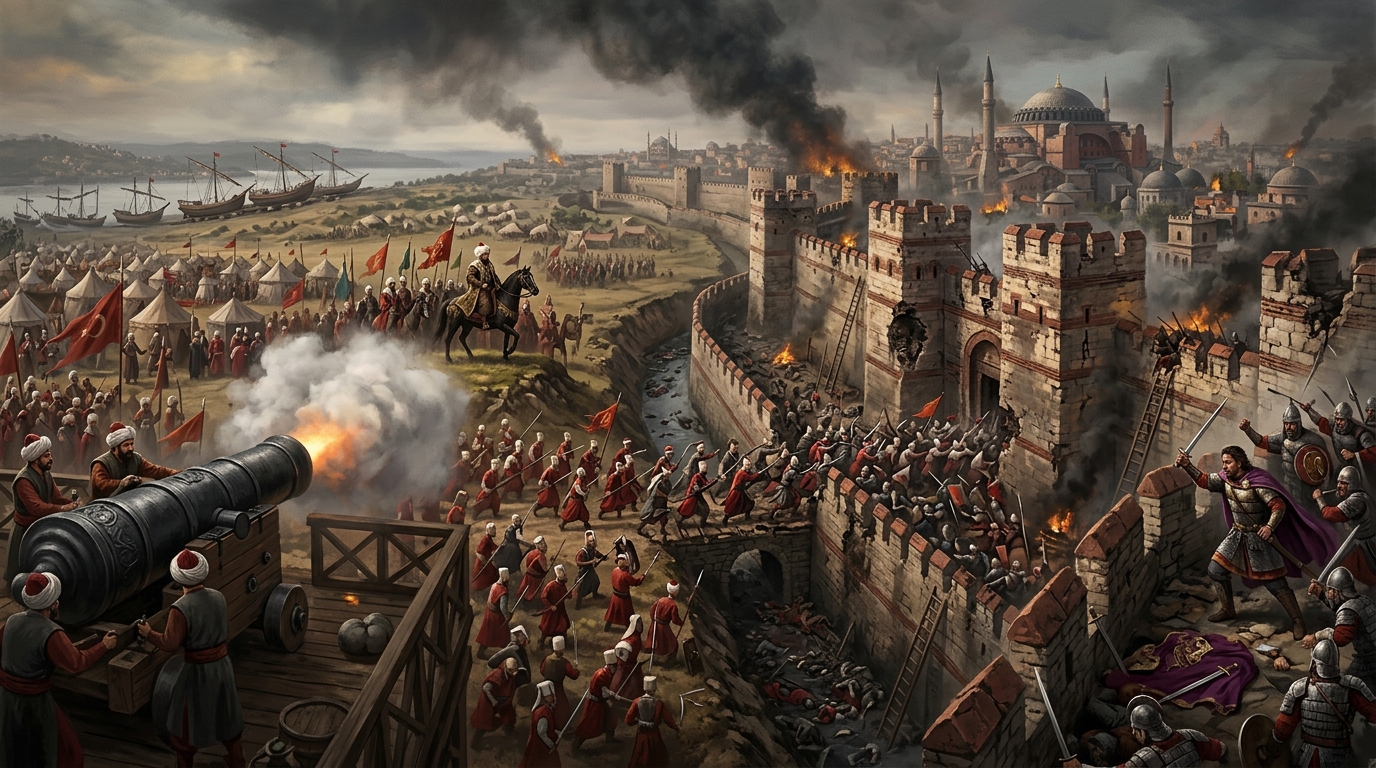
29 May 1453 is called the last day of Rome. But that title gets something wrong. Rome did not end that day. It changed hands. The walls fell, the emperor stayed and died, the city was plundered for three days, and then the conqueror walked into Hagia Sophia, picked up a handful of earth, placed it on his own head, and ordered the greatest church in Christendom converted, not destroyed. What survived the fall of Constantinople tells you more about Rome than the fall itself. This is the last day of Rome, told through what refused to die.
The morning the walls broke
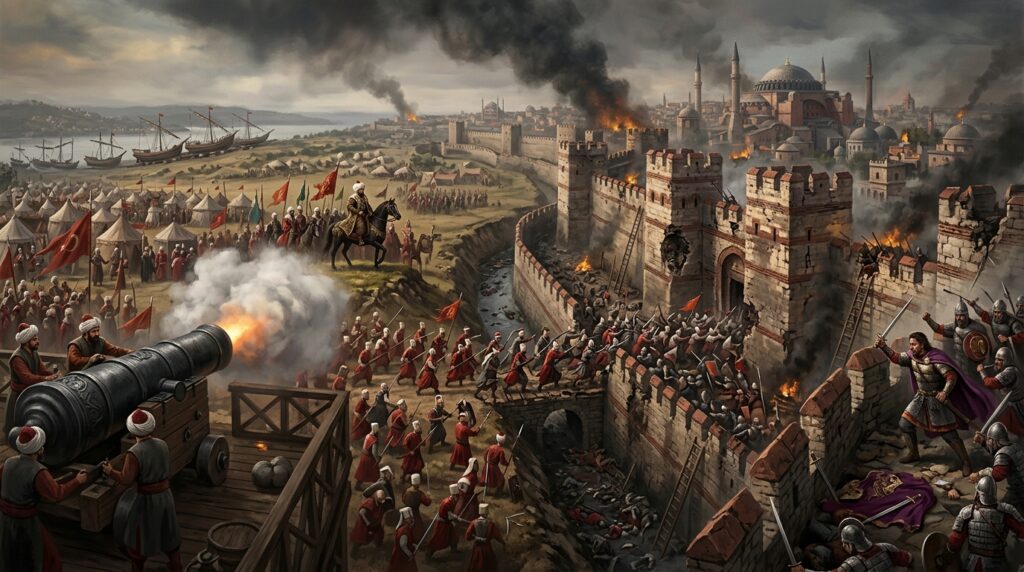
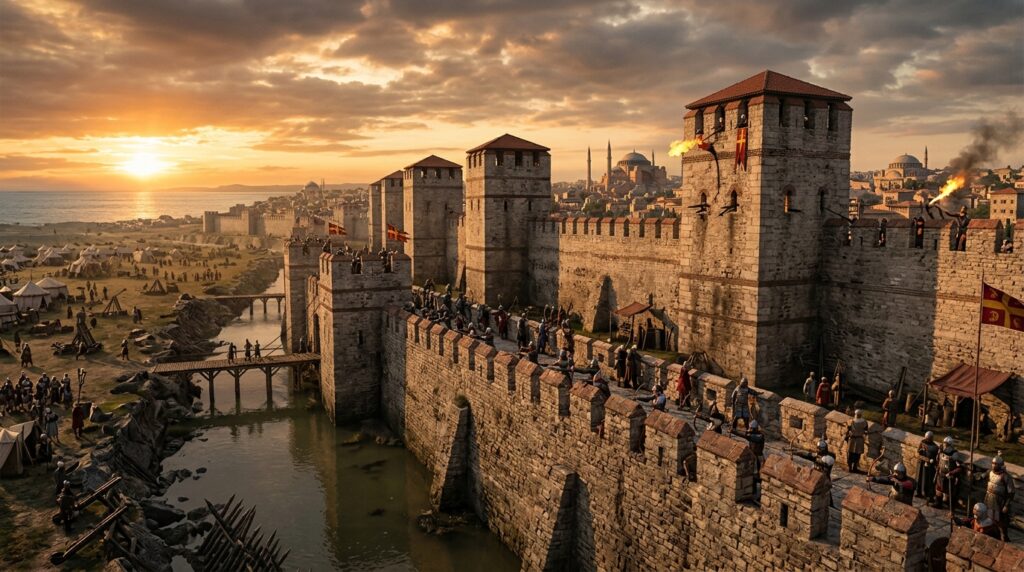
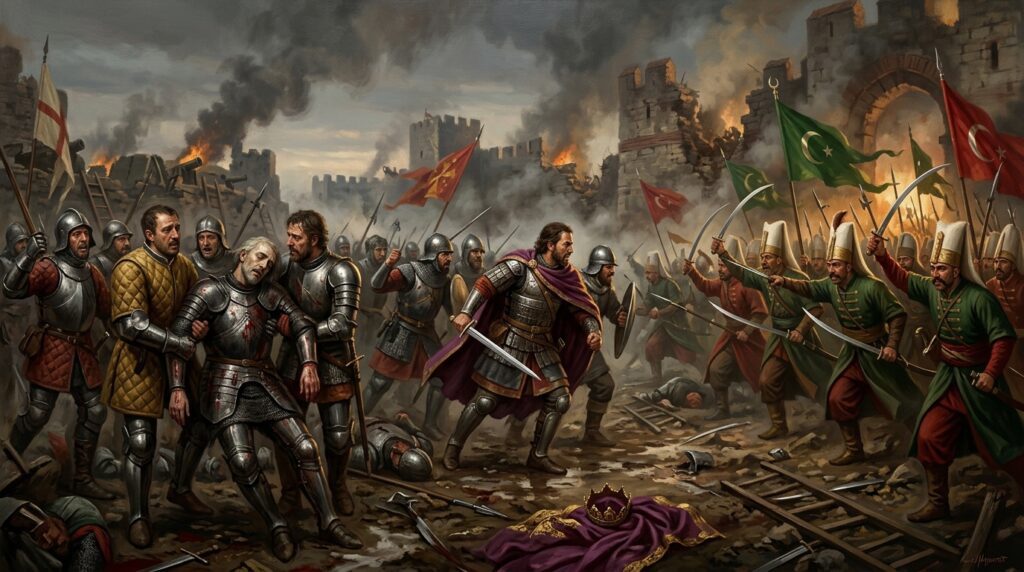
By the final morning, the siege had already lasted 53 days. The Theodosian walls, which had stood since the fifth century and never fallen to a foreign enemy, were broken in places by weeks of cannon fire. The defenders, perhaps only 7,000 against an army estimated at more than 100,000, had repaired the breaches by torchlight night after night with rubble, timber, and earth. On the last morning, there would be no more repairs.
The final assault came in waves before dawn: irregular troops first, sent to exhaust the defenders, then Anatolian regulars, then, just before sunrise, the Janissaries, the sultan’s elite, fresh, disciplined, and relentless. At the critical moment, a small gate, the Kerkoporta, forgotten and left unguarded in the chaos, was found by Ottoman soldiers. Janissaries poured through it, fought their way from inside to the central gates, and opened them. The whole Ottoman army entered through them.
Constantinople fell. Behind the walls, soldiers abandoned their posts and fled, trying to reach the harbor, searching for ships. But there were no ships. The Ottoman navy controlled the whole sea.
The emperor who stayed
And Emperor Constantine XI did something no Byzantine emperor had done in a thousand years.
Constantine XI was near the walls when he learned that the enemy was inside the city. He could have fled. Ships were still in the harbor. He could have fled to Italy, fled to the Peloponnese, lived in exile, tried to rebuild. He did not flee.
Constantine removed his imperial insignia: the purple cloak, the crown, everything that marked him as emperor, so that he could not be recognized and made a prisoner. He took a sword and stepped out of the neighborhood toward the walls, toward the breach, toward the battle. His advisors begged him to flee. He refused.
He said: “The city is fallen, and I am still alive.”
And then he vanished in the chaos of battle.
No one knows how Constantine XI died. Byzantine sources claim he plunged into the Ottoman ranks and died fighting like a common soldier. Ottoman sources say he was trampled in the chaos and his body was never conclusively identified.
What we know for sure is this: Constantine XI Palaiologos, the last Roman emperor, died fighting with his men on the walls of Constantinople on 29 May 1453. An empire that began in 27 BC with Augustus, 1,480 years earlier, ends here. Rome ended, and the Ottoman sultanate was just beginning.
Or so it seemed. What happened next is why this story is not really about an ending.
Three days of plunder
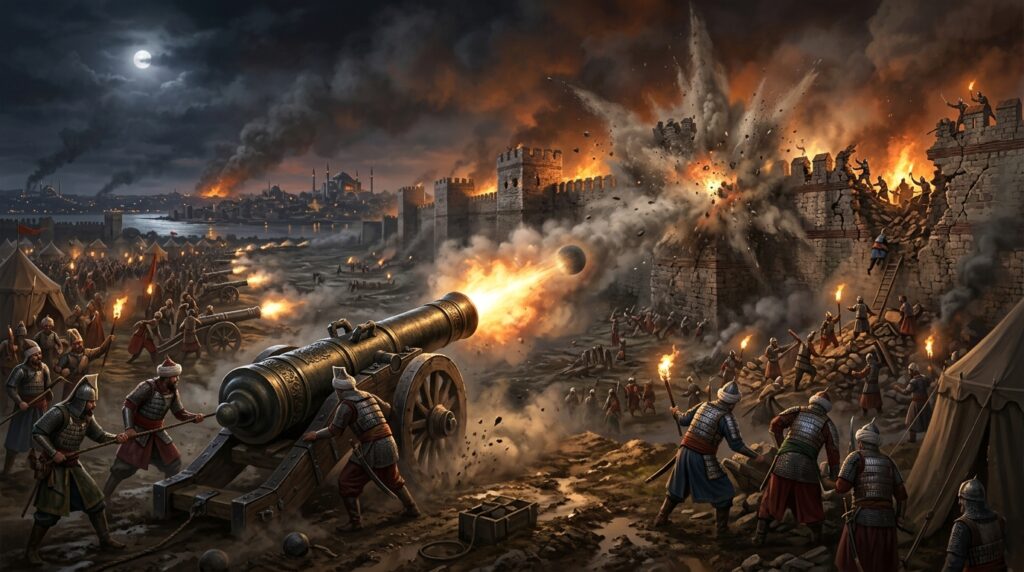
After the walls fell, Mehmed allowed his army to plunder Constantinople for 3 days. This was the ancient custom: the prize for taking a city by force.
What followed was merciless. Churches were looted. Houses were stripped. Hagia Sophia, untouched for 916 years, had its golden altar pieces broken, its mosaics smashed, its icons thrown onto the streets. Thousands of citizens were killed. Thousands more were enslaved, led in chains out of the city to slave markets across the empire.
For three days, the queen of cities belonged to its conquerors in the oldest, harshest sense of the word.
The fourth day
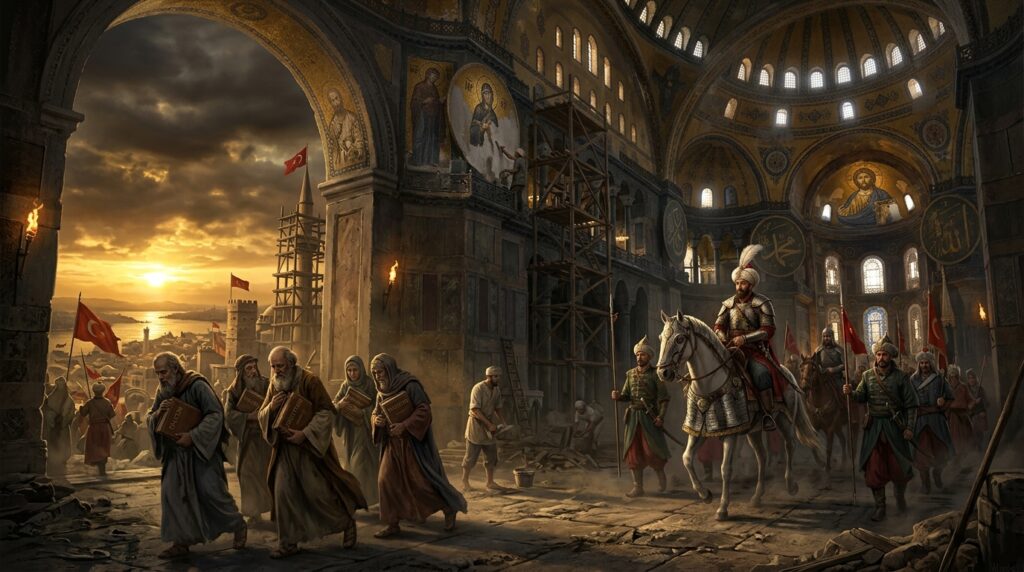
But on the fourth day, 31 May, Sultan Mehmed II entered the city. He rode through the streets to Hagia Sophia, the largest church of the Christian world, built by Justinian in 537 AD, the heart of Orthodox Christianity for 916 years.
Mehmed dismounted at the door. He picked up a handful of earth and placed it on his head, a gesture of humility before God. Then he went inside. The interior was huge: the dome 180 feet above the floor, sunlight coming in through the windows, the mosaics of Christ, the Virgin Mary, the saints still glittering despite the damage.
Mehmed ordered Hagia Sophia converted into a mosque. Not destroyed. Converted. The Christian mosaics were covered with plaster, not broken, but covered. Minarets were built outside. But the architecture itself, the dome, the apse, the structure, was preserved.
That one decision is the whole story of the fall in miniature. A conqueror who destroys a building erases a past. A conqueror who converts it claims it. Mehmed was claiming Rome, not erasing it.
The heir, not the destroyer
Mehmed did not see himself as the destroyer of Rome, but as its heir. He declared himself Qaysar, Caesar of Rome. He kept much of the Byzantine administrative system. Greek officials were retained. The Orthodox Church was restored under a new patriarch. Genoese and Venetian communities were given trading privileges. The city’s name became Istanbul, but its soul was not erased. It was transformed.
And the building at the center of it all kept standing. Hagia Sophia would serve as a mosque for nearly 500 years, then as a museum, then as a mosque again. Its dome, built by Justinian, still rises over the city. The mosaics, covered for centuries, were uncovered again in the modern era. The church that survived the fall outlived every empire that claimed it.
The Greeks, meanwhile, turned their loss into a legend. They whispered that Constantine XI had not really died: that an angel had turned him to marble and hidden him beneath the city, waiting for the day Constantinople would return to Greek hands. The Marble King, asleep under the Golden Gate. It was a myth born of grief, but also of hope, sustaining identity through centuries of foreign rule.
So what actually ended on 29 May 1453? A state ended. A dynasty ended. A capital changed its religion and its name. But Rome, as an idea, did not end. It moved into Ottoman administration, into the Patriarchate that Mehmed restored, into the dome of Hagia Sophia that still stands, and into the legend of a sleeping emperor who never left his city.
The walls fell, the emperor stayed, and Hagia Sophia survived. The last day of Rome was not an ending. It was a handover.
Read also: The End of the Roman Empire and the Birth of the Ottoman Era
Read also: The Fall of Constantinople and the Rise of Istanbul How 1453 Changed the World