This is no ordinary man. He is the king of India! The last link of the family that once ruled the world’s richest empire! He before whom the English bowed and asked permission! But today the last person of this family is begging for his life before those same English! This is the last Mughal emperor, Bahadur Shah Zafar! Homeless, in ruins. But why? Why did the Mughals face this humiliation and helplessness? Was it the English conspiracy? Treachery of their own people, or something else? Did the Mughals lose to external enemies, or was there something inside them that hollowed them out?
Today we will talk about the story of the Mughal Empire’s rise and fall! Today they will be praised, but hold your heart, because criticism will also come, and it will be harsh!
Plan B that became an empire
The Mughal Empire’s story does not begin with a great victory, or with a celebration, but with the tears of a defeated prince, whose name was Babur! History calls him the founder of the Mughal Empire, but the truth is, he was only a refugee, just that! In his veins ran the blood of two great conquerors: from his father’s side Timur, and from his mother’s side Genghis Khan! But in his fate there was not even ownership of a piece of land. But why? Babur conquered India, so why do we say this?
Because the reality is that Babur’s destination was never Delhi. His obsession was Samarkand, his great-grandfather Timur’s city! He conquered Samarkand three times. Yes! Three times, and three times he had to leave the city, sometimes defeated by Uzbeks, sometimes for other reasons! And then the time came when he was hiding in the mountains of Central Asia. He had only a few loyal companions, just that!
Babur had an interesting habit, he wrote a diary, which later came before the world as the Baburnama. In this book he wrote: “I have been wandering from place to place, like a ball!” The doors of the north had closed on him, so in despair he took the southern route.
He was militarily intelligent, so he conquered Kabul, and established a small state! And from there he turned toward India. He did not make this journey from desire, understand it as Babur’s compulsion. This was his Plan B, because he needed a country to survive! Anyway, a human can live anywhere and in any condition, but the minds of the courageous work in some other way!
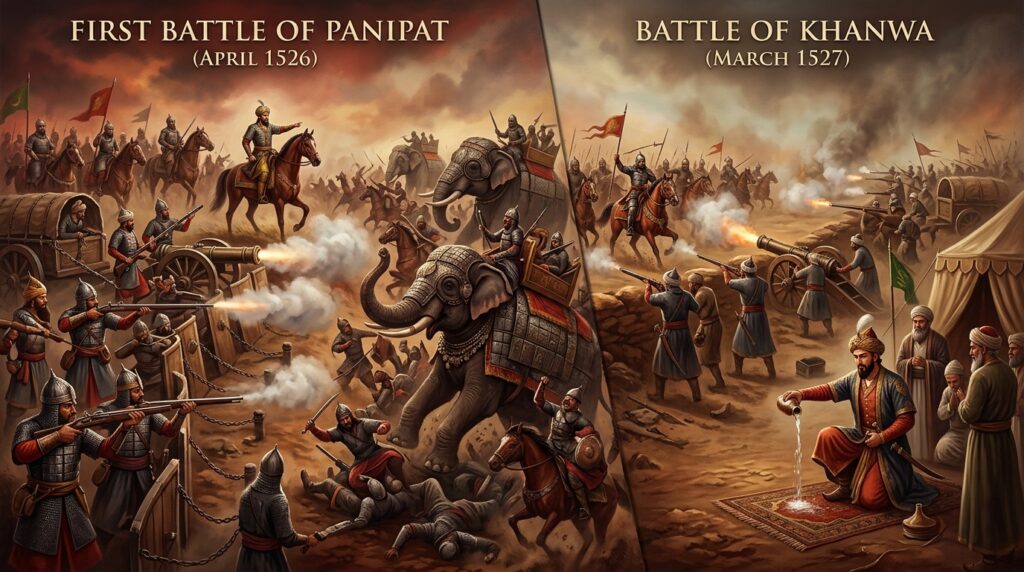
So Babur moved forward, kept walking, until in April 1526, he stood on the field of Panipat near Delhi! Yes! Babur had reached the doors of India, and here his confrontation was with Delhi’s Sultan Ibrahim Lodhi!
It is said that Babur had only 12,000 soldiers, and before him was an army two, perhaps three times larger! In fact, in the Baburnama Babur writes that Ibrahim’s army consisted of 100,000 souls! Even if not, he definitely had war elephants. Consider them the tanks of that era, before whom not only Babur, but great cavalry could not stand!
But Babur had the thing India had never seen: a game changer technology, gunpowder! Babur was very impressed by the Ottomans, and brought their technology with him! Babur’s army had cannons and guns. This was his secret weapon!
When after days of waiting the war finally began, and Lodhi’s elephants advanced, Babur signaled. For the first time in India, such a sound echoed as had never been heard before! The roar of cannons, as if the trumpet of Judgment Day had been blown! Explosions and smoke drove the elephants mad. Those beasts that came to crush Babur’s army turned back and in panic trampled their own soldiers! Lodhi’s army within a few hours turned into a heap of corpses, or fled from the field! In only half a day, India’s destiny was decided!
That person who failed in his homeland, the serial loser Babur, succeeded in a new country. He laid the foundation of a great empire, the Mughal Empire! But an interesting fact, they never called themselves Mughal! Actually Mughal is the Persian word for Mongol. In India they were called Mughal, because every Turkic-speaking military elite coming from Central Asia was called Mughal! The truth is the Mughals never called themselves Mughal. They called themselves Timurids!
So after this great victory, the Mughal, or Timurid Empire was made. So Babur must have found peace? Absolutely not! This is the strange contradiction of his story: Babur did not like India at all! He did not like its people, nor horses, nor fruits, nor food, nor weather, nothing! But whether he liked it or not, Babur did not go back!
Now Delhi was Babur’s, Agra was Babur’s, places easy to conquer, but very difficult to hold. In March 1527, the Rajput king Rana Sanga reached Delhi, the same Rana Sanga who once invited Babur to attack Ibrahim Lodhi! Perhaps because during the Delhi Sultanate era, attacking Delhi himself was not possible for him! But these new Mughals, whose hearts were not even in staying here, seemed easy to defeat! Perhaps thinking this, Rana Sanga invited Babur to attack Lodhi, but when the occupation happened, he stood as the biggest opponent! His Rajput confederation gathered an army of 100,000. In it both Hindus and Muslims were included. This was an army that would spread terror!
Babur got so nervous that he gave up wine. He even vowed that if he won, he would abolish the taxes of every Muslim! Yes! This was the same Babur who said: “Babur, enjoy pleasures, because there is no second life.” But now, a repentant Babur appeared.
In the Battle of Khanwa, he faced Rana Sanga, and what a war it was! Here too Babur’s artillery proved the decisive factor! Babur won again, eliminating the two biggest claimants to Delhi’s throne, he proved Delhi was now only his! But after doing all this, he could not rule Delhi for long! Only three years after this great victory, in December 1530, he died at only 47 years of age!
The orphan empire
After that, Babur’s favorite son Humayun became king. Just as the descendants of a cruel Timur were very different, Babur’s son was completely different from him! Understand that he was not made for kingship: a very pious, soft-hearted, and slightly superstitious man! He was more interested in the movement of stars than in politics! And to hold India, it was necessary that your mind worked in a military manner! Perhaps that is why he could not hold the empire, because he faced India’s most intelligent man, Sher Khan, known as Sher Shah Suri! An Afghan leader, who drove the Mughals out of India!
In the battles of Chausa and Kannauj, Humayun’s army was defeated so badly that he barely escaped saving his life! The empire ended, not for a year or two, but for 15 years! This equals three terms of today’s democratic government! This was a very shameful chapter of Mughal history! Their king was fleeing, in Rajasthan’s heat, in Sindh’s deserts. He had neither army, nor throne, nor government! He could not go to Kabul, nor anywhere else, because no one wanted to see him! This was the reality of the time: prove yourself on the battlefield, otherwise even your brother is not yours!
So in this fleeing, in Sindh’s desert, in a place called Umarkot, Humayun had a son born! His name was kept: Akbar! Yes! Akbar was not born in a palace. He was born in wandering, in exile, in obscurity! Who knew that this child would become India’s greatest king, called Akbar the Great! Anyway, the time to come came. Now Humayun was fighting for his life! He had only one hope, the neighboring country Iran! Where the Safavid Empire ruled! The Safavid king Tahmasp gave Humayun shelter, but it is said he charged a heavy price! He asked him to change his religion! But why? The Safavid government was like that. We will tell about the Safavid Empire in a separate video! So, whether Humayun changed religion or not, we cannot say, but this is certain that he definitely got Iranian help!
Humayun re-entered, he defeated his brothers, and took back Kandahar and Kabul! Then he tried to take Delhi, but it took him 15 years. In 1555, he finally sat again on Delhi’s throne, when Sher Shah, and his son Salim Shah were also dead! Whatever, after a long gap, the Mughal Empire revived again! But see fate, after so much hard work and effort, enduring so much humiliation and difficulties and fighting so many wars, when Humayun got the chance to rule, he got only six months! One evening, he fell in his library, and got such a severe head injury that he died within three days!
Humayun left, leaving an India where his 13 year old son Akbar had to rule! Who began a new and controversial era in religion, politics, and culture! The Mughal Empire was reborn, but before becoming strong, it became orphan again!
After Humayun’s sudden death, circumstances became such that the Suri Empire’s Hindu general, Hemu, captured Delhi, and became king of India by the name of Hem Chandra Vikramaditya! Mughal armies were now scattered, fleeing! Everyone was saying: “Let us go to Kabul. India is beyond our capacity!” But there was one man refusing to flee: Khan-i-Khanan Bairam Khan! Mughal military commander and guardian of 13 year old Akbar! He took the prince, and with the whole army came to the field of Panipat! That same field, where Babur defeated Ibrahim and laid the foundation of the Mughal Empire. There, in November 1556, the decision was to be made: whether the Mughals stay or not? Then the Second Battle of Panipat happened! A war perhaps won not by sword, but by luck!
What happened was Hemu’s army was creating havoc, near victory. The Mughals’ feet were about to be uprooted, when suddenly an arrow came straight into Hemu’s eye! Who shot this arrow? From where did it come? No one knows! His soldiers saw only the king falling unconscious, and panic spread! Victory turned to defeat! And thus Akbar, whom till yesterday no one even knew, was now the king of India! Then, when he grew up he understood that if he had to rule India, he could not remain as a foreigner. He had to become Indian!
The Indian who made it Indian
Then Akbar changed policy, he put the sword in its sheath and took out the dagger of politics! Instead of defeating the Rajputs, he made relations with them. He married into them! He made their princesses Mughal queens! By this one step, India’s temperament changed. The warriors here became the Mughals’ greatest protectors! Now the Mughal Empire was not only for Muslims. It was an empire for the whole of India!
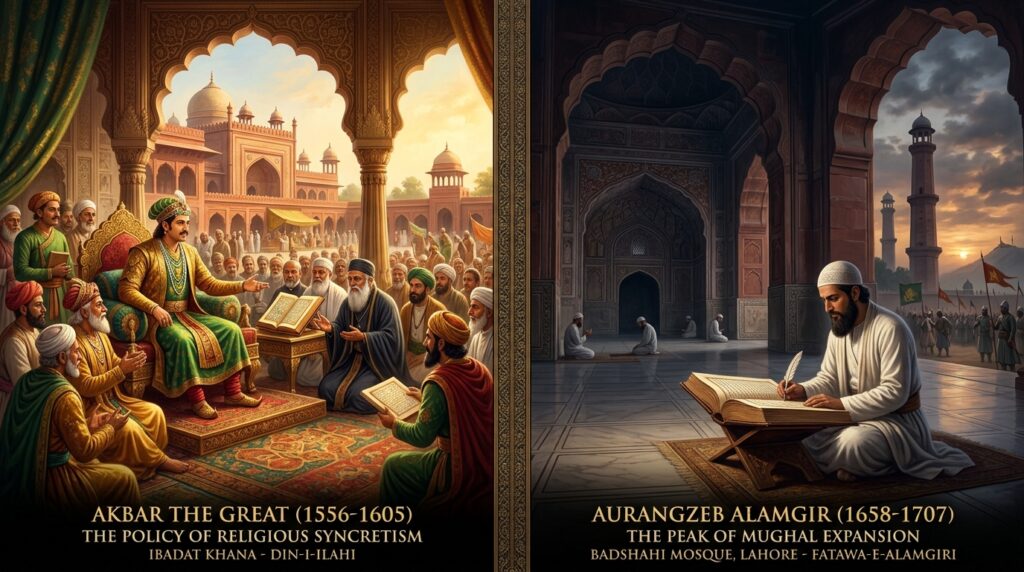
Okay, if it had stopped here, it would have been enough. But the intoxication of power is such that no intoxication in the world can compete with it! What happened was Akbar, to unify his empire, broke religion! He thought that if everyone’s religion became one, then his power would remain safe forever! He did not know reading and writing, a man of completely different temperament from Babur and Humayun! Initially his religious temperament was very strong, but doubts arose in his mind from the actions of the court ulema! The court ulema could have handled him, but they encouraged him! And matters grew so much that a new religion was invented, called Din-i Ilahi! A cocktail, in which Islam, Hinduism, Christianity, and Buddhism were all included!
Did Akbar really invent a new religion? Or was he a champion of enlightened moderation among Muslims? Some historians say the name Din-i Ilahi was never even taken in Akbar’s court, but it was his policy, whether named or not. Finally, it really was a new religion! This may be a policy to keep everyone happy in a multi-religious country like India, but the reality is that this proved a big blow for Islam and Muslims! Sacrifice of religion for the state, even the worst Muslim ruler never adopts! And people adopt the religion of their rulers. When the elite’s religion is such, guess the condition of those below?
Anyway, Akbar ruled India for almost 50 years, and after him his son Salim, by the name of Jahangir, sat on the throne! Due to Akbar’s policy, the era of wars had ended. Now it was the era of art, and yes, of justice too! Jahangir hung a large chain outside his palace, called the Chain of Justice! Any complainant, day or night, could pull this chain, and directly ask the king for justice! Consider it the citizen portal of that era, a direct hotline to reach the king of India! Whether justice happened or not, we cannot say, but looking at the peace of that era, it seems the chain was doing its work!
However, in Jahangir’s era, an incident occurred which at that time seemed very small and trivial, but later it dug the Mughals’ grave! This was 1615, when in Jahangir’s court a white man came. His name was Thomas Roe! He was the ambassador of the King of Britain, and he asked for permission for trade in India! A king like Jahangir, whose name itself meant Conqueror of the World, what danger would he feel from a small trader? Carelessly, he gave the English permission for trade! But he had no idea these were not traders, they were termites, who would eat the whole of India! He was not signing a trade agreement, but the death certificate of coming generations! This was the Mughals’ biggest intelligence failure. They did not recognize the threat coming from across the sea!
Anyway, after Jahangir came Shah Jahan, and the Mughals reached their peak. Consider it the golden age of India! That era when India really became the Golden Bird! Kings of Europe, hearing stories of India’s wealth, drooled! With this wealth, Shah Jahan did works which still astonish the world today! He built the Taj Mahal, that symbol of love in memory of his queen, which still stuns the world today! Then the Red Fort, Jama Masjid, Shalimar Gardens! Then he had the Peacock Throne built. The world’s most precious diamonds were in his treasury, from the Koh-i-Noor to the Darya-i-Noor! His constructions were magnificent, his treasures eye-dazzling!
But then history’s old principle: every rise has a fall! When Shah Jahan, after ruling 30 years, grew old, then his own sons made his life hell! Shah Jahan had four sons, but only one throne. The eldest, Dara Shikoh, was the father’s favorite, while the most capable was Aurangzeb! Shah Shuja and Murad Bakhsh were also there, and while the father was alive, these sons fought among themselves! The father was with the eldest son, and the rest with Aurangzeb! And when they faced each other on the field of Samugarh, Aurangzeb won! He imprisoned his father Shah Jahan in Agra Fort, where he spent the last 8 years of his life! Here, he longingly watched the Taj Mahal from a window! This was a lesson: the father who did not stop his sons from fighting finally himself became the target of their fight!
The peak that was the cliff
Thus, after Shah Jahan, sat on the throne the person whom history calls either a saint or a villain! The last great Mughal emperor, Aurangzeb Alamgir! Who took the empire to such heights, from where only one path remained: the path of decline!
Year 1658! On the Peacock Throne sat the person who imprisoned his father and had his three rebel brothers killed! Yes! Aurangzeb Alamgir! The most misunderstood king of history! A king who died more than 300 years ago, but is still alive today! In today’s history books, media, news, politics, in India he is still presented as a tyrant, a Hindu enemy, a temple breaker! But why? Is this a story spread by the English, or propaganda of Hindutva followers? Let us find the truth:
First thing, if Aurangzeb was so much a Hindu enemy, why was the number of Hindu generals in his army more than Akbar’s? In Aurangzeb’s time, in the Mughal administration almost 33 percent were Hindus, which is the highest in the whole of Mughal history! Second point, it is said that he broke temples. Yes! He broke them, but which ones? Only those where plans of rebellion against him were being made, where conspiracies were born! This was the same Aurangzeb, who also built dozens of temples and gurdwaras, gave them official estates and lands as gifts, and the farmans issued for this still exist today! The truth is, Aurangzeb was not an enemy of any religion. He was the enemy of the state’s enemy! Whether it was his own brother, or a raja, or a religious leader! Before the state’s order, no one had any importance!
And personally, what was Aurangzeb like? Shah Jahan was the maker of the Taj Mahal, but Aurangzeb did not believe in this kind of luxury! If he built anything, it was mostly mosques, the most important and prominent being Lahore’s Badshahi Mosque! Personally too, Aurangzeb was different from all other Mughal kings! Among whose ancestors wine and women were common, in their lineage came a dervish and simple man like Aurangzeb! Even before dying, he willed that no tomb be built over his grave. Let this remain raw earth! He is the only one among the great Mughal kings who has no tomb, no shrine! Then he was the one who compiled Islamic laws for the rule of law under the name of Fatawa Alamgiri! Many people will not like many things about him. There are people who do not like Akbar either. Every king has flaws! Kingship itself is the biggest evil, then what is good and what is evil!
So under Aurangzeb, the Mughal Empire reached its peak. Consider it the largest India of modern history! Almost the whole of India was at his feet. It had really become a superpower! Militarily, no power in India could compete with the Mughals, but economically outside the country, no one was its rival: more than a quarter of the world’s economy was Mughal India! But this is the point where this great king made a very big mistake! Aurangzeb expanded the empire so much, made it so big, that managing it became not only difficult, but impossible! In today’s language, call it strategic overstretch!
Aurangzeb spent the last 26 years of his life, yes, 26 years, fighting wars in southern India! He stayed away from the capital Delhi, away from Agra! He gave his obsession so much time that the time to save the empire passed! Result? Administration in the north became weak! In the absence of a strong king, corruption grew! Jagirdars became powerful! And most importantly, continuous wars were emptying the Mughal treasury! The Golden Bird was now gasping! Under Shivaji’s leadership, the Marathas fought guerrilla war, a war for which even Aurangzeb’s large army had no answer! Why? Because remember one thing: you cannot kill a fly with a cannon, and this was what Aurangzeb was doing! Until in 1707, after ruling almost 50 years, Aurangzeb was on his deathbed! And perhaps here he realized what would happen after he left? In his last letters written to his sons, we see a strange despair! He wrote: “I want that there be no war for power between you two, but still, I can see that after I leave, much blood will flow!” This was a titan’s confession! At 90 years of age, Aurangzeb died, and as soon as his eyes closed, understand that the sun of the Mughal Empire’s peak also set!
The three termites
What was the cause of this decline? Were Aurangzeb’s sons incompetent? Or was there a flaw in the Mughal system? Before moving forward, let us do some critical analysis. Let us look at those mistakes which turned India from a peak power into a colony.
After Aurangzeb, the Mughal Empire’s decline began suddenly, but no, it did not happen suddenly, these were centuries-old diseases, breeding inside, which had now come to the surface! We have always heard that the English were very clever, their technology was better, or traitors were born among us, that whatever happened was because of them! All this is true, but this is not the whole truth! The reality is that the Mughals, during their peak, made some historic mistakes, which cut their very roots! If these mistakes had not happened, perhaps matters would not have reached this extent!
The first and biggest mistake was: ideological vacuum! Look carefully at the map of the Muslim world! Wherever the Arab conquerors went: Egypt, Syria, Iran, North Africa, wherever they went, they not only conquered land, they won hearts! Those areas either became 100 percent or majority Muslim areas! Their language, culture, thinking, everything molded into the framework of Islam! But what happened in India? From the Ghurids to the Mughals, they ruled here for almost 800 years. No nation in the world rules a place for so long, yet remains in minority! But when the Mughals came, when they were at peak, when they declined, when they ended, Muslims were in minority, remained in minority, and are to this day! Why? The answer is very bitter, but the truth is that the Mughals, as a state, never made any organized and serious effort to spread Islam! No! I am not saying it should have been spread by sword. Islam did not spread by sword, nor can it spread! I am saying, prepare the ground where Islam gets the opportunity to advance? You will say kingship is like this, their priority was not religion, only collecting revenues, just that! No! Where the king’s name is taken in Friday’s sermon, where he is called God’s shadow, that state makes no system for the preaching of faith? This is a very big negligence, a shortcoming, rather a crime!
Among the Mughal kings, Akbar crossed the limit. To unify the state, he put on the spectacle of Din-i Ilahi! That is, the government of Muslims itself began weakening the roots of Islam! When Aurangzeb came, it was too late! So big a vacuum had been created in society that fixing it was beyond Aurangzeb’s capacity, or anyone else’s! If the Mughal kings had used the state’s power and resources for the preaching of religion, perhaps the map of the subcontinent today would be something else! This was their biggest ideological failure!
The second mistake, they completely ignored the sea! This was the Mughals’ most astonishing, rather I would say, foolish negligence! They came from Central Asia, they were kings of mountains and plains, perhaps that is why their minds also remained attached to land! The temperament of India itself was such: the people here were not accustomed to leaving their land! So neither the Mughals understood, nor the local people, that the world was changing! Now the danger would not come from the Khyber Pass, but it was coming by sea route! Vasco da Gama had reached India. The English, French, Dutch, Portuguese, all came by sea route! Europe was becoming a naval superpower, but the Mughals? From Akbar to Aurangzeb, the world’s richest kings never even thought of building their own navy!
And the third and most dangerous mistake: the jungle law for power! Every successful empire has a law: who will come after the king? The eldest son? Or the one chosen by the king? But the Mughals had no such law! Their constitution consisted of one sentence: throne or coffin! In the system of kingship, there is no kinship. The father’s respect, love for brother, love for sons, all this is for people like us, ordinary people! In kingship, every person is the enemy of the other, just that! That is why after every king’s death, rather even before dying, a terrible civil war would begin! The empire would divide into two, three, or four parts! The country’s best princes, best generals, and best soldiers, who should have been used against the enemy, would kill each other and end! The treasury would empty! Administration would collapse! People’s trust would end! Think, if the transfer of power does not happen peacefully, the transfer of power, whether in two, five, six, eight years, or even after thirty, forty years, what will happen? What happened in the Mughal era: Jahangir rebelled against his father Akbar! Jahangir’s son Khusrau raised the sword against him! And Aurangzeb? He crossed all limits, stopping after imprisoning his father and killing his three brothers! This was a bloody cycle, which never stopped! This system poisoned every relationship, and also created an atmosphere of fear! The king feared his brothers, the son feared the father! And even one minister feared another minister! This atmosphere made the whole Mughal elite psychological patients! So when the house burns from inside, outsiders will definitely benefit!
The Mughal Empire looked like a strong tree from outside, very strong, very magnificent, but these three mistakes were eating it from inside like termites! And as soon as Aurangzeb’s eyes closed, a storm came to bring down this hollow tree! Not from outside, but a storm rising from inside itself! War after war created such an atmosphere that the best work became that of a mercenary, a hired killer! In India there was a new culture: the system of might is right! Or say it better: whoever has money, has soldiers! We often emotionally say that the English conquered us, but the truth is, the English did not conquer us, they bought us! Why? Because at that time, the Indian soldier did not fight for the state. He fought for salary! Here even a poet like Ghalib says:
“For a hundred years, the profession of my ancestors has been soldiering, poetry is not a means of honor for me.”
That is, Ghalib did not feel honor in poetry, he took pride in soldiering! What was this soldiering? Who will pay us more? We will fight for him! For them it made no difference whether their master was Mughal, Maratha, Hindu, Muslim, or a white man! Only one condition was there, salary must come on time! And when it came to paying salary on time, at that time number one was: the East India Company! The Mughal treasury was empty, kings had no money to pay soldiers their salaries. They were rebelling, looting their own generals! But on the other side, the British corporate company’s system was strong! On the first of the month, the soldier got his salary, got uniform, got rations! Result? India’s best fighters, Purabiyas, Rohillas, Rajputs, Gurkhas, began enlisting in the British army! See the irony, the English conquered India through Indians themselves! In their army, 90 percent of soldiers were local! Our own people, for a few coins, were selling their own and our freedom! At that time there was no concept of India, nor of Pakistan, only the concept of loyalty to salt, and the Company was providing the salt!
Bought, not conquered
But it was not only soldiers, big nawabs and ministers were also for sale! And the kings who came after Aurangzeb, called the weak Mughals, Bahadur Shah I, Jahandar Shah, Farrukhsiyar, were not kings, they were puppets, just that! Real power was in the hands of their ministers, whom they wanted they put on the throne, whom they wanted they removed. Kingship had become a spectacle! Seeing this chaos, the empire’s powerful ministers decided: the boat is sinking, take out your own separate boat! Nizam-ul-Mulk Asaf Jah, the Mughals’ most capable minister, left Delhi and went to the Deccan and established a separate state in Hyderabad! Saadat Khan established his separate state in Awadh! Bengal, Mysore, Marathas, all separated! Now India was not one country anymore. Anyway, it was never one country, but the Mughals had stitched it together, but for how long? Now all were separating, and fighting among themselves! Marathas against Mughals, Nizam against Marathas, no one against anyone! And the English, standing on the side, were laughing! They used one against the other, sold them weapons, and finally, swallowed both! This was their classic policy: divide and rule! But remember, the English did not divide us. We created the division ourselves! They only benefited from it!
But before them, another opportunist, as soon as he got the chance, cleaned up! A storm, which also turned to dust whatever remained of Mughal prestige! His name was: Nadir Shah! This was the moment when the funeral of Mughal prestige was raised, as the poet said: “Honor departed from the house of Timur.” Only 12 years after Aurangzeb’s death, on the throne sat the person who was the biggest joke of Mughal history: Muhammad Shah Rangila! Understand from the name itself! This was the king who left governance and took up culture! He would get news that the enemy had crossed the border, he would say: “Delhi is still far!” He remained intoxicated, lost in dance and music, always jokes, poetry, melodious tunes, and colors! He turned the volume of music so high that the roar of the coming storm was drowned in its sound!
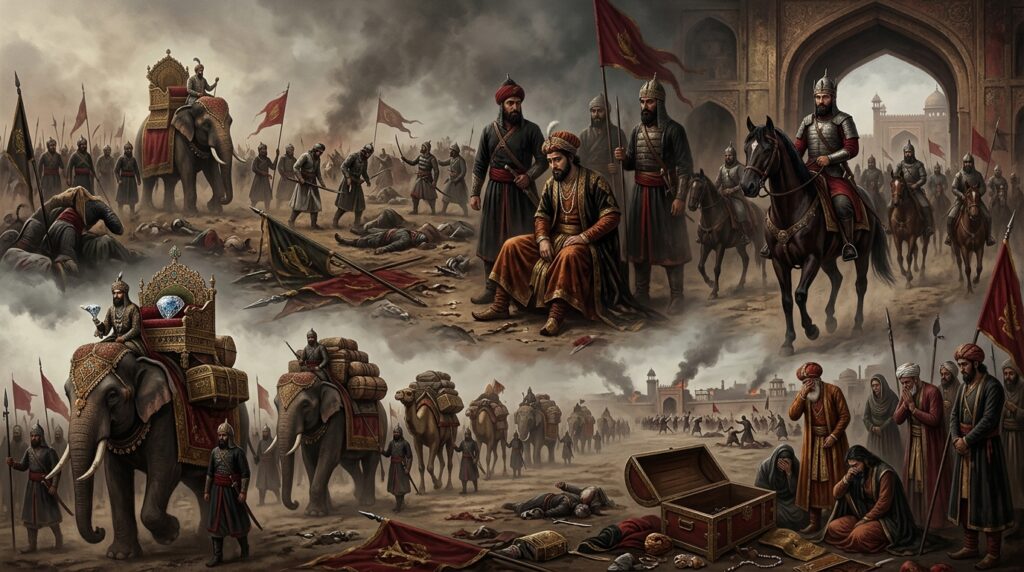
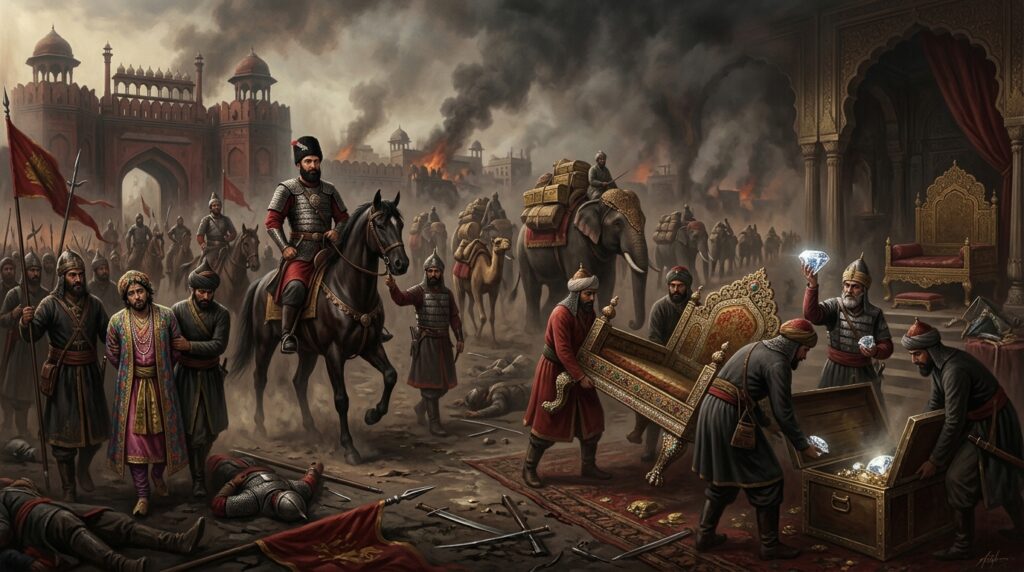
In 1739, the king of Iran, Nadir Shah, entered India! The Mughals had an army of millions, but it was only on paper! In the Battle of Karnal, this army was defeated in only three hours. Yes! Only three hours, defeated by Nadir Shah’s troops. Muhammad Shah, who perhaps had never even seen sunlight, now stood a prisoner before Nadir Shah! This was the military death of the Mughals, the Mughals whose success’s basic reason was their military power, superiority on the battlefield, their prestige turned to dust! Nadir Shah entered Delhi! Then in this city a massacre happened. In a single day, 30,000 people were killed! And then, the Mughal treasury was cleaned out!
What did he take with him? Shah Jahan’s built Peacock Throne, the world’s famous Koh-i-Noor diamond, and so much gold, silver, and jewels that hundreds of elephants, camels, and horses fell short to carry them! History tells us that after Nadir Shah returned to Iran, for three years he did not collect tax from his people, because he had looted so much from India!
So this was the day when the Mughal Empire’s back was broken! It was now not a king, but a beggar! And this was the best opportunity for the East India Company to advance. First it captured Bengal in 1757, defeating Siraj-ud-Daulah in the Battle of Plassey, and thus officially became part of the great game of India! Here the Mughals got a chance, just as Yusuf ibn Tashfin gave the Muslims of Spain a last chance for revival! Exactly such a lifeline Ahmad Shah Abdali gave! In 1761, he defeated the Marathas in the Third Battle of Panipat, but the Mughals could not benefit from this chance either! Because their system had become so rotten that there was no possibility of revival! And finally, the last veil of Mughal greatness fell! In 1764, with defeat in the Battle of Buxar against the English, the Mughal king’s rule ended! Now he was only the English pensioner. His job was only to sit in the Red Fort, arrange poetry gatherings, and collect his pension, just that!
The last king in a small room
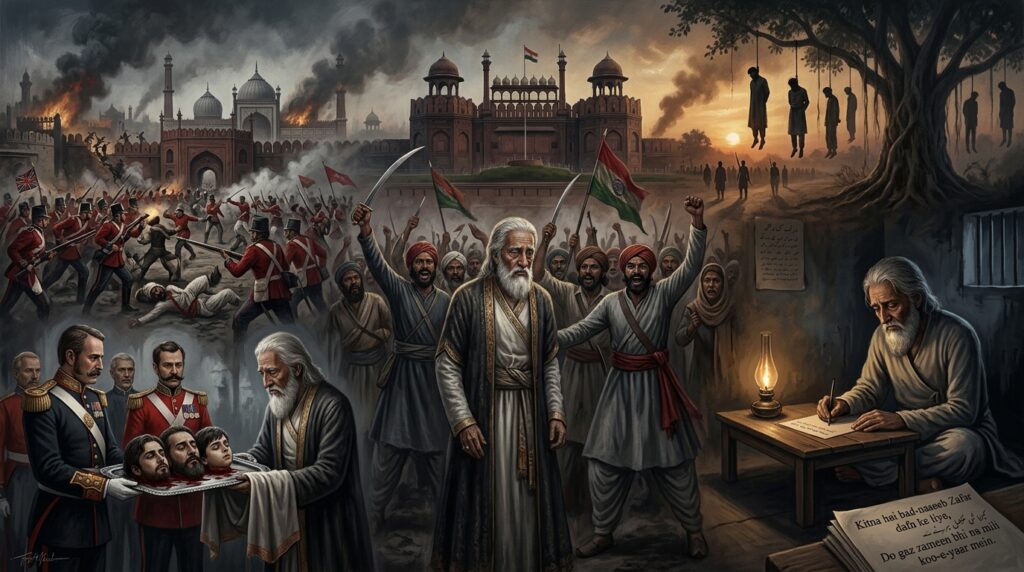
Until finally, this chapter also ended in 1857! When India revolted against Company rule, which we today call the War of Independence 1857! Everyone made the old Mughal king Bahadur Shah Zafar their leader, but by then it was too late! These were the works that should have been done much earlier, when it was time to show unity, time to sit together, they destroyed their own power by fighting each other! Now when the English had become very powerful, rising against them was futile! There was no discipline, no modern weapons, and no vision! In war, passion and enthusiasm alone are not enough. Look at history, passion and enthusiasm will only work for you when there is discipline, modern weapons, and vision!
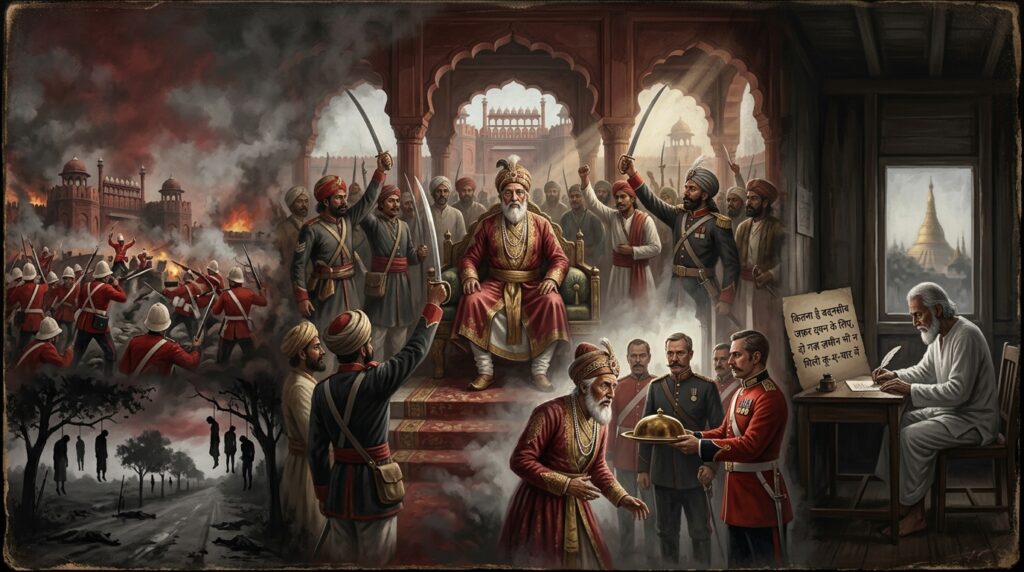
So what was feared happened, the English crushed the rebellion badly! And since the rebellion’s leader was a Muslim king, punishment was mostly given to Muslims! From every tree in Delhi hung the body of some scholar or soldier! And the king was arrested! And then such an atrocity was done that shamed humanity! The English army beheaded Bahadur Shah Zafar’s sons and grandsons, presented them decorated on a platter as breakfast! And then the king was exiled to Burma, where he spent the last years of his life in a small room! And he wrote the elegy of his helplessness himself:
“How unfortunate is Zafar, for burial, not even two yards of land was found for him in his beloved’s street.”
The first Mughal king, Babur, was buried outside India, and the last Mughal king too! A lamp of an empire that burned for 300 years went out forever!
But did the Mughals really end? Or are they still alive today in our culture, in our civilization, in our language, our food, even in our DNA today? The Mughals left, the Red Fort became empty, princes became beggars! But did the Mughals really end? No! Even today, when we speak Urdu, we are speaking the Mughals’ language! When we eat biryani or qorma, we are tasting their taste! When we wear sherwani, we are wearing their dress! They did not only give us buildings, they gave us a civilization, an identity, on the basis of which the Muslims of the subcontinent later said: we are a separate nation! If there were no Mughals, perhaps today the Muslims in the subcontinent would have no identity, that same political identity which became the basis of Pakistan! This is their favor upon us!
But wait! We did not only take virtues from them, we also inherited their flaws! Even today, that Mughal virus is present in our blood, which built not institutions, but personalities, kings! Even today, we cannot strengthen institutions. We only wait for one leader, a messiah, who comes and waves a magic wand and fixes everything! We are still mentally subjects, not citizens!
The second flaw, flattery and recommendation! In the royal system, especially the Mughal court, merit did not work. Flattery and recommendation ran, just that! Even today, our whole system runs on recommendations, slips, and relations! This is the same court culture that entered our DNA!
Flaw number 3: war with one’s own people! Among the Mughals, brothers fought brothers for power, and even today, our politics, our institutions, and our political parties, are busy showing each other down!
The Mughal Empire is a mirror, in it we see our past, and alas, our future too! They were the world’s biggest economic power, but distance from religion, technology, and discipline made them slaves! Today we have the atomic bomb, army, resources, but do we have the system that keeps nations alive? The decision is yours! Because the Mughals’ story has ended, but our story is still being written!
Read also: The Slave Who Became the Last Great Ottoman Empire Queen