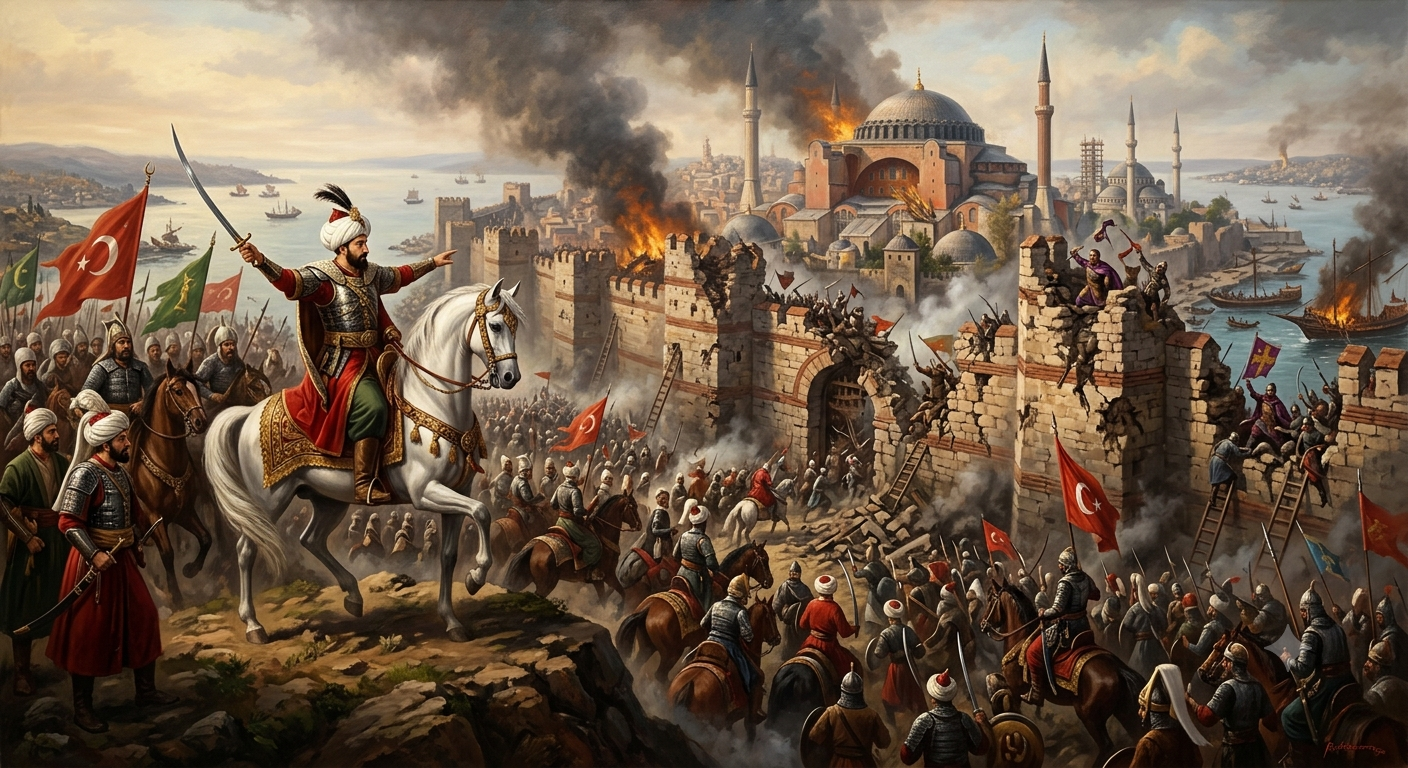
In Ottoman history, 29 May 1453 was not just the day of a city’s conquest, but a revolution that turned the direction of world history. The capital of the Byzantine Empire, Constantinople, was considered an impregnable fortress that no Muslim ruler had conquered for centuries. But a 21-year-old young Ottoman sultan, with extraordinary war strategy, firm resolve, and modern technology, made the impossible possible.
This is the story of Sultan Mehmed the Conqueror, who not only ended a thousand-year-old empire but fulfilled a famous prophecy awaited for centuries by the Muslim ummah.
The city that could not be taken
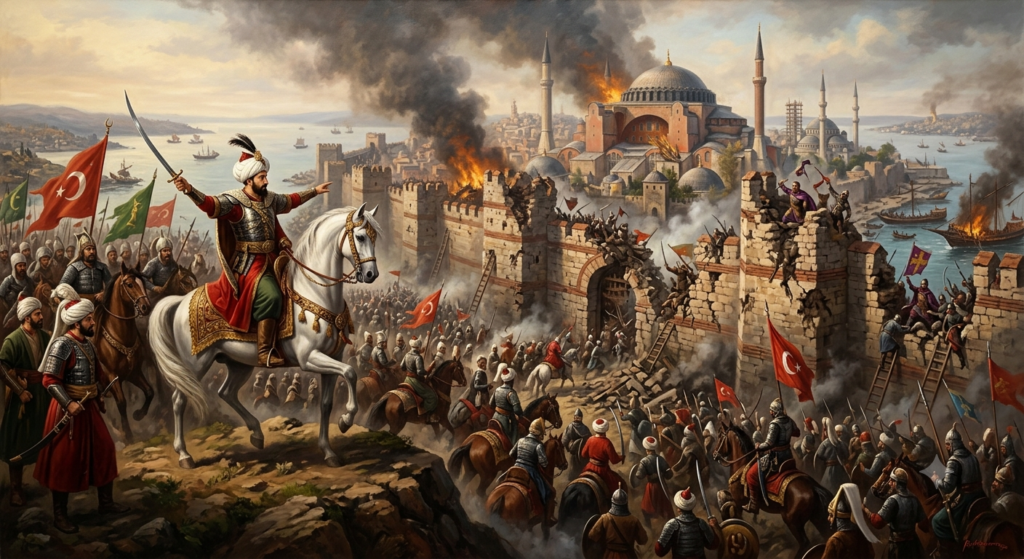
Constantinople, present-day Istanbul, stood at the junction of two great continents, Asia and Europe. The city was surrounded on three sides by water, the Black Sea, the Sea of Marmara, and the Golden Horn, and on the fourth side were the Theodosian Walls, considered the strongest defensive walls of that era.
In Islamic history, the importance of conquering this city can be gauged from the fact that, according to a sahih hadith in Musnad Ahmad, the Prophet said: “You will surely conquer Constantinople, so how excellent will be that commander, and how excellent will be that army.”
Before Sultan Mehmed II, in the Umayyad and Abbasid eras, the city was besieged many times, but because of its strong geographical position and the use of Greek Fire, all attempts failed. The siege in the era of Sulayman ibn Abd al-Malik is a big example of this.
The city, in other words, had three locks: the sea lane that fed it, the walls that guarded it, and the chain that closed its harbor. Mehmed did not break the city by force alone. He picked each lock, one by one.
The first lock, the sea lane
In 1451, when Mehmed II sat on the throne, he had only one dream: the conquest of Constantinople. He knew that conquering this city by traditional methods was impossible. So he took a few extremely modern and revolutionary steps.
The first was the construction of Rumeli Hisari. The sultan had a great fortress built right opposite Constantinople, on the Bosphorus strait. Its purpose was to completely block the European aid and grain supply reaching the Byzantine Empire from the Black Sea side.
Before a single shot was fired at the walls, the city was already being starved of help. The sea lane, the first lock, was picked.
The second lock, the walls
The second was the world’s biggest cannon, the Shahi, the Basilica. The sultan hired a famous Hungarian engineer, Urban, who made the era’s biggest brass cannon, called the Shahi cannon. This cannon could throw 800-pound stone balls miles away, and its purpose was to break Constantinople’s impregnable walls.
On 6 April 1453, the siege began. In early April, the Ottoman army, numbering between about 80,000 and 100,000, surrounded the city. The Byzantine Emperor Constantine XI took command of the city’s defense. For the first few weeks, Ottoman cannons bombarded the walls, but the Byzantines repaired the walls at night.
The walls were the second lock, and the cannon was the key cut for them. Night after night, the damage was repaired, but the bombardment never stopped, and the walls never fully recovered.
The third lock, the chain
The biggest problem was the Golden Horn bay. The Ottoman navy could not enter the bay because the Byzantines had placed a huge iron chain under the water which blocked the bay’s path.
When the sea route was found blocked, Sultan Mehmed played a war trick which stunned the experts of modern military history. On the night of 22 April, the sultan ordered his soldiers to grease wooden planks and drag the ships over land, over the hills, into the Golden Horn bay.
It was an overnight feat: in just one night, the Ottoman army carried about 70 ships over land, past the chain, into the bay.
It was a psychological blow. The next morning, when the Byzantines saw Ottoman navy flags waving in their safest bay, their courage broke and chaos spread inside the city. The third lock had not been broken. It had been walked around.
The morning after
After several weeks of continuous siege and attacks, on the morning of 29 May, the sultan ordered the last and decisive attack. The Ottoman army’s brave troops, the Janissaries, attacked a weak part of the walls and succeeded in entering the city.
Emperor Constantine XI was killed fighting, and the Ottoman Empire’s flag was raised over Constantinople. When Sultan Mehmed entered the city, he went straight toward Hagia Sophia, at that time the Christian world’s biggest church. He declared peace there and ordered the building converted into a mosque. From that same day, he is remembered in history as Sultan Mehmed the Conqueror.
The conquest of Constantinople not only gave new glory to Islamic history, but changed the world map forever. Historians consider this event the end of the Middle Ages and the beginning of the Modern Era. Istanbul became the Ottoman Empire’s new capital and remained the center of the Islamic world for the next four and a half centuries. The Greek scholars of Constantinople fled to Italy, where they promoted knowledge and literature, which created the wave of awakening, the Renaissance, in Europe.
Three locks, three keys, 53 days. The city that could not be taken was taken, not because it was weak, but because one 21-year-old refused to attack it the way everyone else had.
Read also: Sultan Mehmed the Conqueror The 21-Year-Old Who Did the Impossible
Read also: The End of the Roman Empire and the Birth of the Ottoman Era